Ranked #59 of 74 · Updated October 2026

Allswap review
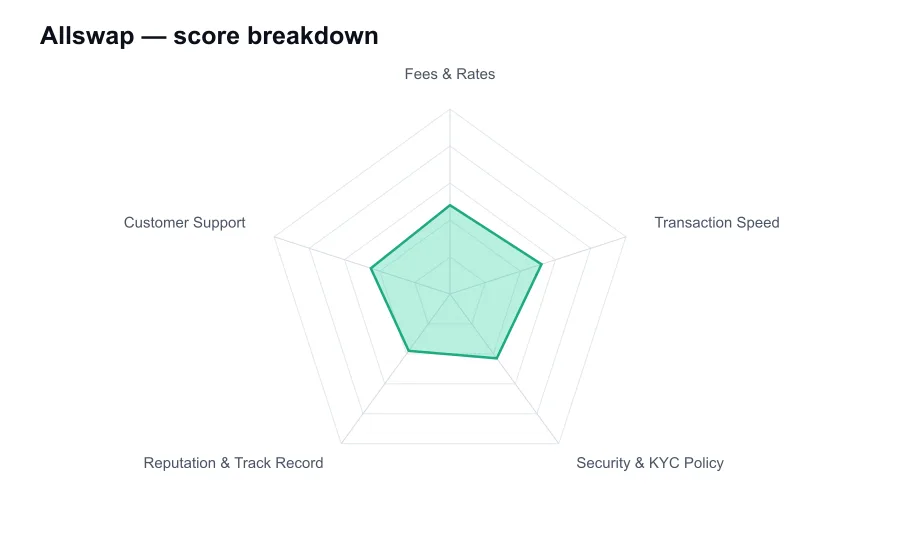
Allswap scores 4.5/10 overall in our independent review, measured against every other provider we've compared, strongest on Transaction Speed (5.2/10) and weakest on Reputation & Track Record (3.8/10).
Crypto swaps · Wallet-based flow · Quote comparison · Small-test recommended
Allswap is a far less established name than the major centralized exchanges and the better-known cross-chain aggregators. It presents itself in the broad category of crypto swap services, where the promise is simple: exchange one asset for another without wrestling with a full trading terminal. That category is crowded and unforgiving. A clean swap screen is easy to build. Sustaining reliable liquidity, transparent execution, secure infrastructure, and accountable support is much harder.
The first issue for a prospective user is not whether Allswap can display an attractive quote. It is whether the service provides enough independently verifiable information to justify sending funds through it. Smaller swap providers often rely on external liquidity, which can be perfectly legitimate, but that arrangement should be clear. Users need to know whether they are trading against Allswap, an automated market maker, a third-party exchange, or a routing network. Without that clarity, it is difficult to separate a genuine low fee from a quote that simply hides a wide spread.
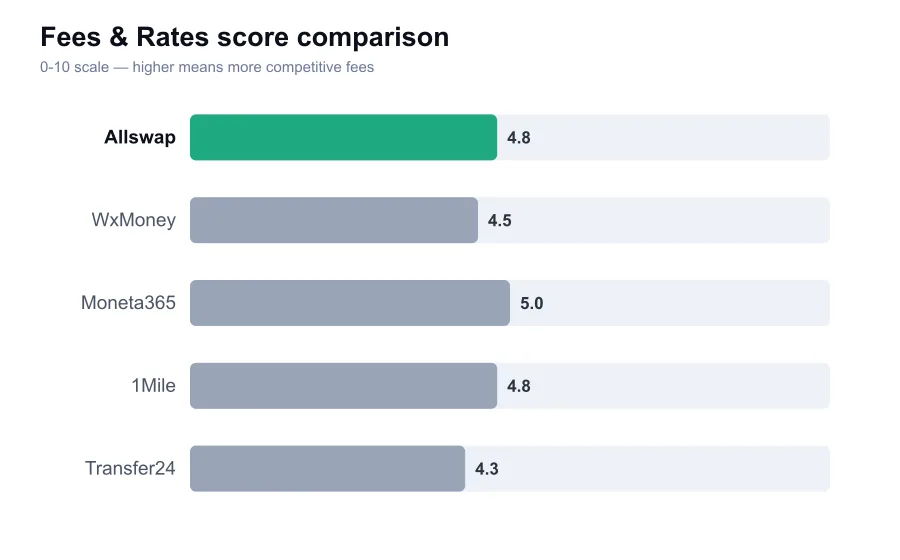
I would approach Allswap's fee claims cautiously. Unlike a mature exchange with a published maker and taker schedule, small swap services frequently express their charges through the output quote. The visible rate may include a service margin, provider spread, network fee, and any cross-chain routing cost. That does not automatically make it expensive. It does mean that a customer should compare the exact amount received against at least two alternatives before pressing confirm.
This is especially important for popular pairs such as BTC to USDT, ETH to USDC, or stablecoin-to-stablecoin conversions. Those markets are liquid enough that an unusually weak Allswap quote is easy to spot against a large exchange, a decentralized exchange, or another instant-swap provider. With small-cap tokens, comparison becomes harder and the risk of poor execution rises. If you cannot explain why the quoted rate differs from the market rate, do not send a large order merely because the interface calls it the best rate.
The lack of a consistently documented, universal fee table is a weakness rather than a minor presentation issue. Transparent pricing is one of the easiest ways a new provider can earn trust. A displayed estimate should distinguish network cost from service cost where possible, state whether the rate is fixed or floating, and explain what happens if the market moves before the deposit arrives. Users should be able to evaluate the trade without becoming amateur forensic accountants.
Speed is also difficult to judge without a long, independently observable record. Any service can claim instant swaps, but actual settlement depends on deposit confirmations, liquidity availability, wallet operations, transaction batching, and the destination network. A Tron or Solana route may settle quickly. A Bitcoin deposit or an Ethereum transaction during congestion may not. If Allswap uses external providers, response time can also vary depending on which route is selected behind the scenes.
The sensible expectation is not instant settlement but completion after the required blockchain confirmations and execution steps. For a small test swap, that may be a few minutes. For a larger conversion, an illiquid token, or a route involving several networks, it can take much longer. I would not use Allswap for a deadline-sensitive transfer, a liquidation during a volatile market, or a payment where a delayed arrival creates a serious problem. A provider without a deeply established public status history has not earned that level of operational trust.
Security is where the gap between a known platform and an obscure one becomes most serious. If Allswap is operating a noncustodial, transaction-by-transaction model, that is better than asking users to leave an enduring balance in a newly known custodial account. It does not remove counterparty risk during the swap. The service still touches the execution path, and users must trust the site, the destination address handling, the quote engine, and any third parties involved in settlement.
I could not treat the public security posture of Allswap as equivalent to that of an exchange with widely reviewed custody controls, a long public audit trail, and documented proof-of-reserves practices. Security badges and generic statements are not enough. A serious user should look for named audits where smart contracts are involved, clear company and jurisdiction information where custody is involved, documented incident history, and a transparent explanation of how the service manages operational keys. If those facts are not easy to find, the appropriate response is smaller transaction size, not blind confidence.
KYC policy needs the same disciplined reading. Some swap services advertise no registration or no KYC for normal transactions, then retain the right to request identity documents after an AML screening flag. That model is common and may be necessary for a service interacting with liquidity partners. It is not the same as a guarantee of anonymous settlement. Before using Allswap, read the terms and AML policy closely and assume that a flagged transaction can be paused pending documentation.
That possibility creates a practical dilemma. A service with conditional KYC may be convenient for a routine wallet swap, but a user who cannot or will not provide documents should not risk funds on the belief that no verification will ever occur. The same applies to source-of-funds questions and wallet screening. Crypto users sometimes discover this only after a deposit has been sent. It is wiser to understand the policy before initiating a transaction than to argue about it after a compliance hold.
Reputation is Allswap's weakest area. It does not have the widely recognized, multi-year public footprint of WhiteBIT, ChangeHero, Kraken, or even some of the more visible instant exchange brands. That does not prove the service is unsafe. It does mean there is less evidence available for a reviewer to assess recurring execution quality, dispute handling, solvency, or how management responds to a serious incident. In financial services, limited history is a real risk factor, not merely a branding inconvenience.
A lack of large-scale public discussion can be deceptive. It may mean a provider is young and serving a small user base. It may also mean there are simply too few independently documented transactions to draw strong conclusions. I would place much more weight on verifiable on-chain transactions, credible third-party coverage, public technical documentation, and clear legal disclosures than on testimonials displayed by the provider itself. Reviews are useful clues, but they are not a substitute for evidence.
Customer support should be tested before funds are at stake. Send a basic question through the stated contact channel and see whether the reply is specific, timely, and written by someone who understands the product. Does the site provide a transaction ID, a status page, refund rules, and a clear escalation route? Those mundane details become vital if a swap is delayed. A live chat bubble means little if there is no accountable path for resolving a missing payout or a transaction sent with the wrong memo.
For Allswap, I would expect support quality to be variable until there is a larger body of evidence. Smaller operations can sometimes provide remarkably personal assistance, but they can also be overwhelmed by a handful of complicated cases. The absence of a robust public help center, named support commitments, or a visible incident process should make users conservative. Never share a seed phrase, private key, or remote-access code with anyone claiming to solve a swap issue. Legitimate support does not need them.
There may be a use case for Allswap as a convenience tool after you have verified a route with a small amount and found its final output competitive. That is the narrowest sensible recommendation. It could suit an experienced self-custody user making a low-value conversion who understands that the test transaction is part of due diligence. It is not suitable for a first crypto transaction, a large treasury movement, a retirement-sized holding, or any transfer where recovery would be difficult.
My final view is deliberately cautious. Allswap may offer a workable swap experience, but the available public confidence signals are too limited for me to rank it alongside established providers. The fee model needs quote-by-quote comparison, the security story needs stronger independent evidence, and the support process should be proven with small transactions before larger use. Until it develops a longer record and clearer disclosures, treat it as an experimental convenience service, not a core piece of your crypto setup.
Who it suits
Allswap is only a tentative fit for experienced users testing a small, nonessential wallet swap after comparing quotes. It is not a good choice for beginners, large transactions, urgent payments, or users who need a long-established compliance and support framework. Traders seeking predictable execution should use a recognized exchange. Privacy-focused users should still read any AML terms rather than assume a swap site guarantees no KYC.
The practical view
Strengths and trade-offs
What stands out
- Simple swap-oriented proposition
- Potentially convenient for small conversions
- May suit self-custody workflows
What to weigh
- Limited independently verifiable track record
- Fee and execution transparency need improvement
- Security disclosures are not strong enough for large transfers
- Support reliability is difficult to assess publicly
Scorecard
How the score is built
Verdict
My take on Allswap
Allswap has the basic appeal of a simple crypto conversion service, but simplicity does not overcome a thin public track record. The prudent stance is to verify everything through a small test, including the quote, timing, transaction tracking, and support response. It has not shown enough public evidence to justify trust with meaningful balances. Until its disclosures and independently observable reputation improve, established competitors are the safer choice.
Review questions
Allswap FAQ
Is Allswap safe for large crypto transactions?
I would not recommend using a lightly established swap provider for a large transfer without strong independent security, liquidity, and support evidence. Test a small amount first.
How can I check Allswap's real fee?
Compare the exact final amount quoted by Allswap against at least two alternatives. Include blockchain fees, spread, price impact, and whether the rate is fixed or floating.
Will Allswap ask for KYC?
Do not assume that a no-registration flow prevents compliance checks. Read the current terms and AML policy before depositing, since flagged transactions can require review.
Reader experiences
What users report
Continue your comparison
Read across the full ranking before deciding which provider best fits your own needs.
Compare providers