Ranked #44 of 74 · Updated October 2026

MoneroBridge review
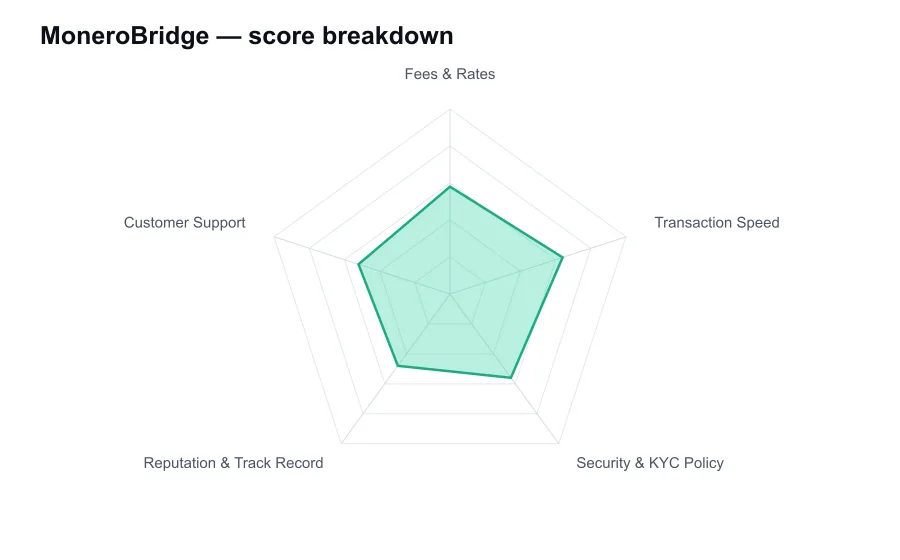
MoneroBridge scores 5.6/10 overall in our independent review, measured against every other provider we've compared, strongest on Transaction Speed (6.4/10) and weakest on Reputation & Track Record (4.8/10).
Monero-focused routes · No-account swaps · Crypto-to-crypto exchange · Transaction tracking
MoneroBridge is a specialist exchange service built around access to Monero and privacy-oriented conversion routes. It is not trying to be a giant multi-purpose crypto brand. Its audience is people who want a relatively direct path into or out of XMR without depositing assets on a large centralized exchange. That specialization is useful, but it also puts the service in a more difficult regulatory and liquidity niche than a broad platform such as SimpleSwap.
Monero remains controversial in regulated markets because its blockchain obscures sender, receiver, and amount information by design. Several major exchanges have reduced or removed support for XMR under compliance pressure. A focused bridge can therefore solve a real access problem for users who hold Monero legally and want a simpler conversion route. It also attracts greater scrutiny, which affects both the service's policies and the risk borne by its customers.
The user journey is familiar to anyone who has used an instant exchange. Select the asset to send, choose the asset to receive, enter the destination address, and transfer the required amount to the deposit address. There is usually no conventional account balance to manage. That makes the service easier for a one-time exchange, but users must be much more careful because a mistaken address, wrong network, or underpayment cannot be corrected as easily as an error inside a custodial account.
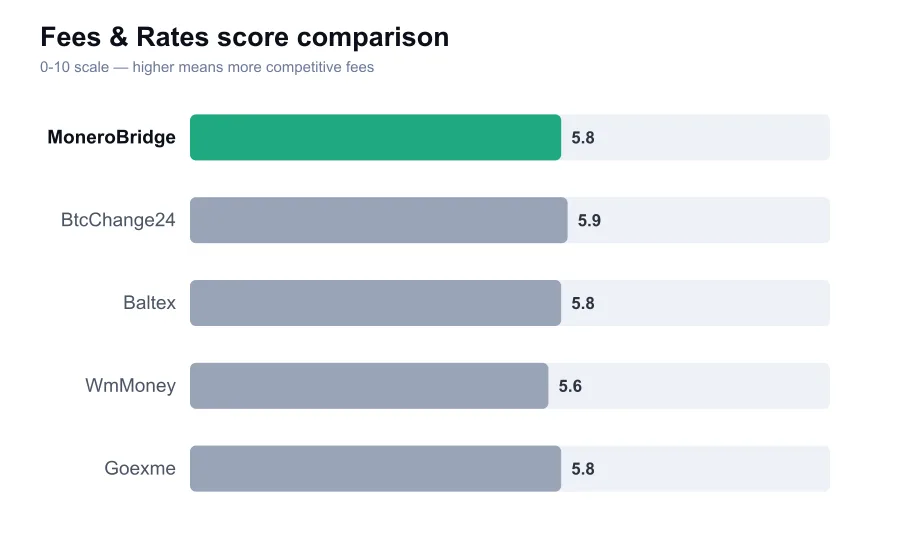
Pricing needs particular attention here. Monero routes often have wider effective spreads than BTC or ETH conversions because XMR liquidity is more fragmented and some counterparties simply will not support the asset. The visible quote can include the service margin, provider spread, network costs, and the cost of managing a difficult route. Users should not assume a higher fee is automatically abusive, but they should compare the final payout against at least one alternative before sending funds.
The service's pricing model is quote based rather than a simple public trading-fee schedule. That is common for instant exchanges, but it makes the final receive amount the only number that really matters. A stated zero-fee or low-fee message means little if the exchange rate is uncompetitive. Compare the amount of BTC, LTC, USDT, or XMR you receive after all costs. For larger transactions, even a two percent difference is expensive.
Fixed-rate availability can be valuable for Monero swaps because XMR can move sharply and the route may take time to settle. If a fixed quote is offered, check its payment deadline and the amount required with care. Payment outside the allowed window may result in a floating conversion or a support review. If a route is floating, expect the final amount to be based on market conditions during execution rather than the first figure displayed on the page.
Speed is decent for ordinary routes, but users should be realistic. Monero has its own confirmation process, and the outgoing asset has its own network conditions. A straightforward exchange may settle in minutes after the deposit is detected. It can take longer when the service needs extra confirmations, when liquidity is thin, or when one side of the transaction involves Bitcoin. Privacy-chain support is not a guarantee of instant settlement.
MoneroBridge's narrow focus is both its best feature and its main limitation. A specialist may understand XMR route handling better than a generalist platform that lists thousands of assets. On the other hand, it has less obvious scale, less public infrastructure, and fewer signs of the mature operational redundancy seen at the largest providers. I would use a specialist for a targeted conversion, not as the sole route for a time-sensitive or very large transfer.
No account requirement should not be confused with a promise of complete anonymity. Even a service focused on privacy coins can apply anti-money-laundering screening to the transparent chain side of a transaction, inspect transaction patterns, restrict jurisdictions, or request information where its compliance procedures demand it. The exact thresholds are not usually public, which is frustrating but unsurprising. Anyone who needs certainty about legal or reporting obligations should seek professional advice, not rely on website slogans.
Security is also about your own operational choices. Download Monero wallets from verified sources, confirm the receiving address directly in your wallet, and do not reuse an address copied from a chat message or browser extension. For stablecoins, make certain the network selected at MoneroBridge matches the destination wallet. The most common catastrophic losses in swap services are not sophisticated hacks. They are wrong-network deposits and addresses compromised by malware.
The public reputation footprint is modest. That demands more caution than it would with a service that has years of independently documented incident handling, regulatory disclosures, and broad user discussion. I would not call a small footprint evidence of wrongdoing. Still, privacy-focused exchanges face a special burden of proof because their customers may be moving assets that are hard to replace and because a compliance dispute can be more difficult to resolve than a simple delayed trade.
Support quality is hard to judge until something goes wrong. MoneroBridge provides a transaction-oriented support path, but users should not expect the resources of a major exchange with multiple escalation teams. Before opening a ticket, gather the order ID, deposit transaction hash, exact amount, network, timestamps, and screenshots. If verification is requested, decide whether you are willing and able to provide it before sending additional funds. Never send a second deposit merely because an unofficial messenger asks.
For a small XMR conversion, MoneroBridge can be a practical option if its quote is competitive and the route is currently available. It is especially relevant to users who find their local centralized exchange no longer supports Monero. The sensible approach is to send a test amount first, wait for it to complete, then decide whether the service deserves a larger transaction. That is prudent practice with any smaller exchange, not paranoia.
My take is reserved but not dismissive. MoneroBridge exists because mainstream access to Monero has become more constrained, and that gives it a legitimate role. The price of that convenience is wider route risk, limited public operating history, and the possibility that compliance rules will matter despite the privacy-centric use case. It can serve a knowledgeable user well for modest transfers. It should not be treated as a guaranteed anonymous tunnel or a venue for funds that cannot tolerate delay.
Who it suits
MoneroBridge is best suited to experienced wallet users making a modest, legal XMR-related conversion after comparing quotes. It can be useful in regions where major exchanges have delisted Monero. Beginners, high-value users, and anyone needing a guaranteed anonymous or immediate transaction should look elsewhere. A small test swap is the sensible starting point.
The practical view
Strengths and trade-offs
What stands out
- Purpose-built access to Monero conversion routes
- No conventional exchange account required
- Useful where centralized XMR listings are limited
- Simple one-time swap workflow
What to weigh
- Wider spreads are common on privacy-coin routes
- Limited public track record and transparency
- No-KYC expectations can still be disrupted by compliance
- Not ideal for urgent large transfers
Scorecard
How the score is built
Verdict
My take on MoneroBridge
MoneroBridge addresses a real market gap, but a market gap is not the same thing as a broad endorsement. Its Monero focus can be more useful than a general swap site that treats XMR as an afterthought. The compromises are clear: pricing may be wider, operational history is thinner, and compliance uncertainty does not disappear. Use it deliberately, verify every network detail, and avoid assuming privacy software eliminates counterparty risk.
Review questions
MoneroBridge FAQ
Can MoneroBridge be used without an account?
The service is designed for direct swap orders rather than a conventional trading account, though transactions can still be reviewed under compliance procedures.
Why are MoneroBridge rates sometimes wider?
Monero liquidity is more restricted and fragmented than major crypto markets. The quote can reflect route availability, provider spread, and network costs.
How long does an XMR swap take?
A normal order may finish in minutes after required confirmations, but Monero, Bitcoin, liquidity conditions, and network congestion can extend the wait.
Reader experiences
What users report
Continue your comparison
Read across the full ranking before deciding which provider best fits your own needs.
Compare providers