Ranked #27 of 74 · Updated October 2026
Nexchange review
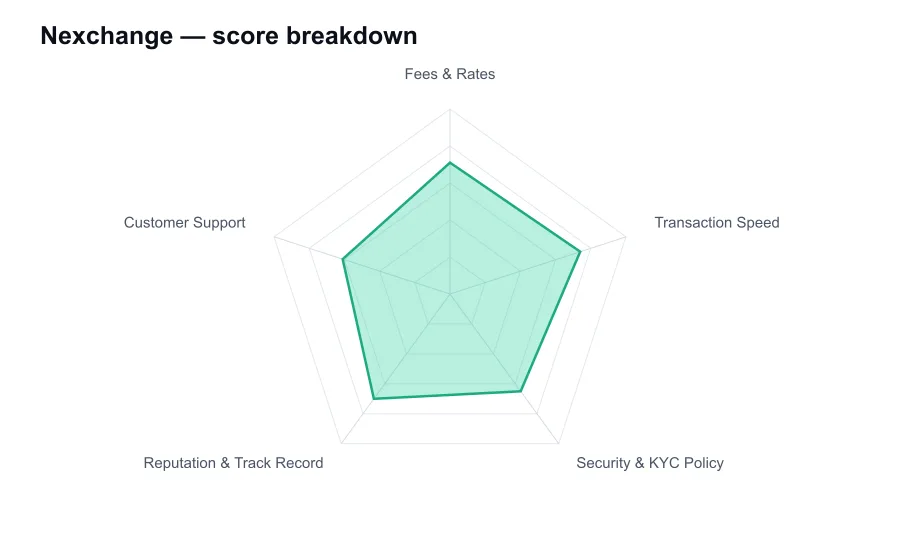
Nexchange scores 6.9/10 overall in our independent review, measured against every other provider we've compared, strongest on Transaction Speed (7.4/10) and weakest on Customer Support (6.1/10).
Fixed Rate · Floating Rate · API Access · No Account for Many Swaps
Nexchange sits in the older, infrastructure minded corner of the instant crypto exchange market. It is not primarily trying to be a glossy retail trading venue with charts, staking promotions, and a mobile app full of notifications. Its core proposition is simpler: route a conversion through liquidity partners, show a quote, take the deposit, and deliver the requested asset. It also has an API business, which matters because a service built for integrations tends to think differently about execution and reliability than one built purely around marketing.
That positioning gives Nexchange a sensible niche. A user who wants to turn Bitcoin into Ether without opening an account on a large centralized exchange can use it with relatively little ceremony. Developers and wallets can also use its exchange functionality in the background. The tradeoff is that the public interface is utilitarian. It doesn't have the polish or huge asset catalogue of ChangeNOW, nor the brand recognition of Coinbase or Kraken. Nexchange feels like a service for people who already understand what a network confirmation is and don't need a hand held explanation.
The first thing to understand about pricing is that an instant swap quote is not the same thing as a transparent exchange order book. Nexchange can offer fixed and floating quotes, depending on the pair and liquidity conditions. In a fixed quote, the displayed output is intended to be honored if the deposit arrives within the stated window and the amount is within tolerance. In a floating quote, the final result follows the market after the deposit is received. For a small, routine swap, that distinction can be more important than a headline fee.
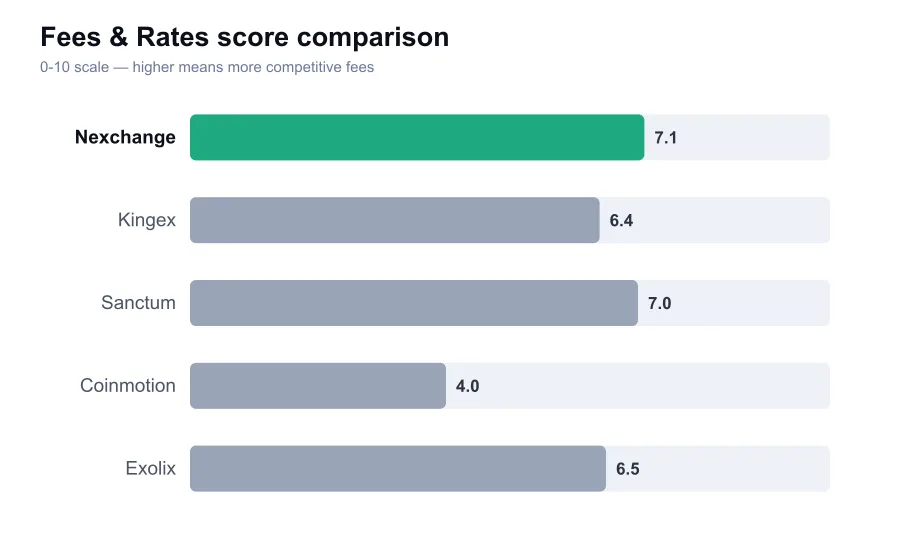
Nexchange has historically presented a 0.5% service fee in its API documentation, though the actual cost facing a retail customer is the quoted rate after partner liquidity, network fees, and any route specific spread are accounted for. That is fair enough if the quote is competitive, but it means you should compare the final receive amount, not assume that 0.5% is your all in cost. The service is usually respectable on large liquid pairs. On thin tokens or during a busy market, the difference versus a deep order book at Kraken can be noticeable.
There is no free lunch in a no account conversion. The convenience premium is part of the price. Nexchange is not where I would execute a five figure rebalance without first checking a few competitors and an exchange order book. For a modest conversion, the simplicity may be worth more than squeezing out a few basis points. The site is also clearer than some anonymous swap pages about rates being dynamic, which is preferable to advertising an implausibly low fee and hiding the margin inside a poor quote.
Speed is one of Nexchange's better qualities, provided the blockchain involved is behaving normally. The platform can create an order immediately, identify the deposit address, and start processing after the required confirmations arrive. Fast chains and popular routes can settle in minutes after confirmation. Bitcoin based deposits naturally take longer, especially if the sender uses a low mining fee. A conversion that appears slow is often waiting on the inbound network, not sitting unattended at Nexchange.
Still, instant is a marketing term, not a guarantee. A route can be delayed by wallet maintenance, a liquidity partner, blockchain congestion, or an anti fraud review. Fixed rate orders also have time limits, so a late deposit can become a refund or a manually resolved case rather than a clean swap. Nexchange exposes order status information, which is useful, but its tracking page isn't a substitute for proactive communication when a transaction becomes exceptional. Users moving time sensitive funds should leave a comfortable margin.
Nexchange's noncustodial style reduces one familiar risk, because it doesn't ask users to preload an account balance and leave it on the platform. Funds are sent for a specific conversion. That said, calling any swap service entirely noncustodial can mislead people. The provider and its liquidity counterparties control the process after receiving the deposit, and an error in the destination address is not something a password reset can fix. Test with a small amount if a route is new to you.
The company can request identity information where its compliance systems or partner rules require it. Nexchange should not be treated as a guaranteed no KYC venue. Most normal swaps may proceed without an account, but transaction monitoring, sanctions controls, source of funds questions, and partner requirements can still interrupt an order. This is common across the sector, yet it deserves plain language. Anyone whose priority is certainty around privacy should recognize that a no signup screen is not the same as a promise of no verification.
Security information is adequate rather than unusually detailed. There is a public facing product, API documentation, HTTPS protection, and an operational focus that has kept the service visible for years. What I do not see is the sort of extensive independently audited custody architecture, proof of reserves program, or public security reporting that a major centralized exchange can provide. That isn't automatically disqualifying for a swap broker, but it limits how much blind trust I would place in it.
Nexchange has been around since the middle of the 2010s, which is a meaningful point in an industry where many instant exchangers disappear after a short campaign. Its long running API presence and integrations are stronger evidence than a page of promotional claims. Yet its public reputation is relatively quiet. There aren't huge volumes of mainstream consumer feedback, and that makes it harder to judge how consistently edge cases are resolved. It has survived, but it hasn't earned the broad public confidence of the industry's largest names.
Support is available through the site's contact channels and order references, and the API orientation means there is useful technical documentation for developers. Routine questions are generally the kind that can be answered from the order ID and blockchain transaction hash. The weakness is the same one found at many lean exchange services: there is little indication of a full scale, instantly reachable support operation for every retail user. If an order is delayed, clear evidence and patience help more than sending repeated vague messages.
I like Nexchange best as a practical routing tool, not as a place to build a financial relationship. It makes sense for someone who understands crypto transfers, wants a straightforward conversion, and is willing to compare the final quote. It is less compelling for a beginner who needs live guidance, for a trader seeking deep liquidity, or for anyone moving a large amount under a hard deadline. The product knows what it is, and that is more appealing than an exchange that promises everything.
My view is that Nexchange is credible but not exceptional. The service's age, API focus, and sensible order flow put it ahead of anonymous copycat swap sites. Its fee presentation is quote driven, its compliance discretion is real, and its public support footprint is modest. Use it for ordinary, well checked swaps and it can do the job neatly. For maximum transparency, large orders, or a support safety net, a regulated exchange with a visible order book remains the better choice.
Who it suits
Nexchange suits experienced holders making ordinary conversions and developers needing an exchange API. It is a reasonable fit for users who compare final quotes and understand blockchain confirmations. Beginners who want phone support should look elsewhere. Large traders will usually get better control and liquidity from an order book exchange.
The practical view
Strengths and trade-offs
What stands out
- Established API and exchange infrastructure
- Fixed and floating quote options
- No standing retail account required for many swaps
- Useful for wallet and developer integrations
What to weigh
- Final cost can differ from a headline fee
- KYC may be requested on flagged transactions
- Limited public evidence of high touch support
- Not ideal for large time sensitive trades
Scorecard
How the score is built
Verdict
My take on Nexchange
Nexchange is a credible specialist rather than a destination exchange. Its longevity and technical focus count for a lot in a crowded instant swap category. The service is best judged by its delivered quote and order handling, not by a simplistic fee claim. I would use it for a modest, nonurgent swap after checking the rate, but I would not make it my primary venue for serious trading or large transfers.
Review questions
Nexchange FAQ
Does Nexchange require KYC?
Many swaps can begin without creating an account, but Nexchange or a liquidity partner can request verification for compliance or risk reasons. Do not assume every transaction will remain verification free.
How long does a Nexchange swap take?
It depends on the deposit network, confirmation requirement, asset pair, and liquidity route. Fast network swaps may finish shortly after confirmation, while Bitcoin deposits and exceptional reviews can take much longer.
Is Nexchange pricing fixed?
It offers fixed and floating rate order types. A fixed quote has a deposit window and amount tolerance. A floating order settles against the rate available after the deposit is processed.
Reader experiences
What users report
Continue your comparison
Read across the full ranking before deciding which provider best fits your own needs.
Compare providers