Ranked #26 of 74 · Updated October 2026
Sanctum review
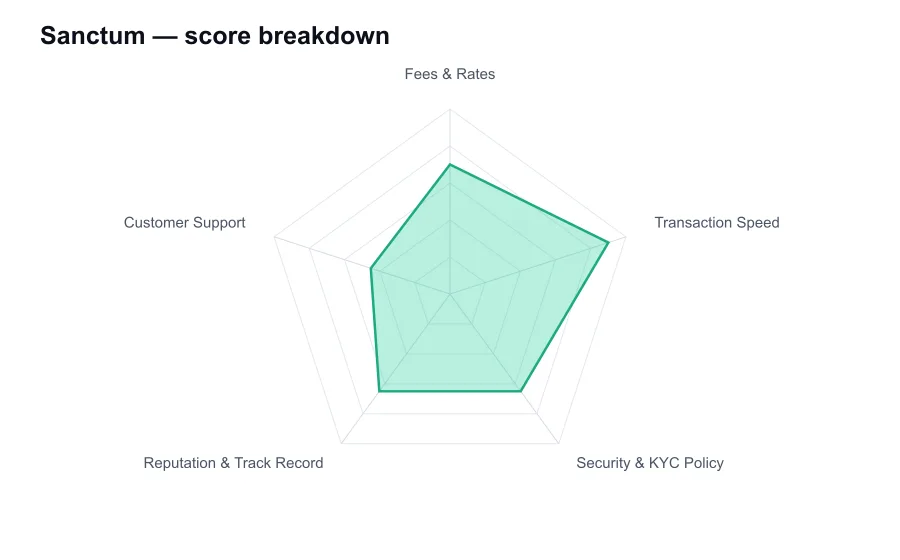
Sanctum scores 6.9/10 overall in our independent review, measured against every other provider we've compared, strongest on Transaction Speed (9.0/10) and weakest on Customer Support (4.5/10).
Liquid staking liquidity · No-KYC · Solana-native swaps · LST redemption access
Sanctum occupies a very specific corner of Solana DeFi: liquid staking tokens. Its core proposition is not simply staking SOL, although it supports that journey. Sanctum aims to make many different Solana liquid staking tokens easier to trade, redeem, and use by concentrating liquidity around them. That matters because Solana's staking market has historically produced a long list of LSTs, each tied to a validator strategy, community, or rewards program. Without shared liquidity, those tokens can become awkward to exit.
The product is best understood as liquidity infrastructure with a consumer-facing interface. A user can stake SOL into supported liquid staking assets, swap among LSTs, or redeem where liquidity and redemption conditions allow. Sanctum's Infinity pool is the technical centerpiece, designed to support liquidity across many LSTs rather than forcing each token to bootstrap a separate conventional pool. It is a smart response to fragmentation, and it gives smaller LST projects a more realistic path to usable markets.
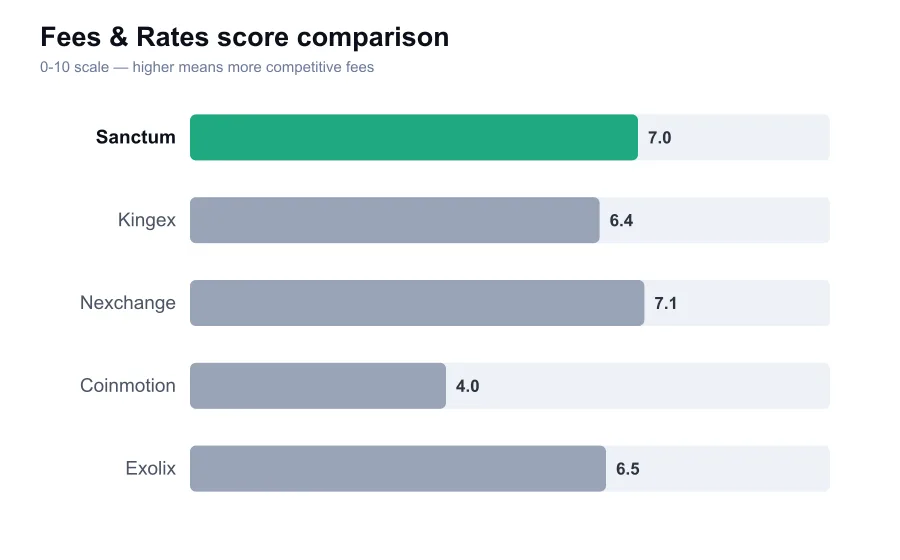
Fees need careful reading because there is no single number that tells the full story. A user may face a staking provider's fee, a validator commission embedded in staking economics, a swap fee or spread, and Solana network fees. Solana transaction fees are usually tiny, often fractions of a cent, so the network cost is not the concern. The important number is the exchange rate between SOL and an LST, or between one LST and another. That rate can move according to liquidity, rewards, and demand.
Sanctum's appeal is that swapping an LST need not require waiting through Solana's native stake deactivation process. Native stake withdrawal can take an epoch boundary, which is roughly two to three days depending on timing. Liquid staking is meant to bypass that delay by giving the user a transferable token. Sanctum can offer immediate liquidity when pool capacity exists, but immediate does not mean free. If a particular LST is under selling pressure, the exit price can fall below the asset's theoretical backing.
That distinction separates knowledgeable users from people chasing headline yields. A liquid staking token can advertise attractive rewards while still being expensive to enter or exit. Sanctum helps expose and manage the liquidity side of the equation, but it cannot guarantee parity with SOL. Before swapping, users should inspect the received amount, compare alternatives, and understand whether they are using a swap path or a slower redemption path. A fraction of a percent matters if the entire reason for staking is yield.
Speed is one of Sanctum's strongest qualities because it is built on Solana. Transactions usually finalize quickly under normal network conditions, and the interface feels much more responsive than comparable Ethereum mainnet staking products. Swaps and deposits can often be completed within seconds. Solana has suffered well publicized congestion and reliability problems in the past, so calling it flawless would be careless. Still, for routine activity, Sanctum benefits from a chain where users do not have to calculate whether a transaction fee is worth paying.
The user experience is more approachable than many raw Solana DeFi interfaces. It makes the idea of choosing an LST less intimidating, particularly through curated assets and its broader ecosystem branding. Yet the product remains conceptually demanding. Users are not merely choosing between SOL and cash. They may be choosing between different validator sets, reward profiles, liquidity conditions, and token incentives. A clean interface cannot remove the need to understand what an LST represents.
Security should be judged with a degree of caution. Sanctum is newer and less battle-tested than foundational protocols such as Lido, Jito, Marinade, or Jupiter. It has published security information and uses audited smart contract infrastructure, but audits are not warranties and composable Solana programs still carry contract risk. Its model also depends on the safety and behavior of the liquid staking tokens it supports. A failure, depeg, or governance problem at an integrated LST can affect users even if Sanctum's own code performs as intended.
The noncustodial design is a positive. Users connect a Solana wallet such as Phantom or Solflare and approve onchain actions themselves. Sanctum does not operate like a centralized staking desk holding a password-protected account balance. No routine KYC is required for wallet-based use. That is attractive to users who value privacy, but it also means no one can restore access if a seed phrase is lost and no support ticket can reverse an executed swap.
Its reputation is promising rather than fully settled. Sanctum became highly visible during the 2024 Solana ecosystem revival, particularly around its LST liquidity work and the CLOUD token launch. It has meaningful name recognition among Solana users, but it has not endured as many adverse cycles as older protocols. The project should be treated as an active, credible specialist, not as a risk-free blue chip. The distinction matters most for users considering large or long-term positions.
The CLOUD token and incentive campaigns have brought attention, liquidity, and speculation. They have also encouraged the familiar behavior of users moving funds for points, quests, or airdrop eligibility rather than because the underlying service suits them. That can produce temporary distortions in liquidity and demand. I would not select an LST solely because it is tied to a campaign. The underlying validator quality, redemption mechanics, and actual swap price are much better reasons.
Support is adequate for a DeFi app but limited for a financial product involving staking decisions. Documentation, Discord, and social channels are where most questions are handled. There is no conventional call center, and users should be extremely skeptical of unsolicited direct messages from people claiming to be staff. The lack of formal recovery support is normal in self-custody, but it can feel harsh when a user has made an irreversible mistake.
Sanctum works best for people already comfortable in the Solana ecosystem who want more flexibility than native staking provides. It is useful for active LST users, SOL holders who may need liquidity without waiting an epoch, and smaller LST communities that need better market access. It is less suitable for someone who wants the simplest possible staking product and does not plan to trade or use DeFi. For that person, a straightforward validator delegation or a large established LST may be easier to understand.
My take is that Sanctum has a genuinely useful answer to Solana LST fragmentation. Its speed and low transaction costs make the product feel practical in a way that liquid staking on Ethereum mainnet sometimes does not. The risk is not transaction latency or gas, it is complexity, smart contract exposure, and the temptation to chase incentives. Use it for liquidity and choice, not because a points program made an unfamiliar token look safe. That is the sensible way to get value from it.
Who it suits
Sanctum fits active Solana users who understand liquid staking tokens and want fast access to SOL liquidity. It is also useful for holders comparing different LSTs instead of being locked into one provider. Conservative users who only want basic staking may prefer native delegation or a larger, simpler liquid staking provider. Anyone unable to assess an LST's redemption and liquidity profile should not chase campaign rewards here.
The practical view
Strengths and trade-offs
What stands out
- Fast Solana-based LST swaps
- Addresses fragmented LST liquidity
- No routine KYC
- Very low network transaction costs
- Can avoid native unstaking delays
What to weigh
- LST prices can deviate from SOL backing
- Newer protocol with less battle testing
- Incentive campaigns can distract from risk
Scorecard
How the score is built
Verdict
My take on Sanctum
Sanctum solves a real Solana problem, and its Infinity liquidity approach is more interesting than another generic staking front end. The product is quick, inexpensive to use, and potentially valuable for LST holders who need flexibility. Its weaker side is the risk carried by a newer DeFi protocol and by the many assets connected to it. It deserves attention, but not blind trust. Treat it as advanced Solana infrastructure, because that is exactly what it is.
Review questions
Sanctum FAQ
Can I unstake SOL instantly through Sanctum?
You can often swap a liquid staking token for SOL quickly when sufficient liquidity is available. That is different from native unstaking, which can require waiting until an epoch boundary.
Does Sanctum require KYC?
Sanctum's wallet-based DeFi functions do not normally require identity verification. You remain responsible for wallet security, local compliance, and verifying the official application.
Why can an LST be worth less than expected?
Its market price can reflect pool liquidity, selling pressure, fees, and demand. A quick liquidity exit may receive less than a slower redemption path or the token's estimated underlying SOL value.
Reader experiences
What users report
Continue your comparison
Read across the full ranking before deciding which provider best fits your own needs.
Compare providers