Ranked #54 of 74 · Updated October 2026

111Obmen review
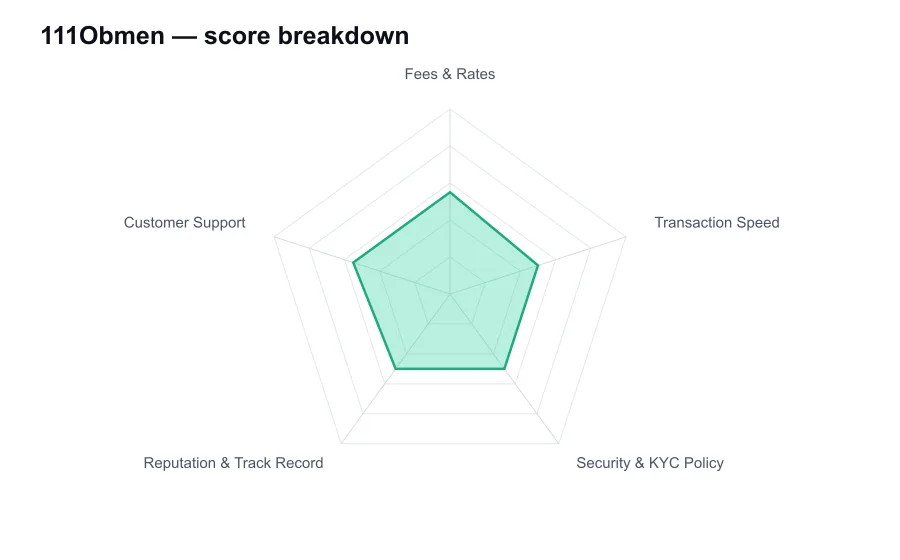
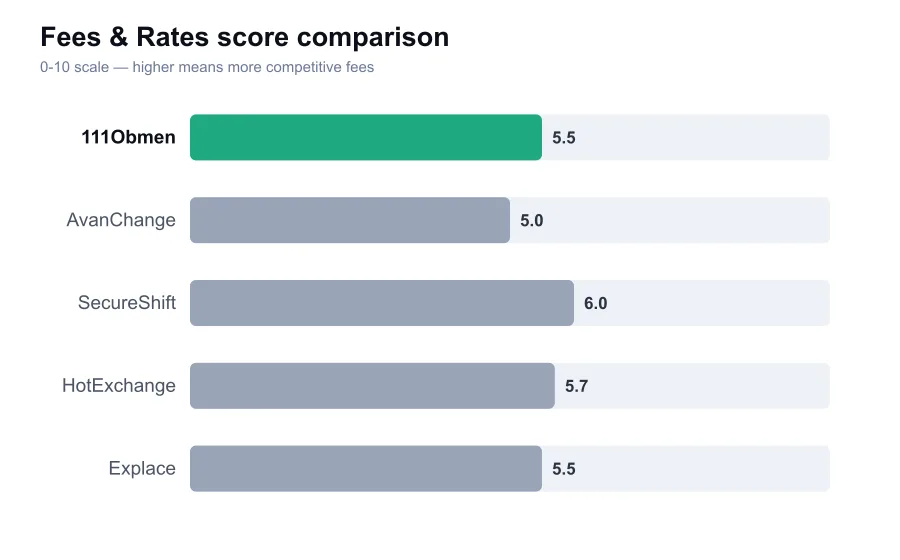
111Obmen scores 5.2/10 overall in our independent review, measured against every other provider we've compared, strongest on Fees & Rates (5.5/10) and weakest on Reputation & Track Record (5.0/10).
Fiat and crypto exchange routes · Reserve-based payouts · Order-based exchange flow
111Obmen sits in a different corner of the exchange market from polished global crypto apps. It is an exchanger-style service, a format especially familiar to users moving between cryptocurrency, electronic payment systems, cards, and local currency rails. That can be very practical in markets underserved by big regulated platforms. It also demands more attention from the customer, because the quality of an individual exchanger depends heavily on its reserves, operators, banking partners, and day-to-day support discipline.
The appeal is obvious if the route you need is awkward. A mainstream exchange may offer excellent BTC, ETH, and USDT markets while providing no useful path to a regional bank card or payment processor. Exchanger services fill that gap. They quote a conversion, collect payment details, and arrange settlement through their own reserves or partners. 111Obmen belongs to this pragmatic category rather than the institutional exchange category.
That distinction matters because the experience is not always instant. A crypto-to-crypto conversion can be comparatively quick after blockchain confirmation. A bank or card payout can depend on business hours, anti-fraud checks, payment-provider delays, and manual operator approval. Anyone expecting the same predictability as sending USDC between two self-custody wallets will be disappointed. Fiat rails are the bottleneck, not necessarily the exchanger itself.
The first thing I would inspect is the live quote, not any advertised commission. Exchanger pricing often blends a visible fee into the exchange rate. A rate can look attractive until you calculate the amount received after card charges, network costs, and possible intermediary fees. This is not unique to 111Obmen, but it is one reason rate-comparison monitoring sites became popular among experienced users in this market. The headline percentage rarely tells the whole story.
For small exchanges, a slightly worse quote may be acceptable if the reserve is clearly available and the payout route is known to work. For larger transfers, small differences become expensive. A two percent rate gap on a modest swap is irritating. On a substantial fiat conversion, it is a serious cost. I would compare 111Obmen's quote with at least two reputable alternatives and check the precise payout amount before creating an order.
Reserve information is another practical issue. An exchanger can list many directions but have limited capacity for a particular bank, e-wallet, or token. If an order exceeds available reserves, a manual delay or partial execution becomes more likely. Customers should not assume a listed route means unlimited liquidity. Ask support before sending a larger amount, especially if the destination involves a local bank, a less common stablecoin network, or an electronic payment system with its own compliance rules.
Speed can be good where the route is simple. Crypto deposits with adequate network fees can normally be recognized after the required confirmations, and a reserve-backed payout may follow quickly. The weaker cases are card payments, cash-like payment systems, and conversions that trigger a manual review. In this sector, a service that says it operates around the clock may still have reduced capacity outside local working hours. The exact route matters more than a generic promise of instant processing.
111Obmen's security model is primarily transactional, not exchange-account based. You are not usually leaving a balance in a trading account, which reduces exposure to a platform wallet breach. But you are still trusting an operator with a payment and personal payout details. That includes the risk of a mistaken card number, a phishing clone, or an order created on the wrong website. Bookmark the legitimate service only after independently verifying its address.
KYC and anti-money-laundering checks should not be treated as theoretical. Exchangers handling fiat payments can request verification when a transaction appears unusual, conflicts with payment-provider policy, or triggers blockchain-risk screening. That is inconvenient, particularly if documents are requested after funds have been sent, but it is a normal risk of this business model. Read the service rules before paying, not after a review begins. A user who cannot provide verification should avoid routes likely to demand it.
Public reputation is important here, but it needs to be read intelligently. A listing on an exchanger-monitoring site, if current and authentic, is more useful than anonymous praise on a social channel because it can show age, reserve details, and complaint patterns. It still is not a substitute for regulation, audited financials, or deposit protection. I would examine recent feedback for repeated issues such as rate recalculation, delayed payouts, disputed card transfers, or unresponsive operators.
I do not see enough widely known international history around 111Obmen to treat it like a top-tier global brand. That is not a condemnation. Many legitimate local exchangers remain little known outside their core market. It does mean the trust decision should be based on current monitoring records, a small test order, and direct communication rather than name recognition. A business can be competent without being famous, but a reviewer should not confuse obscurity with proof of reliability.
Support is more important at 111Obmen than at an automated crypto-only swap service. There are more fields to get wrong, more third parties involved, and more reasons a payout may need intervention. A good operator should answer a question about reserves, timing, and required payment details before it has your money. If replies are vague, scripted, or slow before an order, there is little reason to expect better treatment after a problem develops.
Users should save every piece of evidence. Keep the order number, the quoted rate, payment receipt, transaction hash, destination details, and the correspondence with support. If you are paying by bank transfer, use the stated reference exactly. If a card payment is involved, check the name of the recipient and do not improvise with a third-party card unless the rules expressly allow it. Most avoidable disputes in this market begin with a skipped instruction.
111Obmen can make sense for someone who specifically needs the sort of local payment route that global exchanges do not provide. It is not where I would send funds blindly because a rate table looked attractive. The service should be judged as an exchanger, with all the caution that implies: compare rates, confirm reserves, test support, and start small. For crypto-only conversions, a larger and more transparent non-custodial provider may be simpler. For regional fiat routes, 111Obmen may be useful if current feedback supports it.
Who it suits
111Obmen is most relevant to users who need a specific local payment, card, or electronic-money route unavailable at a major exchange. It suits people comfortable checking reserves, comparing exchanger quotes, and retaining transaction records. Crypto-only users seeking the deepest liquidity should look at established exchanges instead. Do not use it for a large first order without a smaller test.
The practical view
Strengths and trade-offs
What stands out
- Potential access to regional payment routes
- Useful exchanger-style conversion workflow
- Can suit awkward fiat-to-crypto directions
What to weigh
- Rate spread may be substantial
- Fiat payouts can require manual processing
- Limited global brand recognition
Scorecard
How the score is built
Verdict
My take on 111Obmen
111Obmen's value depends on the route, not the brand alone. For a difficult regional conversion, a capable exchanger can be more useful than a famous exchange that simply does not support the payment method. The tradeoff is more operational risk, less transparent pricing, and a greater need for responsive human support. Treat the quote as an offer to verify rather than a promise to trust. It can be a practical tool, but it is not a venue for careless transfers.
Review questions
111Obmen FAQ
Are 111Obmen rates cheaper than exchange trading fees?
Not necessarily. Exchanger costs are often built into the offered rate, so compare the final payout against alternatives rather than focusing on a stated fee.
Can a bank or card payout take longer than a crypto swap?
Yes. Bank and card rails can involve anti-fraud checks, operating hours, and manual processing even after the crypto payment is confirmed.
Should I send a large amount to 111Obmen first?
A small test transaction is the sensible approach, particularly on a new payment route or where a large order may exceed available reserves.
Reader experiences
What users report
Continue your comparison
Read across the full ranking before deciding which provider best fits your own needs.
Compare providers