Ranked #52 of 74 · Updated October 2026

Explace review
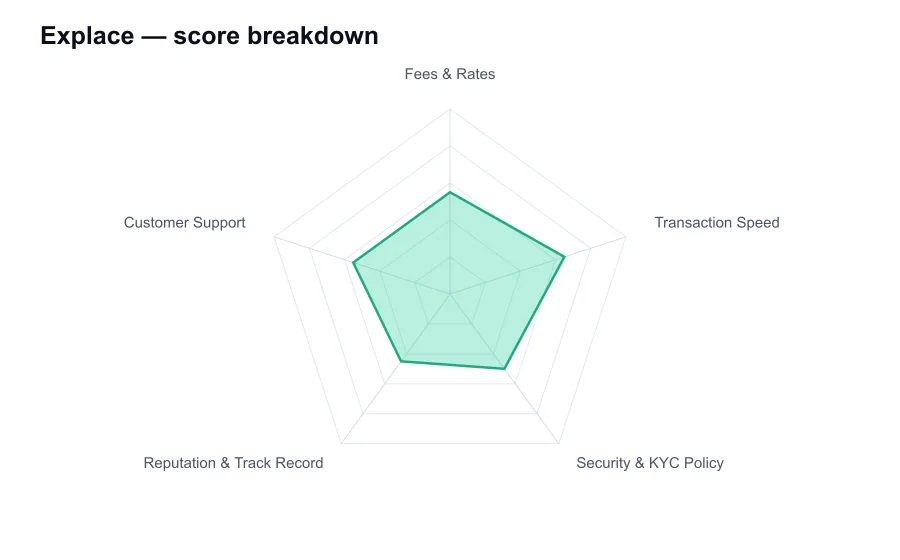
Explace scores 5.4/10 overall in our independent review, measured against every other provider we've compared, strongest on Transaction Speed (6.5/10) and weakest on Reputation & Track Record (4.5/10).
No-account swaps · Fixed-rate option · Wallet-to-wallet conversion · Major crypto pairs
Explace is a relatively small instant crypto exchange service aimed at people who want to swap one asset for another without opening a trading account or learning a conventional exchange interface. It sits in the same broad category as ChangeNOW, SimpleSwap and Exolix, but it has a much thinner public footprint than those better known names. The site is straightforward, the order flow is familiar, and the proposition is simple: choose two coins, send funds, receive the converted asset in a personal wallet.
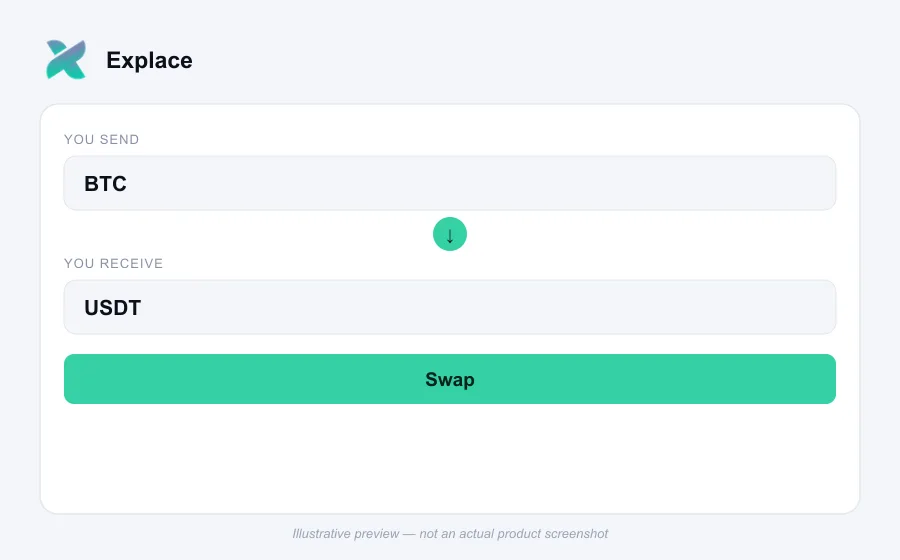
That simplicity is Explace's main attraction. There is no order book, no charting terminal and no attempt to turn a basic swap into a trading experience. A user who has BTC and needs USDT on a particular network can get from quote to deposit address quickly. For a one-off conversion, that is often more appealing than signing up to Binance or Kraken, completing verification and placing a market order.
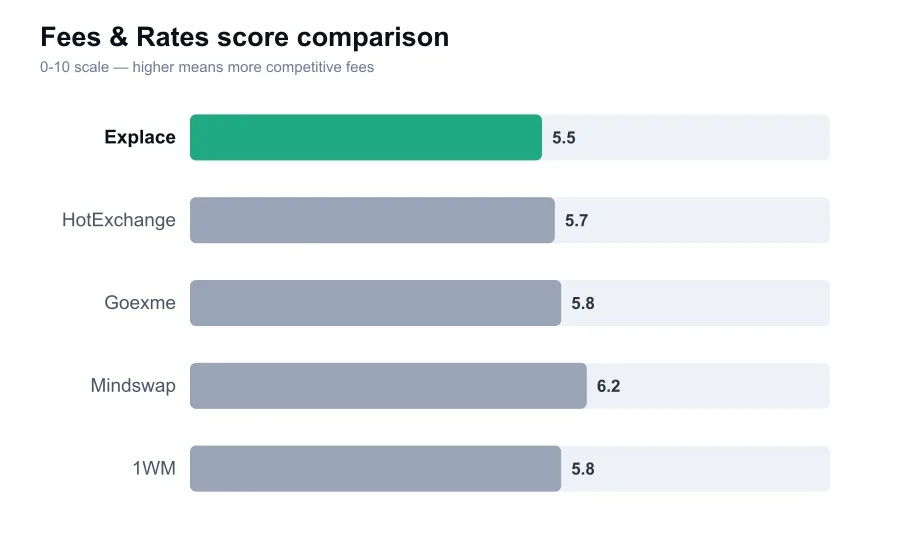
The catch is that a clean interface does not make the underlying economics especially clear. Explace generally presents a final conversion quote rather than a separate service-fee line. That is normal for this market, but it means the cost is embedded in the exchange rate and can be difficult to compare at a glance. You need to check the amount you would receive against at least two alternatives before sending anything.
On liquid pairs, the visible difference may be tolerable for a small convenience swap. On thinner assets, or during a fast market move, the spread can become meaningful. A service that says it charges no fee may still be earning its margin through the rate. Network fees also come out of the delivered amount or are factored into the quote. That is not dishonest by itself, but Explace does not give the kind of fee transparency that a cost-conscious regular user should demand.
Fixed-rate orders are the feature that matters most here. If the platform offers a fixed quote for the selected route, it reduces the nasty surprise of receiving less because Bitcoin moved while confirmations were coming in. Floating-rate swaps can work fine in calm conditions, yet they shift market risk onto the customer. Before creating an order, read which rate mode is selected and do not assume the number on the first screen is guaranteed.
Speed is decent for ordinary routes, rather than exceptional. Once a deposit reaches the required number of confirmations, a common swap involving BTC, ETH, USDT, LTC or TRX can often complete within minutes. Bitcoin deposits are naturally slower than a USDT transfer on Tron, and Ethereum congestion can slow both the deposit and the payout. Explace cannot outrun a blockchain, despite the usual instant-exchange language.
The more important speed question is liquidity and routing. Small swaps on popular networks are unlikely to expose much friction. Larger orders, obscure tokens, bridge-like cross-network routes and coins with shallow liquidity are where instant services sometimes pause, reprice or source the trade from a partner. Explace gives fewer public operational details than mature competitors, so I would not use it for a large urgent transfer where the exact arrival time has financial consequences.
Explace markets the convenience of a non-custodial swap process, meaning the service is not designed as a long-term account where users leave a balance. That is better than parking coins with an unknown platform. Still, funds are sent to an address controlled by the service during the conversion, so this is not trustless self-custody. A user remains dependent on Explace, its liquidity partners and its compliance process until the outgoing transaction is broadcast.
The KYC position needs to be read carefully. A no-registration flow does not guarantee that identification will never be requested. Like most instant exchangers, Explace can reserve the right to seek documents or source-of-funds information when an automated risk system flags a transaction. That can be frustrating, especially if it happens after a deposit, but it is now standard practice among providers trying to manage sanctions and anti-money-laundering exposure.
Security information is where Explace feels underdeveloped. I would like to see a more substantial record of independent audits, public leadership, detailed custody practices and incident reporting. A basic HTTPS site and a stated privacy policy are not evidence of robust operational security. There is no established reason to assume wrongdoing, but there is also not enough independently verifiable history to give the platform the benefit of the doubt with serious money.
Its reputation is therefore the weakest part of the proposition. Explace does not carry the long operating history of BitcoinVN in its local market, nor does it have the volume of public feedback accumulated by bigger instant-swap brands. Reviews can be useful signals, but they should not be confused with proof of reserves or proof of consistent dispute handling. The sparse public record makes a test transaction sensible, not paranoid.
Support appears to be built around online chat and email-style ticket contact rather than a deeply staffed service operation. For a simple order question, that can be enough. If a transfer is delayed, though, the useful response is not a generic message about confirmations. Users need a transaction hash, a clear explanation of any compliance hold and an honest time estimate. Smaller services are often fine until an exception occurs, then response quality becomes decisive.
I would also be careful with token and network selection. A large share of exchange complaints come from users sending USDT on the wrong chain, attaching an unsupported memo, or choosing a similarly named asset. Explace's streamlined form helps, but it cannot rescue an incorrect deposit. Verify the ticker, chain, destination wallet and minimum amount before transferring. Send a small test first if the receiving wallet is new or the route is unfamiliar.
Explace has a legitimate use case for modest, uncomplicated swaps by someone who values a direct no-account workflow. It is not the service I would choose for a five-figure conversion, an unusual asset, or a time-critical payment. The rates require comparison, the public track record is short, and the security story is too light on evidence. Treat it as a convenience tool, keep the transaction size sensible, and use a more established venue when the stakes rise.
Who it suits
Explace suits users making small, familiar swaps between major coins and stablecoins who do not want a custodial exchange account. It is best used with a personal wallet and a test transaction first. Large holders, businesses and anyone needing strong compliance documentation should use a major regulated exchange or a better established OTC provider instead.
The practical view
Strengths and trade-offs
What stands out
- Simple wallet-to-wallet swap flow
- No conventional trading account required
- Useful coverage of common crypto routes
- Fixed-rate option can reduce price slippage
What to weigh
- Limited public track record
- Costs are embedded in quoted rates
- Large or unusual swaps carry more uncertainty
Scorecard
How the score is built
Verdict
My take on Explace
Explace is convenient, but convenience is doing most of the work in its appeal. The interface is easy and standard swaps can move quickly, yet its quoted-rate model and limited public history demand caution. It has not built the level of trust that would justify sending a large amount without comparison or testing. For modest conversions it can be practical. For serious capital, there are stronger choices.
Review questions
Explace FAQ
Does Explace require KYC?
A normal swap flow may not require account registration, but Explace can request verification if a transaction triggers compliance or risk checks.
Are Explace fees shown separately?
Usually the service cost is reflected in the quoted conversion rate, alongside applicable network costs, rather than presented as one flat trading fee.
How long does an Explace swap take?
Common routes may complete within minutes after the deposit confirms. Bitcoin, Ethereum congestion, liquidity checks and compliance reviews can make an order take longer.
Reader experiences
What users report
Continue your comparison
Read across the full ranking before deciding which provider best fits your own needs.
Compare providers