Ranked #18 of 74 · Updated October 2026
LetsExchange review
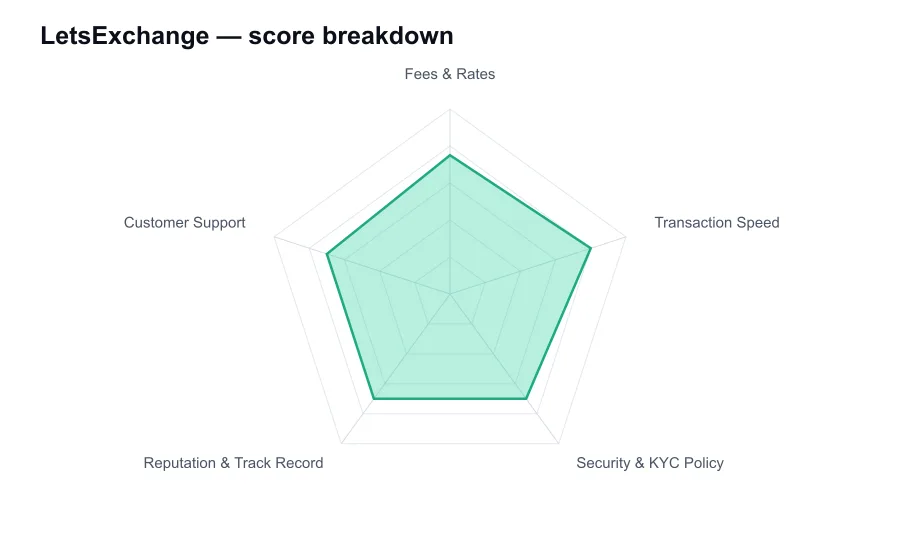
LetsExchange scores 7.3/10 overall in our independent review, measured against every other provider we've compared, strongest on Transaction Speed (8.0/10) and weakest on Customer Support (7.0/10).
No routine KYC · Fixed-Rate Swaps · Cross-Chain Routes · 24/7 Support
LetsExchange is a non-custodial crypto swap service that sits in the crowded middle ground between simple instant exchanges such as ChangeNOW and more technical aggregators. It does not hold a conventional trading account for you. You choose a pair, send funds to a displayed address, and receive the exchanged asset in your wallet. That model is attractive for people who want a quick conversion without handing an exchange their full trading history, but it also means the quality of the experience depends heavily on the liquidity partner behind each quote.
The platform supports a very broad list of coins, tokens, and networks. That is one of its genuine strengths. LetsExchange is useful for awkward swaps that major retail exchanges either do not list or make unnecessarily difficult, including many smaller ERC-20, BNB Chain, Polygon, Avalanche, and Solana assets. Its bridge-like cross-chain swap routes can save time compared with manually selling, withdrawing, bridging, and rebuying an asset.
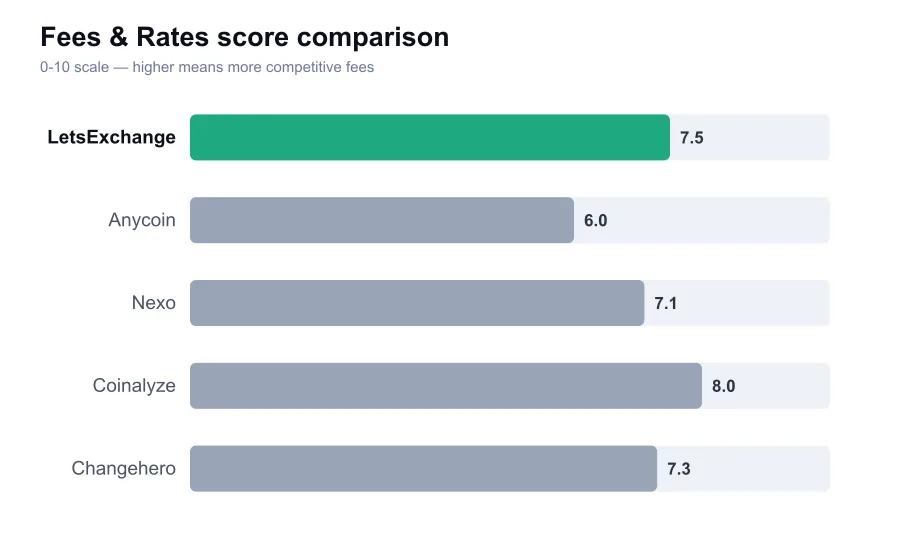
Pricing is less straightforward than a headline fee might suggest. LetsExchange generally builds its compensation into the rate presented to the user, alongside network fees and the spread charged by its liquidity providers. You will not usually see a neat universal percentage such as 0.25 percent. That is common among instant-swap providers, but it makes direct comparison harder. The only sensible way to judge the price is to check the final amount against at least one rival immediately before sending.
On major pairs, its quotes are often competitive. For a straightforward BTC to ETH or ETH to USDT conversion, LetsExchange can land near ChangeNOW, StealthEX, or SimpleSwap, especially during calm markets. It is not reliably the cheapest option. Trocador's aggregation can sometimes find a better route, and an order book exchange will usually be cheaper for someone willing to use KYC and trade manually. LetsExchange charges for convenience, not for bargain-hunting purity.
The fixed-rate option deserves attention. A floating-rate swap exposes the final payout to market movement while the transaction is being processed. Fixed rate locks an expected amount for a limited period, subject to the provider receiving the funds within the stated window. That can be sensible in a fast market or for a larger swap. It generally costs more through a wider quote, so using it for every small conversion is wasteful.
Speed is good rather than magical. A simple swap commonly completes after the deposit receives the required confirmations and the liquidity provider processes it. On quick chains, that can mean a few minutes. Bitcoin, Ethereum during congestion, and cross-chain routes take longer. Ten to thirty minutes is a realistic expectation for many ordinary transactions, while an hour or more is not unusual when the source chain is busy or a partner requires extra confirmations.
LetsExchange does a respectable job of showing status during the process. A transaction page tracks the deposit, exchange, and payout stages, and that visibility is better than being left with only a destination address. Still, tracking does not solve the frustration of a delayed swap. Users should save the exchange ID, transaction hash, chosen pair, and quoted amount before closing the page. That basic discipline makes any support conversation far easier.
The service presents itself as non-custodial, and that is mostly the right description in the account sense. There is no standing balance for an attacker to drain, and users retain their wallet keys. During a swap, though, the coins are temporarily under the control of the exchange route and its partners. Non-custodial is not the same as trustless. You are trusting LetsExchange's routing, address generation, and counterparty selection at the moment it matters.
KYC is not routinely required for ordinary use, which is a major reason privacy-conscious users consider it. That should never be interpreted as a guarantee that verification cannot happen. LetsExchange reserves the right to pause transactions flagged by its compliance systems and request identification or source-of-funds material. This is industry-standard language, but users who cannot or will not complete verification should not send a life-changing amount through any instant exchange.
Security information is adequate but not unusually transparent. LetsExchange has a visible public operation, partner integrations, and a support presence, but it does not provide the sort of detailed proof-of-reserves, audited custody architecture, or public security reporting expected from a mature centralized exchange. That is partly because it is not holding customer accounts in the same way. Still, the platform asks for practical trust, and it has not earned blind trust.
Its track record is better than that of the many anonymous instant exchangers that appear and vanish within a year. LetsExchange has operated since the early 2020s, built affiliate and API relationships, and accumulated a recognizable footprint across crypto comparison sites. Public feedback is mixed in the familiar way for this category. Many users report painless swaps, while negative reports often involve delayed payouts, changing rates, or compliance reviews. Those complaints are not unique, but they matter.
Support is available around the clock through live chat and email, and simple questions tend to get answered quickly. The bigger test is a stuck transaction. In those cases, the team can communicate clearly, but resolution still depends on blockchain confirmations and the underlying liquidity provider. That is the weak spot of the aggregator model. Support can explain a delay, but it cannot always immediately reverse it or force a partner to settle faster.
The interface is clean enough for a first-time user, although the quote screen should be read more carefully than its simplicity encourages. Check the network on both sides, the minimum and maximum limits, whether the rate is fixed or floating, and the exact receiving address. A wrong network selection can turn a convenient swap into a support case with no guaranteed recovery. Small test transactions remain sensible for unfamiliar assets.
I like LetsExchange as a practical utility, particularly for broad altcoin coverage and one-off cross-chain conversions. It is not the service I would use for frequent trading, large transfers, or a transaction where I need absolute certainty about execution price. Treat it as a well-established exchange aggregator, compare its final quote, and keep the amount proportionate to the risk. Used that way, it is one of the stronger options in its particular niche.
Who it suits
LetsExchange suits self-custody users who need a quick conversion between assets or networks, especially obscure altcoins. It also fits people who want to avoid opening another exchange account for an occasional swap. Active traders and anyone moving a large amount should compare order-book venues and several aggregators first. Users unable to complete a possible compliance review should choose their provider and transaction size carefully.
The practical view
Strengths and trade-offs
What stands out
- Very broad coin, token, and network coverage
- Fixed-rate and floating-rate swap choices
- No routine account registration for basic swaps
- Useful API and affiliate infrastructure
What to weigh
- Final cost is embedded in the quote
- KYC can still be requested on flagged transactions
- Large swaps depend on third-party liquidity partners
Scorecard
How the score is built
Verdict
My take on LetsExchange
LetsExchange earns its place because it is broad, usable, and more established than many instant-exchange lookalikes. Its best feature is reach, not rock-bottom pricing. The service is dependable enough for normal-sized swaps, but the opaque all-in quote and partner dependence keep it below the standard of a serious trading venue. Compare the payout before sending, use fixed rate only when the protection justifies the spread, and it can be a very useful wallet-side tool.
Review questions
LetsExchange FAQ
Does LetsExchange require KYC?
Routine swaps normally do not require account registration or KYC. LetsExchange can request verification if its risk systems flag a transaction, so anonymity is not guaranteed.
How long does a LetsExchange swap take?
Fast-chain swaps may take only a few minutes. Bitcoin, Ethereum congestion, large transactions, and cross-chain routes can take much longer because confirmations and liquidity processing are involved.
Are LetsExchange fees shown separately?
Usually no. The service cost, liquidity-provider spread, and network costs are reflected in the offered exchange rate. Compare the final receive amount, not only a displayed rate.
Reader experiences
What users report
Continue your comparison
Read across the full ranking before deciding which provider best fits your own needs.
Compare providers