Ranked #17 of 74 · Updated October 2026

Quickex review
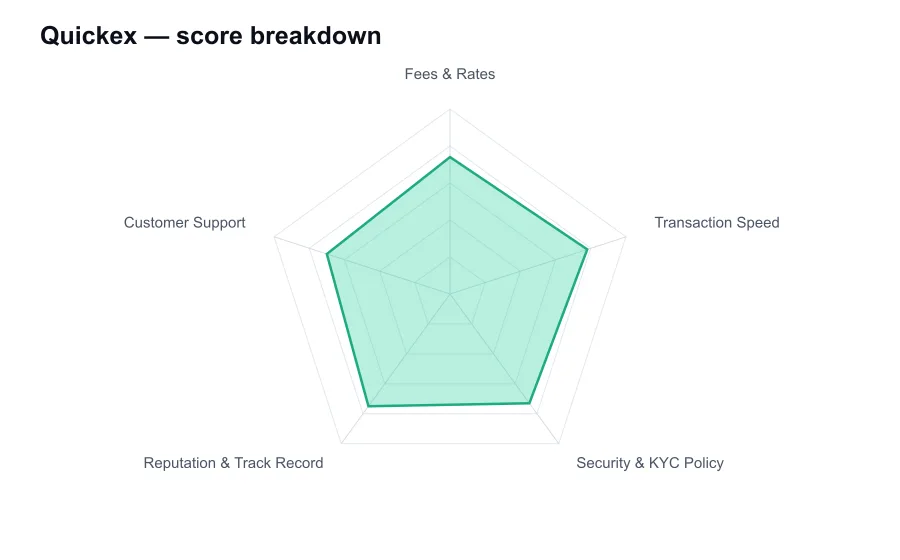
Quickex scores 7.4/10 overall in our independent review, measured against every other provider we've compared, strongest on Transaction Speed (7.8/10) and weakest on Customer Support (7.0/10).
No-account swaps · Fixed-rate exchanges · Broad asset coverage · Transaction tracking
Quickex is one of the older names in the instant crypto exchange category, a service designed for direct wallet-to-wallet conversions rather than conventional spot trading. It aims at users who value speed and low friction more than a sophisticated account dashboard. The product has a recognisable formula: select the assets, enter a destination address, send the deposit, and wait for delivery. That is useful, but Quickex is better judged as a transaction utility than as a full exchange.
The site supports a large number of cryptocurrencies and token networks, which is one reason it remains relevant. A user can often find routes that would require several manual steps on a traditional exchange. This is particularly convenient for moving between major layer one assets and stablecoins. The downside of a huge asset menu is that quality is uneven. A route for BTC or USDT is not comparable to a thinly traded token pair, regardless of what the interface suggests.
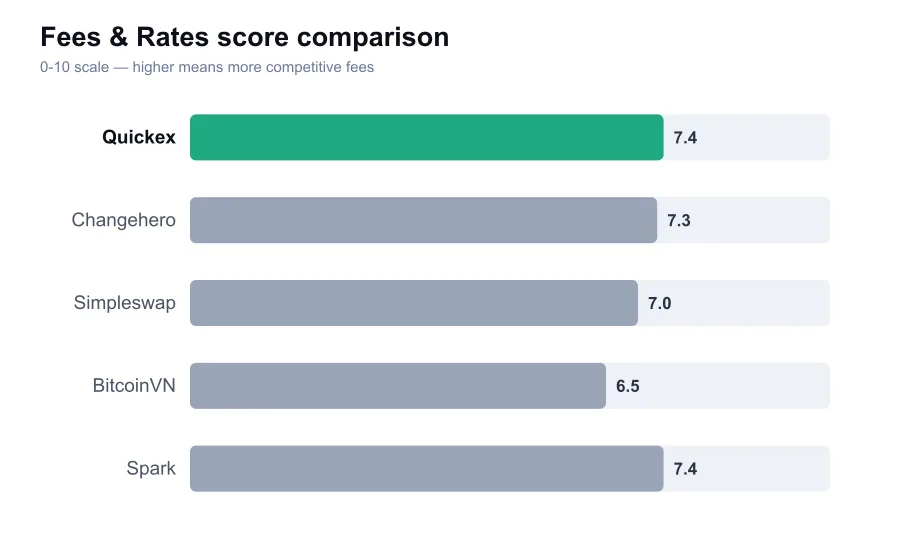
Quickex advertises competitive fees, and its public messaging has long emphasized a relatively low exchange commission. In practice, customers should not focus solely on a percentage claim. The actual quote incorporates the service charge, provider spread, market movement, and network costs. The only meaningful comparison is the amount you will receive. For common pairs, Quickex can be competitive. For obscure tokens or small transactions, network charges and spread can turn a seemingly cheap swap into an expensive one.
The platform offers both floating and fixed-rate transactions. That choice is more important than many first-time users realise. A floating rate can work nicely in quiet markets because it tracks the execution price. It can also punish you during a sharp move, especially if the deposit takes time to confirm. A fixed rate is preferable if the recipient needs a specific amount or if you are exchanging a volatile asset. You may pay for that certainty in the rate, but at least you know why.
Quickex has a genuine advantage in transaction flow. Its interface is direct, and ordinary swaps can move quickly once the incoming transfer has been detected and confirmed. Transactions on fast networks can finish in a matter of minutes. Bitcoin and some privacy-oriented or heavily congested networks are another story. No instant exchanger can make a blockchain confirm faster, and users should be suspicious of sites that imply otherwise.
There is also the problem of liquidity routing. Quickex does not simply operate a public exchange book where the user can see every resting order. It sources or routes conversions through its own infrastructure and partners. Most of the time, that abstraction is convenient. During volatility, wallet maintenance, or limited reserve availability, it can produce delays or a rate recalculation. The platform is fast in normal conditions, but it is not immune to the operational dependencies built into this business model.
The privacy angle is central to Quickex's appeal. It generally allows users to exchange cryptocurrency without creating a permanent account or completing routine identity verification. That is a strong feature for users who believe a one-time conversion should not require handing over a passport. It also reduces the risk associated with storing a long-lived account at another centralized platform. Still, a no-registration exchange is not outside compliance rules.
Quickex reserves the ability to request verification where anti-money-laundering monitoring identifies risk. A transfer can be paused while the customer supplies identity documents or evidence about fund origin. This is common across reputable instant exchange services, and it should be stated plainly rather than hidden behind privacy marketing. If your coins have interacted with sanctioned services, high-risk gambling addresses, mixers, or stolen-fund clusters, assume scrutiny is possible. Do not send funds you cannot afford to have temporarily tied up.
Noncustodial execution reduces exposure to a custodial failure because Quickex does not ask users to maintain a trading balance on the platform. But a swap still requires sending funds into an address controlled during the conversion process. Security therefore depends on the service's operational systems, its providers, and its ability to detect suspicious activity without wrongly freezing legitimate users. Public information about deep technical controls, independent audits, and insurance is limited. That is common here, but it is not ideal.
Quickex has more longevity than many anonymous-looking swap sites. It has been operating since the late 2010s and has built brand recognition through affiliate listings, reviews, and exchange comparison sites. That makes it more credible than a newly launched service with little history. It does not put it in the same trust bracket as a heavily regulated exchange with audited reporting, named executives, and years of public financial scrutiny. Those are different products serving different priorities.
Its public reputation is fairly resilient, although no instant exchanger escapes complaints about delayed orders, rate differences, or verification requests. The important question is whether the complaint describes a platform mistake, a blockchain issue, a user sending an unsupported asset, or a compliance hold. Quickex's long presence gives it some benefit of the doubt. Yet users should remain skeptical of any review ecosystem that rewards a service heavily for referrals. Transaction evidence matters more than star ratings.
Support is available through live channels and email, and Quickex does better than many tiny services simply by maintaining a visible path for an order-specific query. A support agent can usually locate an exchange from its ID and transaction hash. The limitation is obvious: support cannot force a blockchain to confirm or a third party to release liquidity. Good support can explain the delay clearly and communicate often. Poor support goes silent. Prospective users should judge the service by that standard.
I would use Quickex with a practical mindset. Start with a test transaction if you have not used the network combination before. Check the minimum and maximum limits, especially for tokenized assets. Confirm whether the destination wallet accepts the chosen network. A wrong-chain deposit can turn a five-minute conversion into a difficult recovery request. Don't rely on a copied token ticker alone, because similarly named assets can have very different contracts.
Quickex remains a capable choice for users who want broad coin access and a straightforward no-account conversion. It earns stronger marks for history and routing convenience than a newer entrant, though the pricing model still requires vigilance. Its security profile is good for a noncustodial exchanger, not exceptional in the broader financial sense. I would recommend it for routine swaps where privacy and convenience matter. For large, time-sensitive execution, a transparent spot market or regulated OTC provider is still the more professional answer.
Who it suits
Quickex suits privacy-minded users making routine wallet-to-wallet swaps, especially across assets that would otherwise take several exchange steps. It is a practical option for people comfortable checking rates and network details themselves. Day traders need an order book, and high-value users should prefer a venue with clearer liquidity and institutional controls. It is also a poor fit for anyone who assumes no registration means no possible compliance check.
The practical view
Strengths and trade-offs
What stands out
- Longer history in instant exchanges
- Wide cryptocurrency selection
- No routine account creation
- Fixed and floating quotes
What to weigh
- Quotes can widen on illiquid routes
- Compliance reviews can delay funds
- Limited public detail on liquidity infrastructure
- Not designed for active trading
Scorecard
How the score is built
Verdict
My take on Quickex
Quickex has survived long enough to deserve more respect than the typical anonymous swap page. Its broad asset support, clean flow, and no-account model are useful in real life, not just on a feature list. The central caveat is pricing transparency: compare the final output, not promotional fee language. It is reliable enough for ordinary exchanges, but not transparent enough to be the default venue for major execution. Treat it as a well-established convenience service and it makes sense.
Review questions
Quickex FAQ
Does Quickex charge a fixed fee?
Quickex promotes competitive exchange fees, but the effective cost depends on the pair, liquidity, network fees, and whether you use a fixed or floating quote. Compare the final receive amount before sending.
Can Quickex ask for verification?
Yes. Routine use is generally possible without account registration, but suspicious or high-risk transactions can be paused for AML or KYC verification.
Is Quickex fast for Bitcoin swaps?
Quickex can process the exchange promptly after the deposit confirms, but Bitcoin confirmation times are determined by the network. Busy mempool conditions can make a swap take much longer than a fast-chain transfer.
Reader experiences
What users report
Continue your comparison
Read across the full ranking before deciding which provider best fits your own needs.
Compare providers