Ranked #14 of 74 · Updated October 2026
Spark review
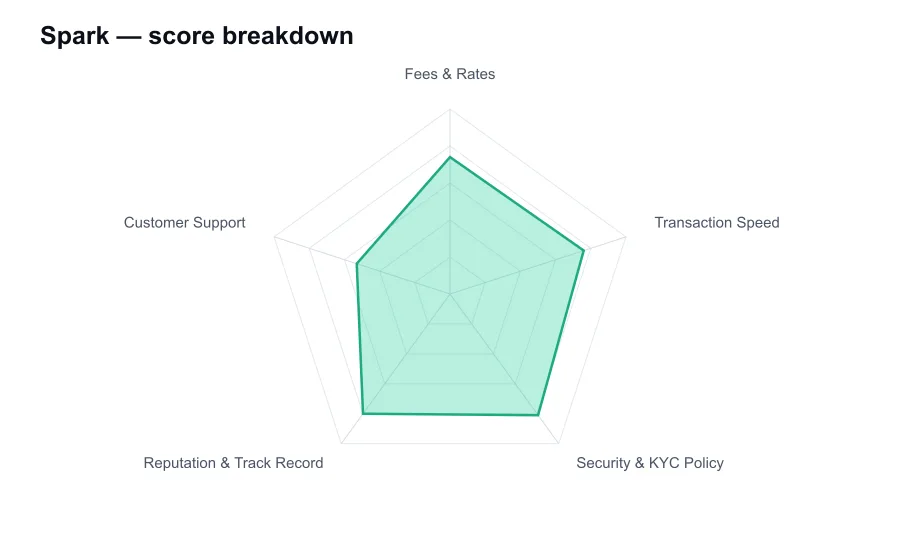
Spark scores 7.5/10 overall in our independent review, measured against every other provider we've compared, strongest on Security & KYC Policy (8.1/10) and weakest on Customer Support (5.3/10).
Onchain lending · Stablecoin savings · No routine KYC · Collateralized borrowing
Spark is not a conventional crypto exchange, and describing it as one can lead users to expect the wrong thing. It is a DeFi lending and savings protocol closely tied to the Maker, now Sky, ecosystem. Its core products let users supply assets, borrow against collateral, and earn protocol based yield, particularly around DAI, USDS, and related stablecoin liquidity. The platform sits much closer to Aave, Morpho, and Maker's old lending infrastructure than to Coinbase or Kraken.
That distinction is important because Spark does not primarily exist to help a newcomer buy bitcoin with a card or trade dozens of tokens. It is designed for onchain capital management. A user with ETH, wstETH, DAI, or USDS can use the protocol to borrow, earn yield, or access liquidity without handing custody to a company. For people already comfortable using an Ethereum wallet, that narrow focus is a strength. For everyone else, it is a steep first step.
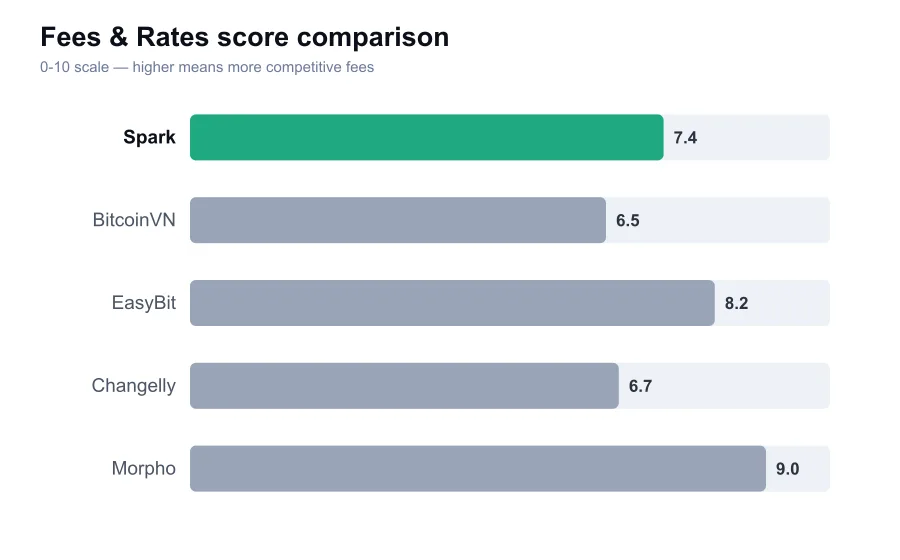
Fees need to be judged product by product. There is no familiar spot trading commission because SparkLend is not a spot exchange. Depositing and withdrawing from a lending market does not work like paying a maker or taker fee at a centralized exchange. Borrowers instead face interest rates that change with market utilization and protocol parameters. Users also pay the gas cost required to execute transactions on the relevant network.
That can be economical or surprisingly expensive. On Ethereum mainnet, a simple approval or deposit can cost enough to make a small balance inefficient. Spark's presence across lower cost environments improves the practical experience, but users should still look at the network selector and the transaction estimate before acting. A protocol can advertise an attractive annual percentage yield while a small depositor loses a meaningful portion of it to entry and exit costs.
Savings products linked to DAI or USDS are one reason people pay attention to Spark. The attraction is straightforward: stablecoin holders can seek onchain yield without chasing a new farm token every week. But a displayed annual rate is not a guaranteed bank deposit rate. It may change according to governance decisions, liquidity conditions, and the product's design. Stablecoins themselves also have issuer, peg, regulatory, and smart contract risks that a percentage figure cannot erase.
Borrowing requires more discipline than supplying. Collateral values can fall rapidly, while debt continues to accrue interest. Spark displays health information, but it cannot make a leveraged position safe. If collateral crosses liquidation thresholds, the protocol's rules can sell or liquidate it. Anyone borrowing against volatile ETH or staked ETH should leave a meaningful buffer, monitor the position, and understand the relevant liquidation ratio before taking a loan.
Execution speed is generally good in the narrow sense that onchain actions settle as soon as the chosen network confirms them. There is no manual credit desk reviewing a normal retail transaction. On Ethereum, that may mean minutes and variable gas during congestion. On layer two networks it can feel much faster and cheaper. Interest and accounting, however, are protocol processes, not instant customer service promises, so users should not confuse a quick wallet confirmation with an instantly risk free financial result.
Spark's security posture is stronger than that of a small anonymous DeFi application because it is linked to one of the most established stablecoin ecosystems in crypto. The protocol has public governance, technical documentation, and a history rooted in Maker's risk management culture. That doesn't make it invulnerable. Lending contracts, oracle feeds, collateral integrations, governance changes, bridges, and user wallet approvals all create attack surfaces. DeFi users should never interpret institutional language as a guarantee.
There is no normal KYC check for direct protocol interaction from a self custody wallet. That privacy and permissionless access are central to the product's appeal. The practical caveat is that front end access, stablecoin issuers, centralized ramps, and local laws may create restrictions outside the core contracts. A user who needs regulated account statements, tax reporting assistance, or a person to call during a dispute will not get that experience from Spark itself.
Spark's reputation is solid within DeFi, especially among users who understand the Maker and Sky lineage. It has more credibility than the average high yield protocol because it is associated with a mature stablecoin ecosystem and risk oriented governance. Still, its reputation is specialized. It is not a household retail brand, and the complexity of its products means a strong protocol reputation cannot substitute for a user's own understanding of collateralized lending.
The user experience is cleaner than many DeFi lending dashboards. Rates, supplied balances, borrowed balances, and health metrics are presented in a way that a practiced user can follow. Yet the most important numbers remain easy to misunderstand. A variable borrow rate, a changing annual percentage yield, and a health factor all demand attention. The interface is good at showing data. It cannot guarantee that someone recognizes the consequence of a collateral drawdown at two in the morning.
Customer support is deliberately limited compared with a centralized platform. Documentation, governance forums, and community channels are useful for understanding mechanics, but they cannot reverse a liquidation or retrieve assets sent to an incorrect address. This is normal for a noncustodial protocol, not necessarily a failure. It is also a serious reason not to use Spark with money that a user cannot afford to manage independently.
Compared with Aave, Spark is less broad but more closely optimized around the stablecoin and collateral markets of its own ecosystem. Compared with a centralized exchange's savings account, it gives users clearer onchain control but far less consumer protection. Compared with a speculative yield farm, it is the more credible choice. Those comparisons explain the platform better than trying to rate it as though it were a universal exchange.
Spark is best for users who already understand wallet security and want purposeful exposure to onchain lending or stablecoin savings. It is especially useful for someone whose assets and strategy already revolve around DAI, USDS, ETH, or wstETH. It is a poor choice for a first crypto purchase, short term gambling with borrowed money, or anyone who wants a support agent to make a mistake disappear. Used carefully, it is a serious protocol. Used casually, it can teach expensive lessons.
Who it suits
Spark suits experienced DeFi users seeking stablecoin savings or collateralized borrowing, particularly people already using DAI, USDS, ETH, or wstETH. It also fits users who prefer visible onchain rules over a custodial yield account. First time buyers, users needing fiat rails, and anyone uncomfortable managing liquidation risk should use a conventional regulated platform instead. Do not use it as a substitute for an emergency cash account.
The practical view
Strengths and trade-offs
What stands out
- Deep connection to the Maker and Sky ecosystem
- Noncustodial lending and savings access
- Useful stablecoin focused products
- Transparent onchain positions and rates
What to weigh
- Not a standard spot exchange
- Borrowing carries liquidation risk
- Ethereum gas can hurt small transactions
- No customer service safety net
Scorecard
How the score is built
Verdict
My take on Spark
Spark is one of the more credible places to use DeFi lending, but only if you respect what it is. Its ecosystem roots, transparent mechanics, and noncustodial structure are meaningful advantages over anonymous yield products. The tradeoff is responsibility, variable rates, transaction costs, and real liquidation consequences. For a prepared user, it is a focused and capable protocol. For a casual user looking for an exchange app, it is the wrong product.
Review questions
Spark FAQ
Is Spark a crypto exchange?
Not in the usual retail sense. Spark is primarily an onchain lending and savings protocol. It does not function like a broad spot market where users buy crypto with cards or bank transfers.
Does Spark require KYC?
Direct interaction with the protocol through a self custody wallet normally does not involve standard account KYC. Third party ramps, issuers, and local rules can still impose separate requirements.
Can I lose collateral on Spark?
Yes. If you borrow against collateral and its value falls enough, your position can be liquidated under the protocol rules. Keep a substantial buffer and monitor any borrowed position.
Reader experiences
What users report
Continue your comparison
Read across the full ranking before deciding which provider best fits your own needs.
Compare providers