Ranked #43 of 74 · Updated October 2026

XChangic review
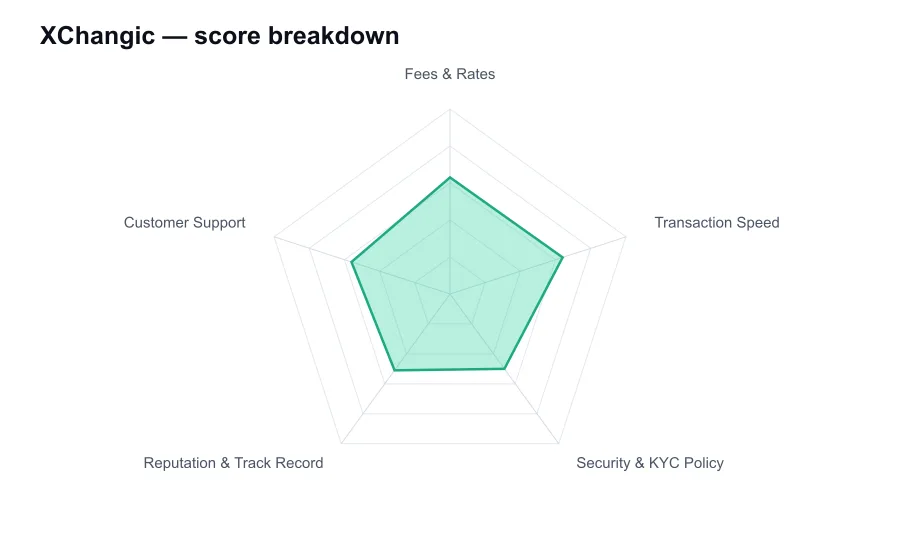
XChangic scores 5.7/10 overall in our independent review, measured against every other provider we've compared, strongest on Transaction Speed (6.4/10) and weakest on Security & KYC Policy (5.0/10).
Instant conversion model · Crypto route selection · No trading terminal · Compliance review possible
XChangic presents itself in the practical end of the exchange market, where users want to move between cryptocurrencies and payment methods without maintaining a full trading account. That is a valid niche. A person who needs one conversion does not always want order books, advanced verification at account opening, derivatives, or a long withdrawal process. XChangic's attraction is the promise of a direct path from one asset to another. The downside is that direct does not necessarily mean transparent.
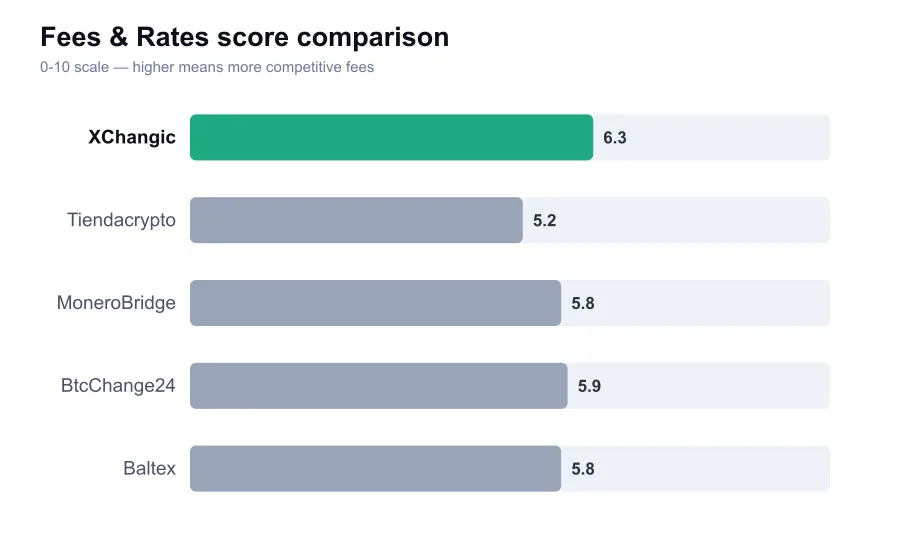
There is a basic distinction that prospective users should keep in mind. A conventional exchange matches buyers and sellers or trades against a large liquidity pool, while an instant exchanger gives you a quote and takes responsibility for sourcing the other side. XChangic falls into the latter mindset. You are not seeing a transparent market price plus a plainly stated trading commission. You are accepting a package price, which may include the provider's margin, network expenses, liquidity costs, and payment-channel risk.
That arrangement is convenient but it makes price discipline essential. Before making an XChangic order, enter the same amount at competing services and compare the actual destination amount. Compare the correct network as well. A USDT quote on TRON can look very different from a USDT quote on Ethereum once network costs enter the picture. Many users blame an exchanger for a poor rate when the real error was comparing unlike routes or ignoring the final payout.
I would not call XChangic a natural destination for frequent traders. If you are swapping liquid assets repeatedly, the accumulated spread can matter far more than the time saved by avoiding an account. A platform such as Kraken or Binance may require more setup but can offer better price discovery and tighter execution for people who know how to use it. XChangic makes more sense for occasional convenience, especially where the exact route is not readily available on a mainstream exchange.
The order timing depends on which part of the process is slowest. For crypto-to-crypto, that can be the incoming transaction confirmation. For card or bank-linked payments, it may be a payment processor, bank review, or manual reconciliation. For an outgoing crypto transfer, it may be the provider's wallet process and current network conditions. It is misleading to assess XChangic solely from a single fast transaction. A good service needs to communicate clearly when the normal path breaks.
There is a difference between reasonable waiting and poor communication. A blockchain transaction needs confirmations, and nobody can honestly remove that requirement. Yet an operator should be able to say how many confirmations are being awaited and whether the outgoing payment has been broadcast. If the order is under review, support should state that directly rather than leave a customer staring at a generic pending label. This is where smaller exchange services often lose goodwill.
XChangic's no-account style may appeal to users who do not want to hand over information before every small conversion. That should be interpreted narrowly. It is not a guarantee that an order can never be reviewed. Compliance systems can flag address risk, inconsistent payment details, unusual volumes, sanctioned exposure, or suspicious transaction patterns. In those situations, identity and source-of-funds questions may arise, even if the service did not ask for them at the initial order screen.
Users who need certainty about privacy should not select any instant exchanger based on casual assumptions. Read the terms, understand that compliance requests can delay access to funds, and do not send money from a source you cannot explain. A request for verification is frustrating, but a customer who has payment proof and a coherent transaction history is in a far better position than one who expected anonymity as a contractual right.
Security is another reason to keep transaction size proportionate to what can be independently verified. A smaller exchanger may operate competently, but outsiders often cannot review its wallet security model, segregation of customer funds, incident response plan, insurance, staff controls, or financial resilience. XChangic does not provide the depth of independently verifiable operational information that would justify a top-tier security score. That limitation is more important than glossy language about secure transactions.
Phishing risk is not theoretical here. Search results, clone sites, messaging apps, and fake support accounts are all common routes to a lost payment. Use a bookmarked address after independently confirming the site, not a link provided in a private message. Verify the destination details on the actual order page. Never give a wallet seed phrase to support. A legitimate exchanger has no reason to ask for it, under any circumstances.
Reputation is where XChangic lands in the middle to lower part of the market rather than the established tier. It may be visible through exchange-monitoring ecosystems and user comments, but that is not equivalent to a long public operating history backed by audited reporting or recognized regulation. Monitoring listings are useful for checking rates and seeing complaint trends. They should be one input, not the entire due-diligence process.
I would search specifically for how complaints are resolved rather than merely count positive ratings. Are delayed orders acknowledged? Is there a documented reason for rate adjustments? Do users describe support locating a payment quickly? Are there repeated allegations around requests for extra payments or unclear verification? Every exchanger attracts frustrated reviews, particularly from customers who made an error. The pattern and the operator's response are more revealing than the raw star average.
Support can make XChangic acceptable for a simple order or deeply unpleasant for a problematic one. Before paying, identify the official contact method and keep the order identifier. If an issue arises, provide concise evidence rather than sending multiple contradictory messages. A useful ticket includes the order number, amount, sender address or payment reference, transaction hash, destination address, and time sent. That gives support something actionable.
My assessment of XChangic is cautious rather than hostile. It can be a reasonable option if it offers the best real payout on a route you understand and you are using an amount that can tolerate delay. It is not where I would place a large conversion because the public information available does not support that level of confidence. Think of it as a convenience counter, not a financial home. That framing keeps expectations sensible and reduces the chance of a costly mistake.
Who it suits
XChangic can suit a crypto user making an occasional, well-documented swap and checking several providers for the best final payout. It is better for a patient user than for somebody with a hard settlement deadline. Active traders should prefer a liquid exchange with visible order-book pricing. High-value users and those who need guaranteed compliance clarity should look for a more established regulated provider.
The practical view
Strengths and trade-offs
What stands out
- Convenient for occasional conversions
- Avoids the complexity of a trading terminal
- Useful for comparing niche payment routes
- Potentially quick on routine on-chain orders
What to weigh
- Not cost-efficient for frequent liquid-asset trading
- Security controls are not independently transparent
- Verification may still occur after funds are sent
- Not appropriate for large first-time orders
Scorecard
How the score is built
Verdict
My take on XChangic
XChangic's convenience is real, but it should not be mistaken for a premium trust profile. The service is most defensible on a small order where its quote is clearly better than alternatives and the customer understands the route. Its weaker areas are public transparency and the uncertainty that accompanies exception handling. Use it with deliberate limits. A test transaction, careful network selection, and complete records are more valuable here than optimism.
Review questions
XChangic FAQ
Does XChangic require registration?
Instant exchangers may allow an order without a conventional trading account, but that does not rule out verification if the transaction is flagged for review.
How should I compare an XChangic quote?
Compare the final amount you will receive on the same asset, network, payment method, and order size. Do not compare only a headline exchange rate.
What should I do if an XChangic order is pending?
Check confirmations first, then contact official support with the order ID, transaction hash or payment reference, exact amount, and timestamp.
Reader experiences
What users report
Continue your comparison
Read across the full ranking before deciding which provider best fits your own needs.
Compare providers