Ranked #39 of 74 · Updated October 2026

YaObmen review
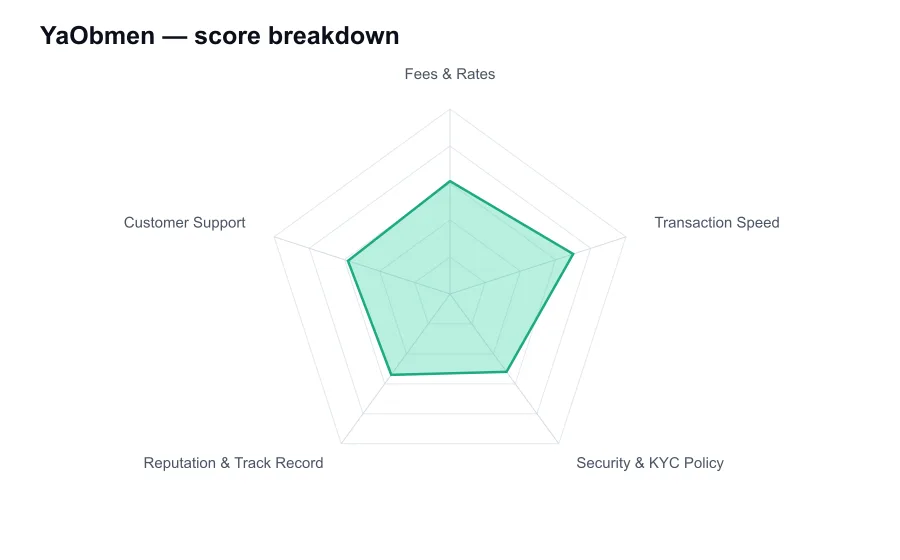
YaObmen scores 5.9/10 overall in our independent review, measured against every other provider we've compared, strongest on Transaction Speed (7.0/10) and weakest on Security & KYC Policy (5.2/10).
Instant exchange flow · Crypto conversion · Live-rate orders · Potential manual review
YaObmen sits in the familiar Russian language instant exchange niche, aimed at people who want to swap crypto, electronic money, or bank-linked payment methods without opening a trading account. It is not trying to be Binance, Kraken, or a full custodial platform. The appeal is convenience: choose a direction, enter the amount and receiving details, pay, then wait for the operator or automated flow to complete the order. That model can be useful, but it also means the buyer has to judge a relatively small service with less public disclosure than a major regulated exchange.
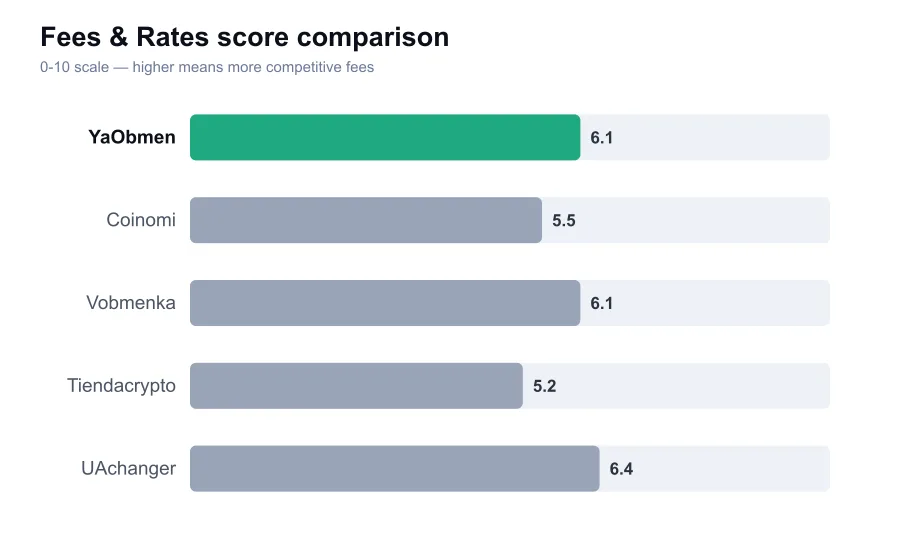
The first thing I look for with a service in this category is whether the quoted rate tells the whole story. YaObmen's usable price is the number shown on the order page, not a headline percentage fee. Instant exchangers commonly build their margin into the conversion rate, and YaObmen appears to follow that standard approach. That is not inherently deceptive. The problem is that a visitor cannot easily separate the provider's spread, network costs, payment processing costs, and reserve risk premium before comparing the final quote with competitors.
For small, ordinary exchanges, the pricing can be acceptable if the route is liquid and the market is calm. The difference becomes more visible on bank card, cash transfer, and less liquid crypto pairs. A rate that looks competitive on a monitoring page can become merely average once the order window is opened. I would not call YaObmen a bargain-first service. It is a quote-first service, and users should compare the exact payout against at least two alternatives before sending money.
Fixed-rate language also deserves careful reading. In this market, a fixed quote often remains fixed only while the customer pays within a short timer and supplies the exact amount. A late payment, a blockchain fee deduction, or a changed sender amount can move an order into manual recalculation. That is a reasonable safeguard for the operator, but it means users should never round down a payment or assume that a wallet's estimated network fee is harmless. Send the exact requested amount, from a personal wallet where possible, and save the order page.
Speed is one of YaObmen's stronger practical points, although it is not magic. Crypto-to-crypto orders can complete after the required network confirmations and internal review. On common networks, that may feel quick, but the actual clock depends on congestion, fee level, and whether the receiving asset needs additional confirmation. Bank-linked directions introduce more variables. Banking hours, payment reference checks, anti-fraud controls, and reserve availability can turn a supposedly instant order into a waiting exercise.
The website flow is relatively simple for someone who has used an exchanger before. It does not bury the customer under charting tools, complex order books, earn products, or account settings. That simplicity is a real advantage for a one-off conversion. New users should still slow down at the payment-details stage. An incorrect wallet address is almost never reversible, and a wrong card or bank reference can leave support trying to identify a payment manually.
YaObmen's security profile is harder to score generously because there is a large difference between a functional exchange form and a transparently governed financial service. A user may be able to make some orders without the onboarding burden associated with a centralized exchange, but that should not be confused with an unconditional promise of anonymity. Payment patterns, transaction size, source-of-funds concerns, or compliance flags can trigger questions or a request for identity documents. No-KYC expectations are often where customers get disappointed.
That policy is not unique to YaObmen. FixedFloat, ChangeNOW, and many smaller exchangers reserve the right to review suspicious transfers as well. The distinction is disclosure and process. Larger brands generally publish fuller compliance language, clearer restrictions, and more established support trails. With YaObmen, I would treat the service as suitable only for funds you can document and for a transaction that does not depend on immediate access to the proceeds.
There is also the custody issue. Once you send crypto or a bank payment to an exchanger, you are relying on its operational controls, staff, liquidity partners, and ability to resolve an exception. The customer cannot inspect cold storage arrangements, insurance cover, corporate audits, or proof of reserves in the way they might assess a large exchange. That does not prove poor security. It does mean the risk is less measurable, which is a meaningful drawback for high-value transfers.
Reputation for services like YaObmen is usually built through monitoring-site listings, repeat users, and the absence of unresolved complaints rather than through years of audited public reporting. That is a weaker foundation than a long operating record at a recognized exchange. Reviews can help identify recurring issues, particularly delayed payouts, rate changes, and identity-check disputes, but they should not be treated as conclusive evidence. Small services can collect positive feedback quickly and still struggle during a liquidity or compliance incident.
I would be particularly cautious about using YaObmen for a first transaction involving a large amount. Start with a modest test transfer, verify that the payout address and destination network are correct, and evaluate the actual completion time. If the test is smooth, that establishes something useful. It does not eliminate the risk that a larger order receives different treatment, but it is far safer than discovering the service's exception process with an amount you cannot afford to have delayed.
Support appears to matter more here than on a deep-liquidity trading platform because exceptions are part of the product. A sensible support team should be able to identify an order, explain whether it is awaiting confirmations or payment verification, and state what information is required. The weak point is that small exchanger support is often reactive. Fast answers during normal periods are nice, but the real test is a mismatched payment, a flagged transfer, or a transaction sent on the wrong network.
I would keep every receipt, transaction hash, screenshot, and correspondence until the order is finished. It sounds basic, yet it is the difference between a support request that can be resolved quickly and one that becomes an argument over incomplete details. Avoid sending a second payment to "speed things up" unless support has explicitly instructed you to do so through a verified channel. Impersonation attempts are common around exchange services.
YaObmen makes sense as a practical conversion tool for users who understand instant-exchanger mechanics and can assess a live quote. It does not earn a high trust score because the public evidence available to an outside reviewer is thinner than it should be for a financial intermediary. The service may be convenient, and a normal small order may go through without drama. My view is still conservative: use it selectively, verify every detail, and do not treat convenience as a substitute for transparent controls.
Who it suits
YaObmen fits experienced exchanger users making a small to medium, well-documented conversion and willing to compare live quotes. It can work for someone who values a simple order form over an exchange account. New crypto users, privacy-sensitive users who cannot provide documents if asked, and anyone moving a large amount should use a more transparent, established platform instead.
The practical view
Strengths and trade-offs
What stands out
- Straightforward one-off exchange flow
- Useful for users avoiding a trading interface
- Can suit modest crypto conversion orders
- Live quote is visible before payment
What to weigh
- Spread and service margin are not clearly itemized
- Public security and corporate transparency are limited
- Large or flagged orders may face delays or verification
Scorecard
How the score is built
Verdict
My take on YaObmen
YaObmen is best treated as a utility, not a place to park money or a provider to trust blindly with a major transfer. Its simple format and potentially quick execution are attractive, but the lack of deep public transparency limits confidence. Compare the final payout rather than chasing a displayed rate. A small test order is sensible. For serious volume, a larger exchange or a provider with stronger public compliance and operational disclosures is the safer choice.
Review questions
YaObmen FAQ
Does YaObmen charge a separate fee?
The practical cost is usually reflected in the quoted exchange rate. Check the exact payout, payment amount, and network conditions before creating the order.
Can YaObmen ask for KYC documents?
Potentially, yes. Even services used without routine registration can request information for compliance, payment, or risk-review reasons.
How long does a YaObmen exchange take?
Crypto timing depends on confirmations and network congestion. Bank and card directions can take longer because payment verification and banking processes may be involved.
Reader experiences
What users report
Continue your comparison
Read across the full ranking before deciding which provider best fits your own needs.
Compare providers