Ranked #71 of 74 · Updated October 2026

CoinDrop review
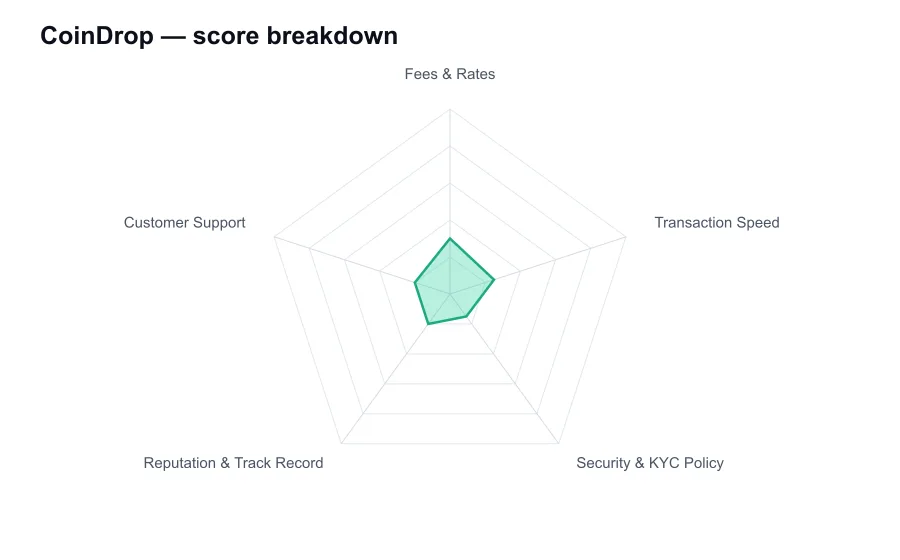
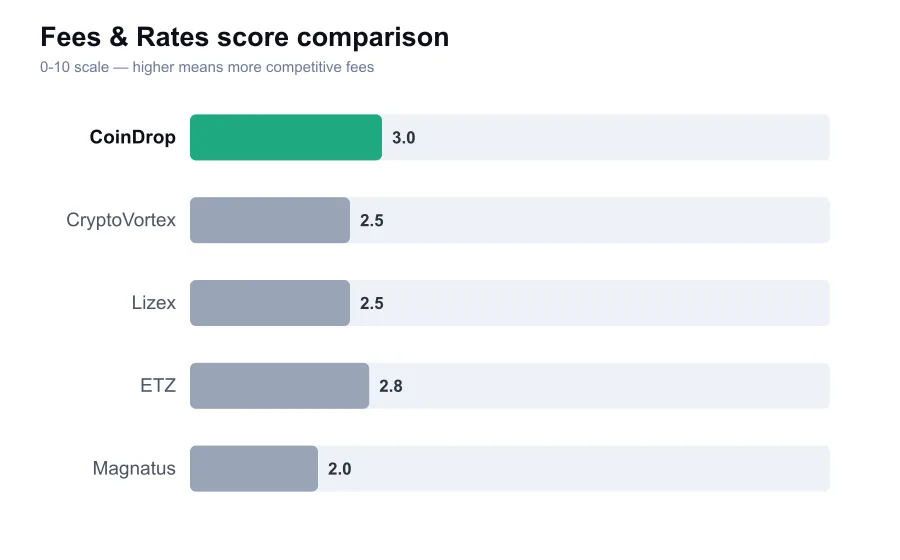
CoinDrop scores 2.2/10 overall in our independent review, measured against every other provider we've compared, strongest on Fees & Rates (3.0/10) and weakest on Security & KYC Policy (1.5/10).
Ambiguous brand identity · Crypto service search term · Limited public verification
CoinDrop is an unusually broad name in cryptocurrency, which creates a verification problem before any judgement about its product can begin. Similar names have been used for giveaways, wallet tools, marketing campaigns, faucets, and small exchange services. Without a reliably identifiable operator and a clearly established official presence, it would be reckless to treat every service called CoinDrop as the same business. That ambiguity is itself a serious drawback for anyone considering a deposit.
For this review, I could not establish a single, well-documented CoinDrop exchange provider with the public standing of recognised retail platforms. I could not confidently match the name to a transparent operator, durable regulatory profile, audited custody setup, or a substantial independent history of exchange activity. A generic name makes impersonation easier too. Users should be alert to copycat sites, social accounts, and messages using nearly identical branding.
That does not mean every CoinDrop-branded project is fraudulent. It does mean the name alone offers no trust signal. Before funding any account, a user should independently verify the exact web address, legal entity, country of incorporation, support domain, and terms of service. Do not rely on a link sent in Telegram, WhatsApp, Instagram, Discord, or a direct message. Type the address yourself after checking it against a credible company source.
Fee transparency is not good enough for a positive score. I could not verify a comprehensive public CoinDrop fee schedule that clearly separates a trading commission from the spread, blockchain miner fee, card processing charge, and withdrawal fee. That leaves customers unable to compare it properly with transparent alternatives. For a straightforward purchase, regulated retail brokers may cost more than a pro exchange, but the customer can at least see the charges and decide whether the convenience is worthwhile.
The zero-fee label deserves special suspicion if it appears. Crypto services rarely operate for free. Revenue may come from a spread, a poor conversion rate, a card surcharge, token incentives, or a withdrawal cost. There is nothing inherently wrong with a spread, provided it is disclosed and competitive. The problem is a provider that advertises one cost while obscuring the amount of crypto the customer will actually receive. CoinDrop has not established the pricing transparency needed to remove that concern.
Speed is similarly unproven. A service may call itself a drop, instant purchase, or rapid exchange, but actual transaction time depends on the payment method, chain congestion, liquidity source, internal risk controls, and whether the withdrawal is processed automatically. Bitcoin, Ethereum, and stablecoins do not share identical settlement characteristics. Good services explain those distinctions rather than turning every delay into the customer's fault.
I found no broad, reliable public record showing CoinDrop's typical withdrawal times or its handling of difficult cases. That matters far more than a claim that deposits are instant. Card payments can be credited quickly while withdrawals are held. A platform may show a transaction as completed internally while the blockchain payment has not been broadcast. Until a provider demonstrates consistent, transparent withdrawal performance, its speed should be judged cautiously.
Security cannot be assumed from an HTTPS padlock, a modern app, or a request for two-factor authentication. Those are basic features, not proof of institutional-grade protection. For CoinDrop, I could not verify public proof of reserves, recurring independent audits, a detailed custody policy, wallet address attestations, or a security disclosure programme. A customer should therefore assume that there is no demonstrated safety net rather than assuming assets are protected.
The question of KYC is also unresolved. Some services use a light onboarding process and reserve document checks for higher-risk transfers. Others collect identity documents immediately. Either can be reasonable if the policy is clear, proportionate, and consistent. What is not reasonable is shifting the rule after a transfer has been made, especially if the customer is then asked to pay a new charge before assets can be returned. CoinDrop's publicly verifiable policy information is too limited to inspire confidence here.
Be especially careful with giveaway language. A genuine promotional airdrop does not require you to send crypto first to receive more crypto back. Nor should a legitimate support representative ask for a recovery phrase, private key, screen-sharing access, or an advance payment to verify a wallet. These are among the oldest tricks in the sector. If CoinDrop is being introduced through a promise of free tokens or a profit opportunity, the safest assumption is that you are being marketed to aggressively, not protected.
CoinDrop's reputation is weak mainly because it is difficult to establish what, precisely, should be evaluated. Reputation needs a stable identity. A customer should be able to trace the same company across its website, legal terms, app-store publisher details, regulator records, support emails, and public statements. If those pieces do not line up, no collection of positive comments should overcome the discrepancy. A serious financial provider should not be a puzzle.
I cannot give customer support much credit either. A provider earns a support score through clear help articles, published response expectations, documented escalation paths, and evidence that it solves withdrawal issues without making users jump through invented hoops. CoinDrop has not built an independently checkable track record of that sort. The practical risk is that a user will have nobody accountable to contact once a transfer is irreversible.
Anyone who still wants to investigate CoinDrop should keep the exercise strictly defensive. Confirm the entity through official records, check the website age and domain ownership where available, compare the quote with recognised exchanges, and make no deposit until every withdrawal condition is understood. Never use borrowed money, never move assets from a hardware wallet into an unverified service, and do not believe a claimed balance until funds have arrived in a wallet you control.
CoinDrop is not a provider I can recommend based on its available public footprint. The lack of clarity around its exact identity, fees, security posture, and support accountability is more consequential than a potentially attractive exchange quote. Crypto users have enough unavoidable risks, including price volatility and transaction mistakes. They should not add brand ambiguity and unverified counterparty risk without a compelling, documented reason.
Who it suits
CoinDrop is not appropriate for people buying their first crypto, businesses accepting payments, or investors moving meaningful balances. It may only be researched by highly cautious users who can independently confirm the exact operator and are prepared to walk away at the first inconsistency. Anyone seeking a simple purchase or swap should use a provider with a distinct legal identity and transparent transaction terms.
The practical view
Strengths and trade-offs
What stands out
- Simple brand concept
- May be relevant to small crypto conversion searches
- Potential for straightforward user onboarding
What to weigh
- Ambiguous brand and operator identity
- No verified transparent fee schedule
- No proven custody or reserve safeguards
- No established support reputation
Scorecard
How the score is built
Verdict
My take on CoinDrop
CoinDrop's core problem is ambiguity. In financial services, customers should never have to guess which company is holding their assets or whether a similarly named website is genuine. The lack of verifiable fee, security, and support information leaves little reason to choose it over established alternatives. A better rate cannot compensate for an unclear counterparty. My recommendation is to avoid depositing until CoinDrop can be tied to a transparent, independently verifiable exchange operation.
Review questions
CoinDrop FAQ
Is CoinDrop's official exchange website easy to verify?
I could not confidently establish a single authoritative exchange operator from the name alone. Be wary of similarly named websites and links shared through private messages.
Does CoinDrop have transparent trading fees?
I could not verify a full public schedule for trading, spreads, and withdrawals. Compare the final receive amount with established exchanges before paying.
Are CoinDrop giveaways safe?
Never send crypto to receive a larger amount back. Legitimate airdrops and promotions do not require a seed phrase, private key, or advance release payment.
Reader experiences
What users report
Continue your comparison
Read across the full ranking before deciding which provider best fits your own needs.
Compare providers