Ranked #72 of 74 · Updated October 2026

CryptoVortex review
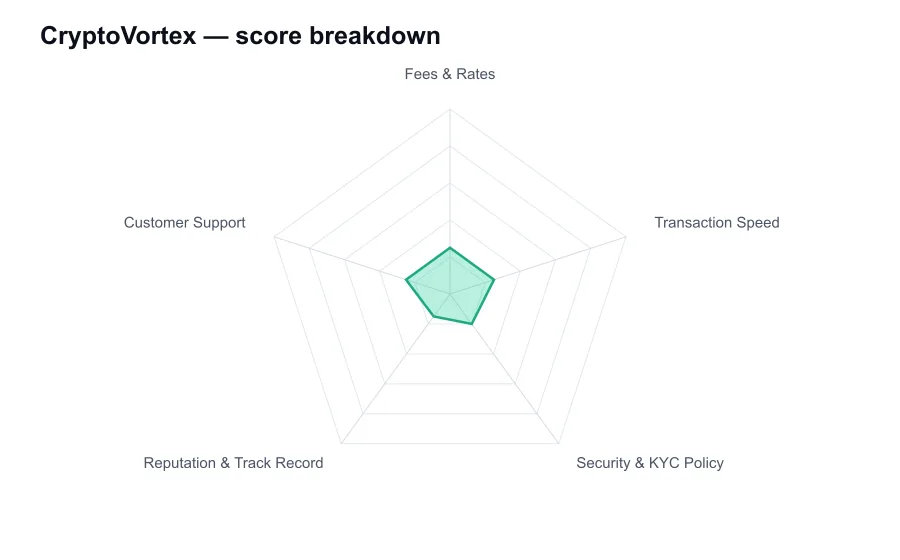
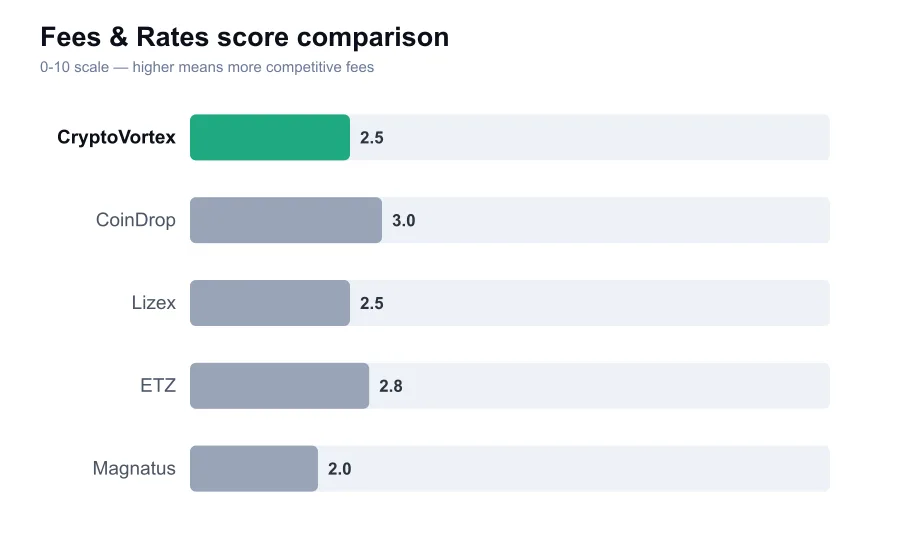
CryptoVortex scores 2.2/10 overall in our independent review, measured against every other provider we've compared, strongest on Fees & Rates (2.5/10) and weakest on Reputation & Track Record (1.5/10).
Unverified provider identity · Test-only risk profile · Independent verification required
CryptoVortex is the hardest provider in this group to recommend with confidence because the public identity behind the name is unclear and easily confused with unrelated crypto projects, communities, and promotional pages. In a market already crowded with lookalike brands, that is not a trivial flaw. A crypto exchange asks customers to send irreversible value. Before discussing rates or speed, a reviewer needs to know precisely who is operating the service and where its official customer channels are.
I could not establish enough reliable, independently verifiable information to treat CryptoVortex as a mature exchange provider with a confirmed long-term operating record. That does not prove the service is fraudulent or incompetent. It does mean the ordinary presumption of trust does not apply. A new or obscure financial service must earn credibility through clear ownership, consistent official documentation, transparent terms, and a visible history of resolved customer issues. A memorable name is not a substitute.
This distinction is particularly important because a search for a name can produce misleading confidence. Social profiles, review widgets, token pages, and affiliate articles can all be created quickly. They may refer to a different business, or they may merely repeat information supplied by the operator. The useful evidence is more demanding: a verifiable official domain, a legal entity where relevant, coherent terms, a support history, traceable security practices, and independent discussion that predates a marketing campaign.
For that reason, I cannot responsibly quote a claimed CryptoVortex trading fee, spread, asset list, or execution time as established fact. Precise numbers without a stable official source would be invention, not reviewing. Any customer considering the service should inspect the live transaction quote, identify which entity receives funds, and compare the offer against a well-known alternative. If a provider makes it hard to determine basic commercial terms before payment, the correct response is to walk away.
Fee opacity is not merely an inconvenience on a small platform. It can conceal a wide spread, a withdrawal charge, a minimum-output condition, or a change in the price after deposit. An honest exchange will show the amount sent, the amount expected, the rate type, the network fee treatment, and the circumstances in which a quote can be revised. If CryptoVortex offers these elements clearly on a verified official service, that is a minimum starting point, not a special achievement.
The right comparison is not with the most expensive platform you can find. Compare it with reputable venues that disclose their pricing. For spot trading, established exchanges publish maker and taker schedules. For instant swaps, reputable providers show a final estimated or fixed output before the customer pays. CryptoVortex has no reason to receive a pricing premium simply because its branding suggests speed or technical sophistication. Unknown providers need to be cheaper, clearer, or uniquely useful to justify the extra trust burden.
Speed claims deserve equal skepticism. Blockchain settlement is visible and measurable, but exchange processing is not. A service can generate a deposit address instantly and still take hours or days to deliver the return asset. Delays may be legitimate if liquidity is thin, a transaction needs compliance review, or a network is congested. The concern is not any delay by itself. The concern is a provider that offers no accurate status information, no realistic timing guidance, and no accountable support response when a delay happens.
There is no credible basis to rate CryptoVortex highly for speed without a substantial body of independently documented execution results. A polished dashboard cannot prove settlement quality. Nor can a handful of testimonials, especially where the reviewer cannot authenticate them. Users who need a time-sensitive conversion should use a platform with published service standards and a large record of real-world use. CryptoVortex should not be the venue for a payroll deadline, an OTC settlement, or a transfer connected to a purchase contract.
Security concerns are even sharper. With an unverified or poorly documented provider, the first threat is not necessarily a sophisticated hack. It is impersonation. Fraudulent sites can copy logos, create similar domains, and direct customers to addresses that have no connection to the service they expected. Never use a link sent through an unsolicited message, a direct-message promotion, or a sponsored social post without independently checking it. Do not allow remote access to your device to resolve a crypto problem.
A legitimate exchange should explain whether it is custodial, which assets it supports, how it handles suspicious transactions, and what happens if a deposit arrives on an unsupported network. It should also publish usable terms and a privacy policy. CryptoVortex has not built enough public, verifiable transparency for me to give it the benefit of the doubt on these basics. Until that changes, customers should assume that KYC, withdrawal restrictions, and manual review policies are uncertain rather than absent.
The lack of a verified reputation record is not something that can be offset by a promise of no KYC. In fact, no-KYC marketing often creates a false sense of safety. A service can request documents after a deposit if it flags the transaction, and an unaccountable operator may offer little clarity about release conditions. People who require regulated consumer protections should not use an unclear provider. People who value privacy should be just as demanding about operational transparency, because privacy is meaningless if funds are trapped.
Support is where obscure exchanges most often fail users. Before depositing anything, ask a specific question through a verified official channel. Ask which network is supported for the exact asset, whether a destination tag is required, and what happens if an order is flagged. A real response should be coherent, specific, and consistent with the published rules. Silence, evasive replies, pressure to deposit first, or requests to continue on an unverified messenger are strong reasons to stop.
I would not perform even a token test transaction until the official identity, domain, and terms have been confirmed from reliable sources. If those checks can be completed, the test should be genuinely small and should not involve a card, bank account, or personal documents. Watch for the deposit confirmation, the promised output, the transaction hash, and the quality of communication. Never send a second payment to unlock a first payment. Legitimate exchanges do not require surprise release, tax, insurance, or verification fees paid in crypto.
CryptoVortex may eventually develop a public record that supports a different judgment. At present, the cautious judgment is the only defensible one. There are too many established exchanges and instant-swap providers available to accept unclear ownership, uncertain policies, and unverified performance for a routine transaction. The possible upside of a convenient quote does not outweigh the downside of an irreversible transfer to an operator you cannot properly identify. Until transparency improves, my recommendation is to look elsewhere.
Who it suits
CryptoVortex is not a sensible choice for beginners, large transactions, time-sensitive settlements, or anyone who needs dependable support and clear compliance terms. Experienced researchers should only consider it after independently verifying an official domain, ownership details, and current terms, then using a very small test. Most users should choose an established exchange or recognized instant-swap provider instead.
The practical view
Strengths and trade-offs
What stands out
- Could become useful if transparent official documentation emerges
- A small test can reveal basic execution behavior
- No established advantage has been independently confirmed
What to weigh
- Unclear verified public identity
- No reliable fee and execution record
- High impersonation and counterparty-risk concern
- Not suitable for significant transfers
Scorecard
How the score is built
Verdict
My take on CryptoVortex
CryptoVortex does not clear the basic trust threshold I apply to a financial service handling irreversible crypto transfers. The problem is not that every obscure platform is bad. The problem is that uncertainty about identity, fees, security rules, and service quality leaves the customer carrying almost all the risk. A compelling quote cannot repair that weakness. Until there is strong independent evidence of transparent operations and dependable execution, avoiding it is the better decision.
Review questions
CryptoVortex FAQ
Is CryptoVortex safe to use?
I cannot verify enough public operational information to recommend it as safe. Verify the official identity and terms independently, or choose a more established provider.
What fees does CryptoVortex charge?
I would not rely on unverified claims about its fees. Check a confirmed official quote and compare the final amount received with established alternatives before sending funds.
Should I test CryptoVortex with a small transaction?
Only after you have independently verified the official service and its policies. Never send a large first transfer or pay an extra fee to release a prior transaction.
Reader experiences
What users report
Continue your comparison
Read across the full ranking before deciding which provider best fits your own needs.
Compare providers