Ranked #73 of 74 · Updated October 2026
Magnatus review
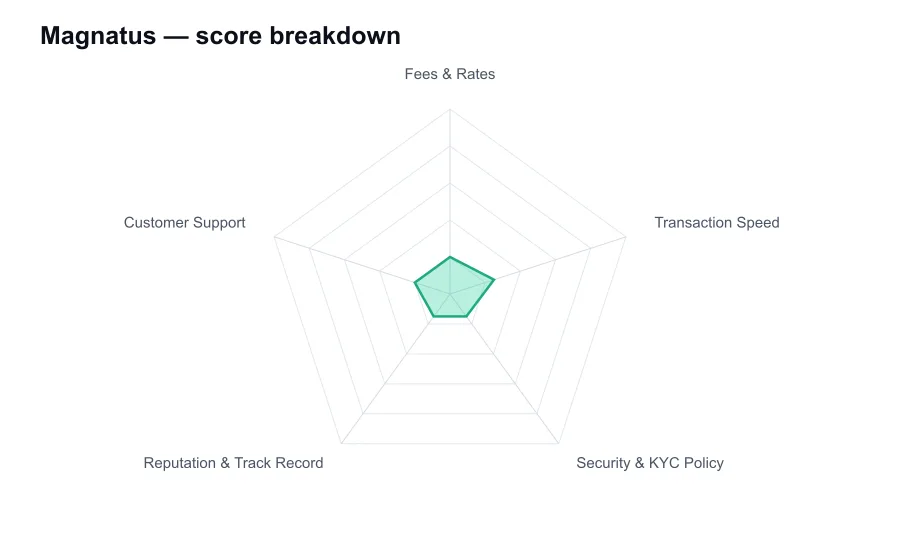
Magnatus scores 1.9/10 overall in our independent review, measured against every other provider we've compared, strongest on Transaction Speed (2.5/10) and weakest on Reputation & Track Record (1.5/10).
Limited public verification · Crypto transfer service · Unclear fee disclosure
Magnatus sits at the obscure end of the crypto exchange market, a name that does not carry the public footprint, regulatory visibility, or independently documented trading history of established venues such as Kraken, Coinbase, Bitstamp, or Binance. That does not automatically prove misconduct. It does mean a prospective customer has to begin from a position of caution rather than trust. In crypto, a thin public record is not a minor inconvenience. It is a material risk factor.
The first problem is basic verification. I could not establish a dependable public record of Magnatus as a widely recognised exchange operator, nor could I verify a transparent corporate history, named leadership team, audited reserve reporting, or a long-running record of service across major independent review channels. A serious platform should make it easy to identify who operates it, where the business is incorporated, what rules govern customer assets, and how complaints are handled. If those details are hard to find, that is the story.
Magnatus should not be judged by the polish of a landing page, an affiliate review, or a chat representative promising fast returns. Those are cheap to produce and common in the riskier corners of the market. The relevant questions are more boring and much more important: can customers withdraw without being pushed into an additional payment, are trading terms published before a deposit is made, and is there a verifiable legal entity standing behind the service? I found no strong public evidence that resolves those questions in Magnatus's favour.
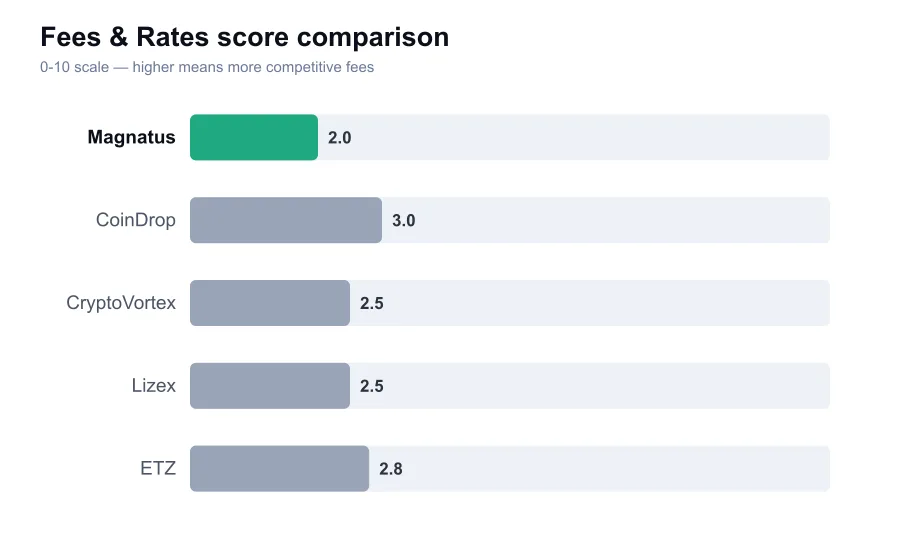
Fees are especially difficult to assess because I could not verify a durable, public fee schedule for Magnatus. That alone prevents an informed comparison with exchanges that state their maker and taker rates clearly. Kraken Pro, for example, publishes a volume-based schedule, while Coinbase and Bitstamp show their charges before an order is placed. A platform that quotes a vague service fee, promises zero commission without explaining the spread, or reveals a withdrawal charge only after funds arrive is not offering a competitive price. It is asking the customer to accept an unknown price.
The spread is where many lightly documented exchange services become expensive. A platform can advertise no trading fee yet mark up the quoted conversion rate far beyond the cost visible on deep, liquid markets. Without order books, clear execution records, or a published pricing methodology, it is impossible to separate a fair retail spread from an opportunistic one. For someone converting a small amount of bitcoin, that uncertainty is irritating. For someone sending a five figure sum, it is unacceptable.
Transaction speed also cannot be rated generously just because crypto transfers can settle quickly on a blockchain. Network settlement and provider processing are different things. Bitcoin confirmations may take from minutes to considerably longer depending on fees and congestion. Stablecoin transfers can be rapid on networks such as Tron or Solana. None of that tells a customer how long Magnatus takes to approve an account, release a withdrawal, review a flagged transaction, or answer a compliance query. Those are the delays that decide whether a service feels reliable.
A legitimate provider normally states its processing windows, any cut-off times, the number of blockchain confirmations required, and whether withdrawals are reviewed manually. Magnatus does not appear to have a well-established public operations record that lets me test those claims against a meaningful body of user reports. That leaves its speed score below average. It is not a claim that every transfer will be delayed. It is a recognition that there is too little independently verifiable evidence to tell a customer what will happen when a withdrawal matters.
Security is the central concern. The phrase no-KYC can sound attractive to privacy-minded users, but it is not a substitute for good custody, lawful operation, transaction controls, or clear customer protections. Nor is KYC inherently proof of quality. What matters is whether a provider explains its identity checks, privacy policy, sanctions screening, source-of-funds process, data retention, and appeal route. I could not verify a sufficiently clear Magnatus policy framework on these points.
There is also no widely known evidence of proof of reserves, independent security audits, public penetration-test reporting, insurance arrangements, or a transparent custody model tied to Magnatus. Major exchanges have had their own failures and controversies, but the better ones at least provide substantial documentation and a long enough history for outside observers to assess their practices. Magnatus does not offer that reassurance through its public reputation. Customers should never assume that deposited assets are segregated, insured, or recoverable unless the operator proves it in writing.
The risk rises sharply if anyone associated with the service asks for a tax payment, activation fee, verification deposit, liquidity release charge, or further cryptocurrency transfer before allowing a withdrawal. Those requests are classic danger signals across crypto fraud cases. Genuine compliance checks may delay or reject a transaction, but a legitimate exchange should not turn a withdrawal into an escalating series of fresh payments. Anyone facing such a demand should stop sending funds, preserve all messages and transaction IDs, and seek help from their bank, wallet provider, and relevant fraud-reporting authority.
Reputation is not merely about star ratings. It is about surviving market stress, publishing incident notices, responding to criticism in public, and building a record that can be checked years later. Magnatus does not appear to have that kind of track record. A handful of promotional mentions or anonymous testimonials cannot replace a documented operational history. This is a market where a company handling customer money needs to earn credibility repeatedly, not simply request it.
Support is another area where the absence of reliable public evidence matters. Fast chat replies before a deposit are not the same thing as effective support after a withdrawal hold. Good support means a real ticket trail, clear escalation routes, plain-language explanations, and staff who can resolve issues without pressuring customers to send more assets. I could not verify that Magnatus offers this standard consistently. That makes its support score cautious rather than neutral.
If you are already interacting with Magnatus, do not test it with your savings. Verify the destination wallet, start only with an amount you can afford to lose, retain screenshots of every quote and conversation, and never share a seed phrase or remote access to your device. Better still, use an exchange whose legal identity, trading fees, withdrawal rules, and support process are all independently checkable before sending any money.
Magnatus has not earned a recommendation from me. The issue is not that every little-known exchange must be malicious. The issue is that a financial intermediary with an unclear public record asks users to shoulder risks they do not need to take. Better documented alternatives exist, including regulated local exchanges for fiat access and large self-custody-friendly platforms for straightforward crypto purchases. Until Magnatus can demonstrate transparent ownership, published terms, robust customer protections, and a credible record of withdrawals, it belongs in the avoid category for most users.
Who it suits
Magnatus is not a sensible choice for beginners, high-value traders, or anyone converting fiat savings into crypto. Experienced researchers may inspect it only after independently verifying the operator and testing a trivial amount, but even that is hard to justify with better-known options available. Users who value transparent fees, dependable withdrawals, and accountable support should choose a regulated exchange with a long public history.
The practical view
Strengths and trade-offs
What stands out
- Crypto-focused service concept
- May appeal to users seeking alternatives to major venues
- No confirmed mandatory fee structure located
What to weigh
- Unclear corporate and regulatory identity
- No verified public fee schedule
- No established proof-of-reserves record
- Thin independent reputation trail
Scorecard
How the score is built
Verdict
My take on Magnatus
Magnatus has too many unanswered questions for a service that may take custody of customer assets. The lack of a clearly verifiable operating record matters more than any appealing quote or promise of quick conversion. Its scores reflect missing evidence, not a presumption that every user will have a bad experience. Still, sensible crypto risk management is about avoiding avoidable uncertainty. This is a provider I would pass over until it supplies far stronger public documentation and an independently credible track record.
Review questions
Magnatus FAQ
Are Magnatus fees publicly verifiable?
I could not confirm a stable, transparent public schedule covering trading, spreads, and withdrawals. Get the full cost in writing before sending funds.
Is Magnatus safe to use?
Its safety cannot be established from a well-documented public record. Do not assume deposits are insured, segregated, or protected without verifiable evidence.
What should I do if a withdrawal requires another payment?
Stop sending funds. Preserve chats, wallet addresses, receipts, and transaction hashes, then contact your payment provider and local fraud-reporting authority.
Reader experiences
What users report
Continue your comparison
Read across the full ranking before deciding which provider best fits your own needs.
Compare providers