Ranked #40 of 74 · Updated October 2026
Coinomi review
Coinomi scores 5.9/10 overall in our independent review, measured against every other provider we've compared, strongest on Reputation & Track Record (6.5/10) and weakest on Customer Support (5.5/10).
Self-Custody · Multi-Asset Wallet · No-KYC Wallet · In-App Swaps
Coinomi is primarily a multicurrency self-custody wallet, not a conventional crypto exchange. That distinction changes how it should be judged. It lets users hold a large range of assets and access swap services from inside the wallet, but Coinomi itself is not the party matching every trade, setting a universal order book or holding a customer cash balance. People expecting Binance-style spot trading may be disappointed. People wanting one wallet for many chains may find it practical.
The wallet has been around since 2014, which gives it more history than most wallet brands still competing for attention. It supports a broad collection of coins, tokens and networks, and it is available across mobile and desktop environments. The interface is less fashionable than some newer wallets, but it gets the basic job done. Coinomi's appeal is breadth and familiarity rather than cutting-edge DeFi tooling.
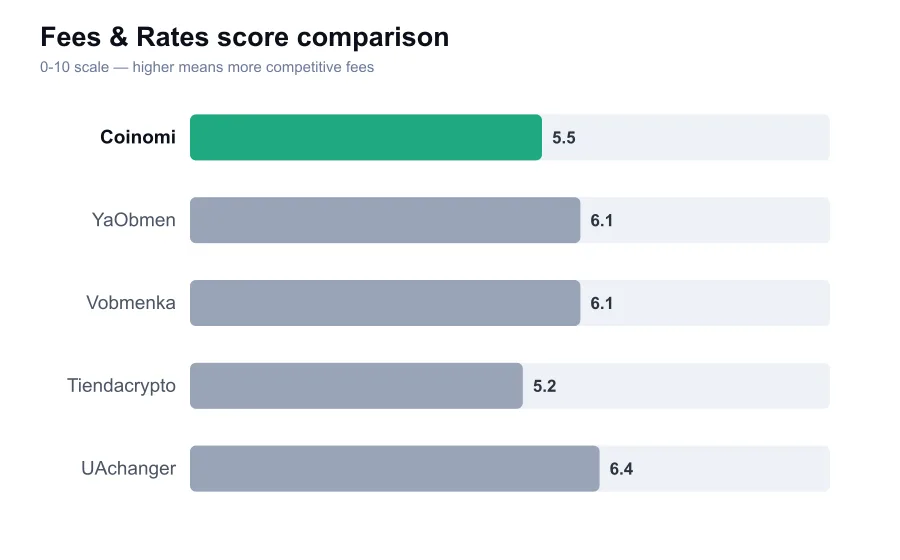
Fees are the part that needs the most careful reading. Receiving and holding assets in a self-custody wallet does not carry a Coinomi custody fee. Sending crypto requires the relevant network fee, which goes to miners or validators rather than functioning as a simple Coinomi commission. Bitcoin and Ethereum fees can be expensive at busy times regardless of which wallet is used. Coinomi gives users fee controls for supported networks, though choosing too low a fee can delay confirmation.
The in-app exchange function is different. Swaps are fulfilled by third-party exchange providers and the rate shown can include provider fees and market spread. Coinomi does not offer the transparent maker and taker schedule that an order-book exchange publishes. For a small convenience swap, that may be acceptable. For a large trade, it is a weak deal unless the user compares the quote with a centralized exchange, a decentralized exchange, or another aggregator first.
This is the central criticism of Coinomi as an exchange provider. You often get a final quote rather than a clean breakdown of spread, service fee and execution venue. That makes price discovery harder. Users who care about execution quality should not assume that an embedded swap is competitive just because it is convenient. Coinomi works better as a place to manage assets than as the default venue for frequent conversion.
Transaction speed depends almost entirely on the asset and the chosen provider. A swap may begin promptly after wallet confirmation, but completion can range from minutes to longer if the source or destination chain is busy. A Bitcoin transfer with a modest fee may take multiple blocks. Ethereum activity can stall behind gas conditions. Coinomi cannot make an external blockchain settle faster, and third-party exchange processing adds another variable.
The wallet's security model is self-custody. Private keys and recovery information are controlled by the user rather than stored as a normal exchange account balance. Coinomi has historically emphasized local encryption and a hierarchical deterministic wallet structure. That is a meaningful advantage over leaving funds permanently on a trading platform. It also creates a brutal failure mode: lose the recovery phrase or expose it to a scammer, and there is no practical support ticket that restores the money.
Coinomi does not ordinarily require KYC to create and use a wallet. Some integrated swap providers may request verification depending on the jurisdiction, transaction size, asset, compliance rules or risk review. Users should not confuse Coinomi's wallet privacy with a promise that every third-party conversion is anonymous. The exact experience can change by provider and country, which is another reason to inspect the terms before sending funds.
Its track record is mixed rather than spotless. Coinomi's longevity is a genuine positive, and it remains recognizable among multi-asset wallet users. But a 2019 disclosure involving a wallet recovery phrase being transmitted through a spell-check service damaged confidence, even though Coinomi addressed the issue. That event matters because wallet software has one job above all else: it must not expose secrets. A long operating history should not erase a serious past security concern.
The sensible security setup is to treat Coinomi as a hot wallet. Keep only the amount needed for active use, secure the phone or computer, write the recovery phrase offline, and verify downloads through official sources. For substantial long-term holdings, a hardware wallet with a conservative operating routine is the better answer. Coinomi may be useful for managing assets, but convenience software should not become a vault by accident.
Support is available through help material and ticket-based channels, but self-custody limits what any support team can do. Staff can help diagnose sync, display or transaction questions. They cannot reverse an onchain payment, retrieve a seed phrase, or safely take possession of your keys. Reports about response experiences vary, which is common with wallet providers, and the lack of live phone support leaves less technical users with a steep learning curve.
Coinomi is often compared with Exodus, Trust Wallet and Atomic Wallet. Compared with Exodus, Coinomi feels more utilitarian and less polished. Compared with Trust Wallet, it is not as deeply tied to a major exchange ecosystem. Its long list of supported assets remains useful, but asset count is not a security feature and not a reason by itself to install another wallet.
I would use Coinomi for modest balances, legacy coin support and the occasional conversion where the quoted rate is clearly acceptable. I would not use it as my primary venue for large swaps, nor would I keep retirement-sized holdings in it. The wallet does enough well to remain relevant, but its exchange layer is convenience-first and its historic security blemish demands a cautious attitude.
Coinomi is neither a scam nor a magic all-in-one solution. It is an established self-custody wallet with broad support and practical built-in services, wrapped around trade-offs that users should see clearly. Its best use is as a flexible tool in a wider crypto setup. If transparent trading fees, bank transfers and strong account support matter most, a regulated exchange will serve you better.
Who it suits
Coinomi fits users who want a long-established multicurrency hot wallet and already understand seed phrase security. It can be useful for smaller balances, older assets and occasional swaps. Active traders, high-value holders and users needing fiat deposits or clear order-book pricing should choose a reputable exchange and a hardware wallet instead.
The practical view
Strengths and trade-offs
What stands out
- Large range of supported assets
- Self-custody wallet model
- No standard wallet KYC
- Built-in third-party swap access
What to weigh
- Swap pricing lacks exchange-style transparency
- Past recovery phrase security incident
- Not ideal for large or frequent trades
- No recovery for lost seed phrases
Scorecard
How the score is built
Verdict
My take on Coinomi
Coinomi's broad asset support and long history keep it useful, but it is easy to overrate the convenience of an in-wallet swap. The wallet is strongest as a self-custody management tool, not as a serious trading venue. Its past security incident is not a reason to dismiss it automatically, but it is a reason to use good wallet hygiene and limit exposure. There are better choices for polished trading and cold storage.
Review questions
Coinomi FAQ
Does Coinomi charge a fee to receive crypto?
Coinomi does not normally charge a wallet custody fee for receiving crypto. Sending funds requires the relevant blockchain network fee, and in-app swaps can include third-party provider fees and spread.
Does Coinomi require KYC?
Creating and using the wallet normally does not require KYC. An integrated exchange partner may request identity verification based on its own rules, your country or transaction details.
Is Coinomi safe for long-term storage?
It is a self-custody hot wallet, so safety depends heavily on your device and seed phrase practices. For large long-term holdings, a reputable hardware wallet is generally the safer approach.
Reader experiences
What users report
Continue your comparison
Read across the full ranking before deciding which provider best fits your own needs.
Compare providers