Ranked #38 of 74 · Updated October 2026
UAchanger review
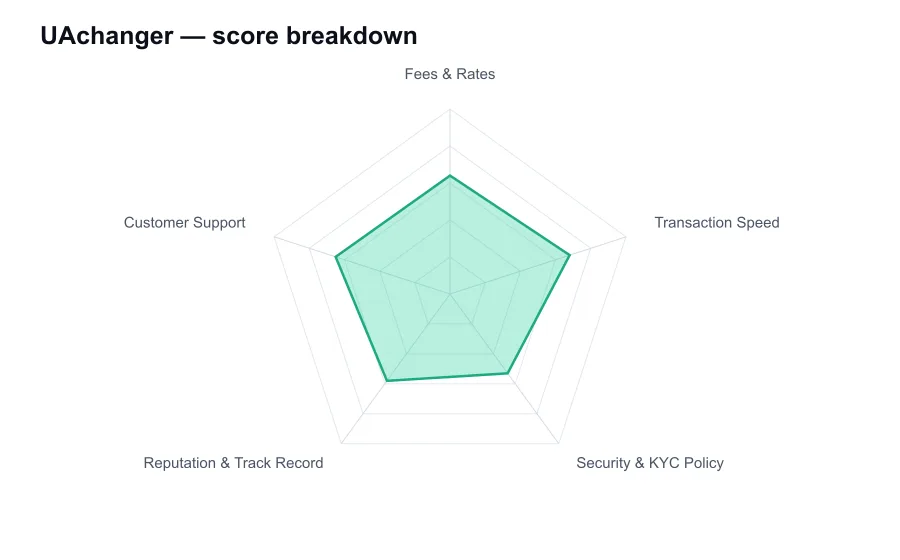
UAchanger scores 6.1/10 overall in our independent review, measured against every other provider we've compared, strongest on Transaction Speed (6.8/10) and weakest on Security & KYC Policy (5.3/10).
Direct exchange orders · Crypto and e-money routes · Manual order assistance · No trading terminal
UAchanger sits in the familiar Eastern European exchange-service niche: a lightweight conversion desk rather than a full custodial crypto platform. It is aimed at people who want to move between crypto, electronic money systems, and sometimes local payment rails without opening a trading account. That focus is useful, but it also means buyers should judge it as an exchange counterparty, not confuse it with a regulated brokerage or a major global exchange.
The site experience is built around selecting a direction, entering an amount, and receiving a quote. That sounds ordinary, but the practical value lies in whether a service can keep its quoted rate through a volatile market move. UAchanger appears more like a manual or semi-automated exchanger than an instant-swap protocol. A request can be straightforward, yet the final pace may depend on reserve availability, bank processing, and an operator checking the transaction.
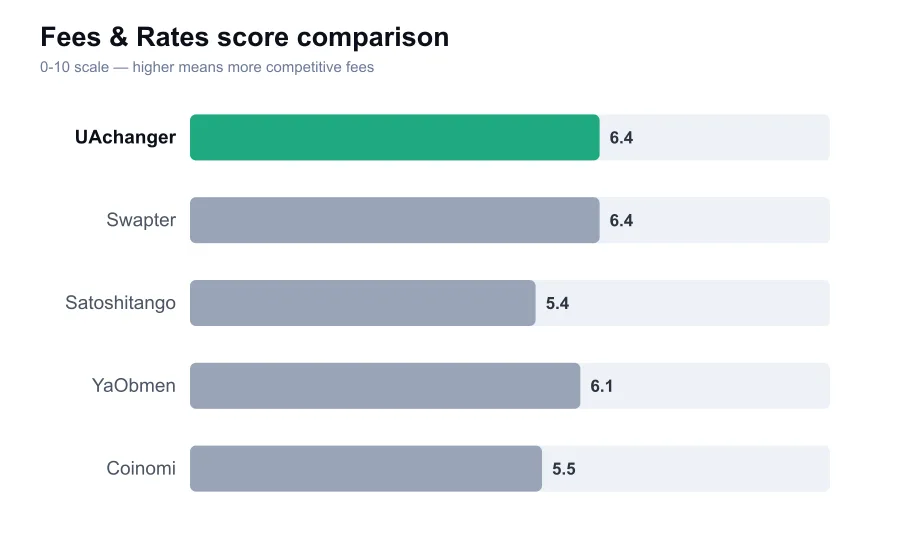
Its rate presentation is usually more important than any advertised service fee. Small exchangers often bake their margin into the conversion rate, and UAchanger should be assessed exactly that way. Before sending funds, compare the final receive amount against two or three alternatives on a monitoring service and against a large exchange's spot price plus withdrawal cost. A quote that looks fee-free can still be expensive if the spread is wide.
For common, liquid directions, UAchanger can be reasonably priced. It is not where I would expect the market's absolute best rate every hour, especially on a weekend or for an unusual payment method. The service is more competitive when convenience and local settlement matter more than shaving a fraction of a percent from the trade. For a large conversion, asking support whether the rate can be fixed is sensible. A poor spread on a five-figure exchange quickly outweighs the convenience.
Minimums and reserves deserve more attention here than they would on Binance, Kraken, or Coinbase. A rate calculator can show an attractive result even while a particular receiving method has a limited reserve. If the reserve is tight, an order can become a support conversation rather than a quick exchange. Check the available reserve, read the payment instructions before creating the order, and do not assume an advertised direction means unlimited capacity.
Speed is good enough for routine crypto transfers, but it is not a service I would use with a hard deadline. A blockchain confirmation, especially on Bitcoin or a congested network, is only the first stage. The exchange still needs to process the order and send the outgoing payment. Crypto to crypto directions can complete quickly after required confirmations, while card, bank, and e-money payouts may take longer because those systems have their own checks and schedules.
The practical test for speed is communication during exceptions. A smooth order tells you little. The more revealing cases are an underpayment, a wrong payment reference, a delayed confirmation, or an amount sent after the quote window. UAchanger's model leaves room for human intervention, which can solve odd cases but also means processing is not as predictably automated as an on-chain swap. Keep the order ID, transaction hash, and screenshots of the quoted terms.
Security is the area where this type of provider needs the most sober assessment. UAchanger is not a self-custody tool. You send assets to an address controlled by the service, then rely on it to send the other side. That counterparty exposure is brief, but it is real. There is no public proof-of-reserves standard, major independent security audit, or institutional-grade disclosure that would put it in the same trust category as the best known regulated venues.
The absence of routine account registration can be attractive to privacy-minded users, but it should not be mistaken for a guarantee of anonymity. Exchange services can request verification when an order triggers anti-fraud or compliance checks, particularly where bank cards, suspicious transaction patterns, or third-party payments are involved. Anyone who cannot tolerate a potential KYC request should not send a large amount first and hope the transaction stays frictionless.
UAchanger's public standing is best described as functional but limited. It has the kind of visibility associated with exchange-monitoring listings and repeat retail use, rather than the long, independently documented operating record of a household-name exchange. That is not a reason to call it unsafe by default. It is a reason to keep position size sensible. A modest test order tells you more about the current operating condition than an old review score ever can.
I would also separate customer reviews into useful and weak evidence. Specific reports that name a direction, an amount range, a date, and how support solved an issue are helpful. Generic praise is not. Complaint patterns matter more than isolated anger, particularly allegations of changed rates, delayed payouts, or sudden verification requests. A service in this market will always receive some complaints. The question is whether it explains problems clearly and resolves them in a documented way.
Support appears central to the product rather than an optional extra. That is a positive, because a smaller exchanger cannot hide behind a maze of automated help pages. Still, availability is not the same thing as response quality. Before placing a meaningful order, I would send a concrete question about the intended direction, expected processing window, and whether a fixed rate applies. The clarity of that reply is a practical due-diligence signal.
There are sensible ways to use UAchanger. Send from a wallet you control, verify every receiving detail, avoid third-party payments, and start with a small amount if the route is new to you. Do not split a large transaction into improvised partial payments unless support explicitly instructs it. Make sure the amount you send matches the order terms, because small deviations can create a manual reconciliation problem.
My view is that UAchanger is a plausible convenience exchanger for users who understand the risks of noncustodial-looking but counterparty-based swaps. It is not a place to park funds, and it is not the best choice for someone who needs deep liquidity, formal regulatory protections, or guaranteed execution at a published institutional rate. Used carefully for ordinary conversions, it can be practical. Used casually for a large, time-sensitive transfer, it asks for more trust than its public transparency fully earns.
Who it suits
UAchanger fits experienced retail users making modest crypto or e-money conversions who are willing to compare quotes and test a route first. It can also suit people who value a direct exchanger over a full exchange account. Traders seeking deep liquidity, API execution, or a heavily regulated venue should look elsewhere. It is a poor fit for anyone unable to accept a possible manual review.
The practical view
Strengths and trade-offs
What stands out
- Useful for direct exchange directions
- No full trading-account workflow
- Can suit local payment conversions
- Human support can resolve odd orders
What to weigh
- Rates may include a meaningful spread
- No institutional-level transparency
- KYC can still be requested
- Large orders depend on available reserves
Scorecard
How the score is built
Verdict
My take on UAchanger
UAchanger is useful in the narrow role it appears built for, quick retail conversions where a conventional exchange is inconvenient. Its strongest point is practical simplicity, not unusually strong transparency or protection. Price-check every significant order, because the real cost is likely to sit in the rate rather than a clean headline fee. I would use it for a tested, ordinary route with a controlled amount. I would not treat it as a primary trading venue or a wallet.
Review questions
UAchanger FAQ
Does UAchanger require KYC?
A routine order may not require a full account process, but verification can be requested for compliance or anti-fraud reasons. Do not assume every transaction is anonymous.
How fast is a UAchanger order?
Timing depends on the asset, network confirmations, reserve, and payout method. Crypto transfers may be quick after confirmation, while bank or e-money payouts can take longer.
How should I check UAchanger's rate?
Compare the final amount you will receive against several live alternatives. Check network fees, minimums, reserve, and whether the quote is fixed or floating.
Reader experiences
What users report
Continue your comparison
Read across the full ranking before deciding which provider best fits your own needs.
Compare providers