Ranked #10 of 74 · Updated October 2026

EasyBit review
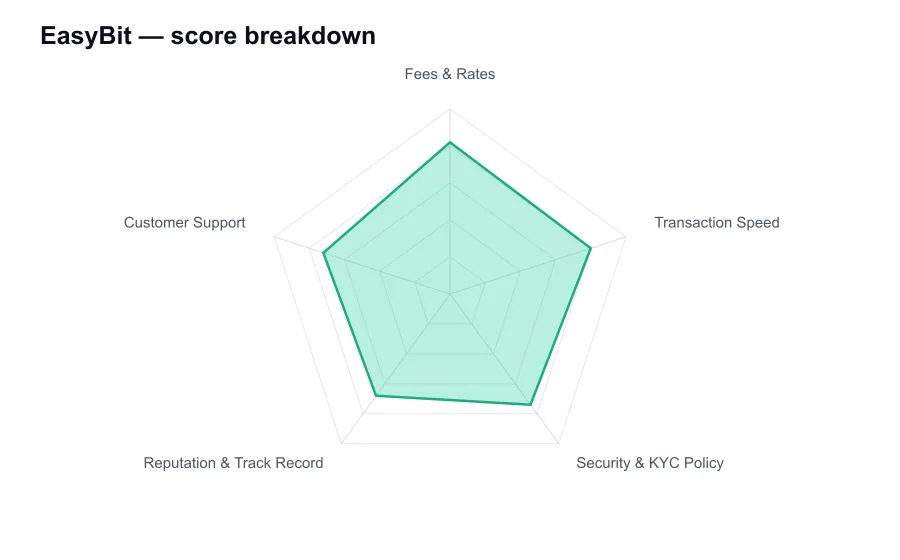
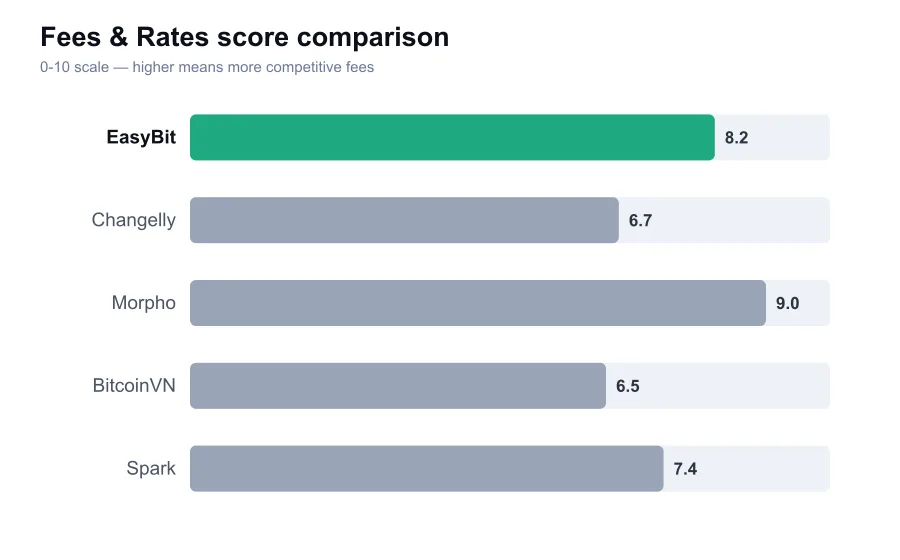
EasyBit scores 7.6/10 overall in our independent review, measured against every other provider we've compared, strongest on Fees & Rates (8.2/10) and weakest on Reputation & Track Record (6.8/10).
No-account swaps · Fixed-rate exchanges · Floating-rate exchanges · 24/7 support
EasyBit is a non-custodial instant crypto exchange aimed at people who want to swap one asset for another without opening a trading account. It sits in the same broad category as ChangeNOW, SimpleSwap, StealthEX, and Changelly, but it has built its pitch around a relatively polished interface, rapid quoting, and a low-friction approach to identity checks. This is not a venue for limit orders, charts, or active trading. It is a conversion desk, and it should be judged as one.
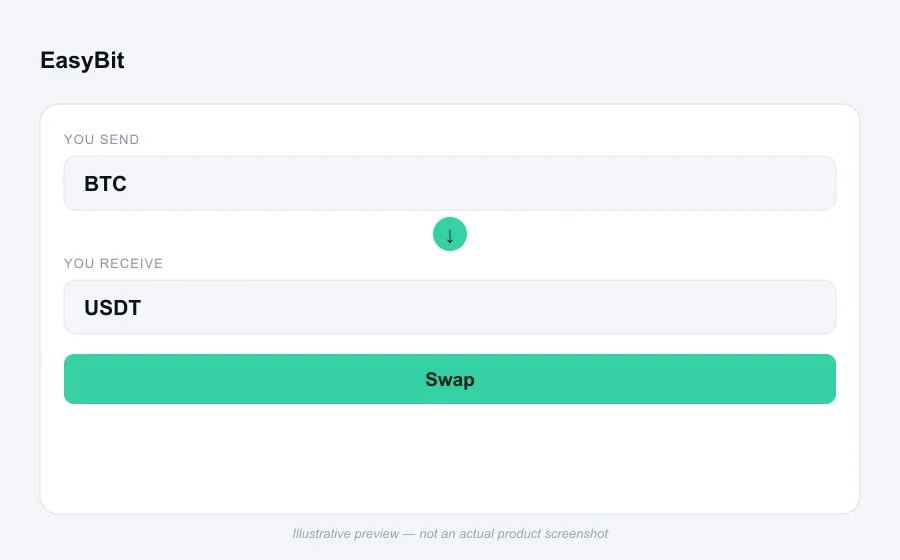
The first thing EasyBit gets right is clarity during the swap flow. You choose the asset you are sending, the asset you want to receive, paste a destination address, and get a quote before sending funds. That sounds basic, but plenty of instant exchanges still make network choices and rate types more confusing than they need to be. EasyBit's layout is calm and readable, which matters when a mistaken network selection can turn a routine exchange into a support ticket.
Its advertised service fee has commonly been 0.2 percent on exchange transactions, although the number that matters is the final quote, not the headline. Crypto swaps involve provider spreads, liquidity partner pricing, and blockchain mining fees. A 0.2 percent service charge can still produce a less attractive conversion than a competitor if the quoted market rate is weak. I would not assume EasyBit is cheapest simply because its published fee is low.
In small test-sized swaps, EasyBit can be competitive, especially on common pairs such as BTC to ETH, ETH to USDT, or USDC to SOL. The comparison becomes less flattering on thinly traded coins, where liquidity costs can dwarf the visible platform fee. That's normal for this business model, but EasyBit doesn't escape it. Before committing a larger amount, check its final output against at least ChangeNOW and a major exchange's spot market after withdrawal fees.
Fixed-rate swaps are one of the better reasons to use the service. A fixed quote reduces the risk that a fast-moving market will eat into the amount you receive between sending your coins and execution. There is usually a time window attached to that promise, and users need to send the exact requested amount promptly. Send late, send too little, or send on the wrong chain and the fixed-rate protection may no longer apply.
Floating-rate swaps are generally better suited to liquid assets in quiet markets. They can settle with a marginally better result if the market moves in your favor, but they leave the user carrying price movement risk. EasyBit makes the distinction visible enough that a careful user can choose intelligently. I still think too many newcomers click through it without understanding that the quoted output is not necessarily guaranteed under a floating rate.
Speed is good, rather than miraculous. Once a deposit is detected and has the needed network confirmations, common swaps often complete in roughly five to twenty minutes. Bitcoin transactions can take longer because confirmation time is not under EasyBit's control. Ethereum and congested token networks can also slow the process. Any provider promising instant settlement across every chain is overselling what happens after the user broadcasts a transaction.
The exchange is non-custodial in the important sense that it does not hold an ongoing account balance for users. Funds are sent for a specific exchange and forwarded after processing. That structure reduces the danger of leaving assets parked at a centralized platform, but it does not eliminate counterparty risk. During the swap, EasyBit and its liquidity partners are still handling execution, so users should not confuse non-custodial with trustless.
EasyBit generally markets exchanges without mandatory account registration or routine KYC. That is useful for privacy-minded users and for people who simply don't want to upload documents for a modest conversion. Still, its compliance policy allows it to request identification or source-of-funds information in flagged cases. This is standard across serious instant exchanges. Anyone who treats no-KYC marketing as a guarantee that no transaction will ever be reviewed is taking an unnecessary risk.
That conditional KYC process is the area where users need realistic expectations. If a transaction is flagged by risk controls, funds can be held while the case is reviewed. The frustrating part is not unique to EasyBit, but it is inherent to the sector's relationship with blockchain analytics and liquidity providers. Don't use any instant exchanger for coins tied to gambling sites, mixers, suspicious counterparties, or activity you may struggle to document.
EasyBit's security posture looks sensible for its model, with HTTPS protection, no required customer wallet custody, and transaction-specific addresses. Yet its public track record is shorter and less independently documented than that of the oldest brands. It does not have the reputation depth of Changelly, and it has nowhere near the transparency or regulatory footprint of a large centralized exchange. That doesn't make it unsafe, but it should affect the size of swaps you are comfortable placing.
Support is available around the clock through live chat and email channels, and the company has been fairly responsive in ordinary pre-swap questions. The real test is an exception, such as an underpayment, an AML hold, or a missing destination tag. Public feedback suggests normal cases are often handled quickly, while complex compliance cases can become slower and more procedural. That pattern is familiar, but it is still where customer confidence is won or lost.
The service deserves credit for not burying the basics. Exchange IDs, status pages, rate modes, and destination details are presented in a way that gives users a useful paper trail. Save screenshots of the quote and exchange ID anyway. If something goes wrong, exact transaction hashes, timestamps, and address details will help far more than a vague description of a delayed order.
My view is that EasyBit is a capable option for straightforward, medium-sized swaps by people who understand wallets and networks. Its fee structure is attractive, its interface is better than many smaller competitors, and its no-account flow has real appeal. I would not use it blindly for a very large conversion, obscure tokens, or funds that could trigger compliance questions. For routine exchanges, it earns a place on the shortlist, but it has not yet earned the unquestioned trust that comes with a longer public record.
Who it suits
EasyBit fits self-custody users making straightforward swaps between major assets, especially those who value a simple no-account flow. It also suits users who want to choose a fixed quote before sending. Large-volume traders should compare executable quotes with major exchanges first. Anyone unable to provide documentation if a transaction is flagged should avoid instant exchange services entirely.
The practical view
Strengths and trade-offs
What stands out
- Competitive advertised 0.2% service fee
- Clear fixed-rate and floating-rate choices
- No routine account registration
- Polished, beginner-friendly swap flow
What to weigh
- Final quotes can vary by liquidity and asset
- Compliance reviews can delay flagged orders
- Shorter track record than leading rivals
Scorecard
How the score is built
Verdict
My take on EasyBit
EasyBit is better than many small instant exchangers because the product feels deliberate rather than thrown together. Its published fee is appealing, and the fixed-rate option is genuinely useful in volatile markets. The limitation is confidence at scale: it has less public history than established names, and no-KYC does not mean no compliance intervention. Use it for normal, well-documented swaps and keep transaction records. It is a strong practical tool, not a place to abandon caution.
Review questions
EasyBit FAQ
Does EasyBit require KYC?
Routine swaps generally do not require account registration or automatic KYC. EasyBit may request identification or transaction information where its risk controls flag an exchange.
What fee does EasyBit charge?
EasyBit has advertised a 0.2% service fee. The actual cost also reflects the quoted exchange rate, liquidity spread, and blockchain network fees.
How long does an EasyBit swap take?
Many common swaps complete in five to twenty minutes after the deposit receives required confirmations. Bitcoin, congested networks, and compliance checks can take longer.
Reader experiences
What users report
Continue your comparison
Read across the full ranking before deciding which provider best fits your own needs.
Compare providers