Ranked #12 of 74 · Updated October 2026

Morpho review
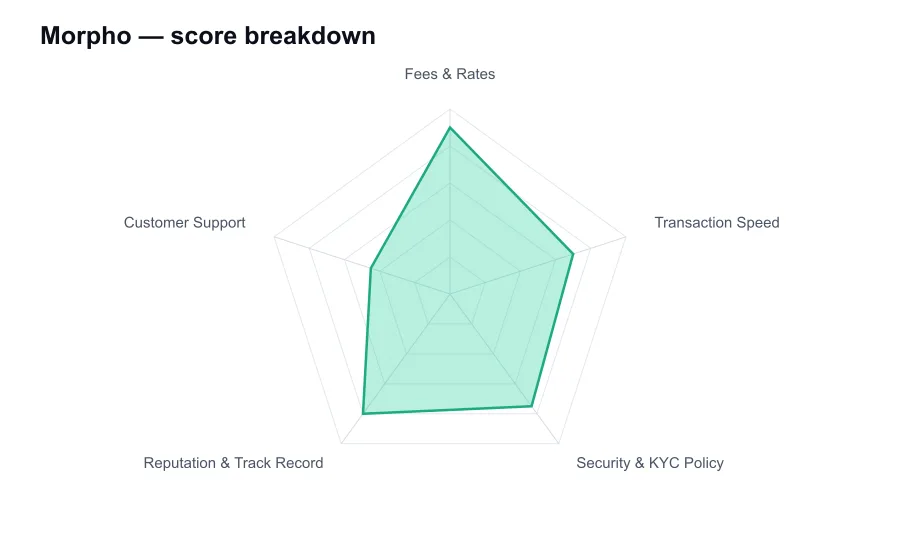
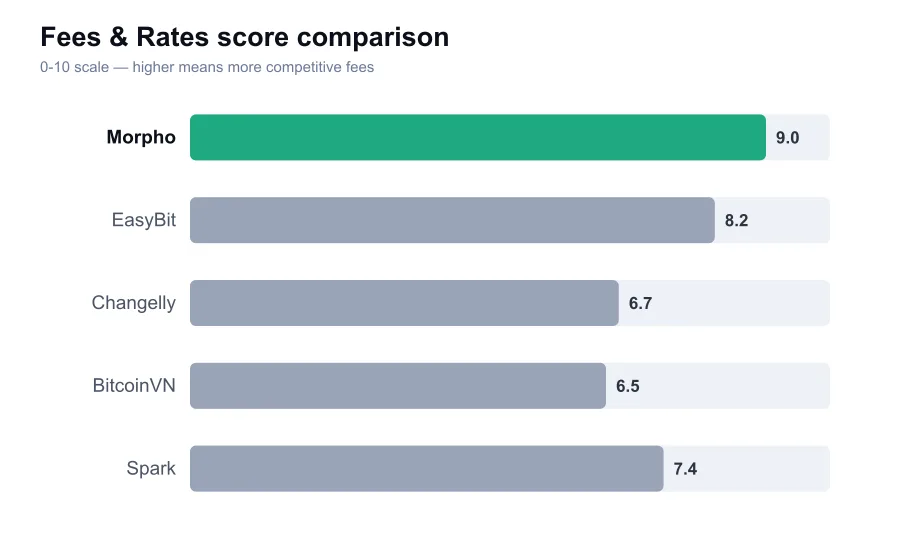
Morpho scores 7.6/10 overall in our independent review, measured against every other provider we've compared, strongest on Fees & Rates (9.0/10) and weakest on Customer Support (4.5/10).
Permissionless lending markets · No-KYC · Isolated collateral markets · Curated yield vaults
Morpho is a decentralized lending protocol that has become one of the more serious attempts to improve on the familiar Aave and Compound model. It started by optimizing peer-to-peer matching around existing lending pools, then evolved into Morpho Blue, a permissionless lending primitive built around isolated markets. The practical result is a platform where users can lend assets for yield or borrow against collateral without handing custody to a company. It is not a simple savings account, and anyone treating it like one is missing the point.
Morpho Blue is deliberately minimal. Markets are defined by a loan asset, collateral asset, liquidation loan-to-value ratio, oracle, and interest rate model. This design avoids a giant shared pool where the risk of one listed asset can spread across every participant. Isolation is a meaningful improvement for risk control. If a particular market is poorly configured or its collateral fails, that problem should be confined to that market rather than threatening all deposits across the protocol.
The cost structure is excellent, at least at the protocol layer. Morpho Blue itself does not impose a protocol fee on borrowing and lending. Borrowers pay interest determined by the selected market's interest rate model, while lenders receive the resulting yield subject to the mechanics of a vault or market. Users still pay blockchain gas and may face fees imposed by vault curators or other integrated applications. Calling Morpho free would be misleading, but it is often cheaper and more transparent than products with a large hidden spread.
Interest rates are not fixed unless a specific market structure says otherwise. They react to utilization and the chosen rate model. That means a borrower can open a position at an attractive annual rate and later see the cost rise as utilization climbs. Lenders have the opposite experience, where a compelling yield can fall when demand changes. Morpho displays market data, but users should read the rate model rather than relying on one annual percentage figure shown at a convenient moment.
MetaMorpho vaults make the protocol more approachable, but they add a layer of judgment. Rather than choosing individual markets, a lender deposits into a vault managed by a curator, which allocates funds across selected Morpho Blue markets. This can diversify exposure and improve capital use. It also introduces curator risk. A vault's performance and safety depend on the manager's market selection, parameter discipline, and response during stress. The vault name is not a substitute for reviewing what it actually holds.
Borrowing on Morpho can be efficient, especially for sophisticated users with ETH, WBTC, or other accepted collateral. The isolated-market architecture lets markets be built for specific risk preferences rather than forcing every user into one compromise. But leverage is leverage. If collateral falls below the liquidation threshold, anyone can liquidate the position according to the market rules. The protocol does not care whether the borrower intended to hold for five years. A fast price move can end the position long before a long-term thesis plays out.
Speed is reasonable but chain-dependent. Morpho's major activity has been centered on Ethereum, where finality and gas costs are not trivial. A deposit, borrow, repayment, or withdrawal settles when the underlying chain confirms it. In ordinary conditions that can mean minutes rather than seconds. Morpho deployments and integrations on networks such as Base improve the day-to-day experience substantially, but the exact speed depends on which front end, market, and chain a user selects.
Execution itself is straightforward compared with a DEX route. The main delay is not matching a trade, it is onchain confirmation and, in some cases, vault liquidity. A lender in a vault may not always be able to withdraw every dollar instantly if capital is actively loaned out. That is not necessarily a flaw. It is the economic reality of lending. Still, users who need instant access to their funds should favor markets and vaults with visible idle liquidity rather than assuming a deposit is equivalent to cash.
Security is one of Morpho's stronger areas, though it should not receive a perfect score. The protocol has undergone audits, uses a deliberately small core design, and has attracted significant scrutiny from technical users and institutional DeFi participants. Its isolated markets reduce contagion risk compared with sprawling shared-pool systems. Yet the protocol is permissionless. Someone can create a market with questionable collateral, an unsuitable oracle, or aggressive parameters. The fact that a market exists does not make it prudent.
Oracle risk deserves special attention. Liquidations and borrowing capacity depend on price feeds. If an oracle behaves unexpectedly, suffers a delay, or is poorly selected for an exotic asset, users can face losses that have little to do with their original credit judgment. Morpho's architecture makes parameters visible, but visibility is not comprehension. Stick to well understood collateral, reputable curators, and markets with sensible liquidity if capital preservation matters more than squeezing out the last point of yield.
There is no normal KYC requirement to access Morpho through a self-custody wallet. That keeps the protocol open and censorship resistant, but it also removes the consumer protections offered by a regulated brokerage. No one can reset a password, reverse a liquidation, or guarantee that an external front end will remain available. Users should verify the website, maintain wallet hygiene, and remember that a token approval is a real permission, not a harmless login click.
Morpho's reputation has risen sharply because it has attracted large deposits, respected curators, and integrations from serious DeFi participants. It is no longer a niche experiment. Still, its rapid growth should not be confused with a decades-long track record. The protocol has lived through crypto volatility, but the hardest test for isolated lending markets is a severe, correlated market break involving collateral, oracles, and liquidity at once. That test is never fully over.
Support is typical for decentralized finance: documentation, community channels, dashboards, and the help provided by the specific interface or curator involved. There is not a conventional support desk that can intervene in an open loan. This can be frustrating, especially because Morpho's terminology is more technical than a basic exchange's. A borrower should know the liquidation threshold and repayment process before opening a position, not after getting an alert that collateral is close to liquidation.
Morpho is best for DeFi users who want to inspect the risk they are taking and who appreciate granular control. It can suit sophisticated lenders, stablecoin borrowers with disciplined collateral management, and users seeking curated vault exposure after doing their own research. It is a poor fit for people who want guaranteed yield or cannot monitor a leveraged position. The interface may look polished, but the underlying activity is still permissionless onchain credit.
I rate Morpho highly as lending infrastructure because the design is thoughtful, efficient, and more risk-aware than many earlier DeFi lending templates. Its fee model is attractive, and the isolated-market structure is a genuine architectural strength. The hard truth is that users inherit responsibility for market selection, curator selection, and liquidation management. Morpho gives competent users excellent tools. It does not make lending and borrowing safe by default.
Who it suits
Morpho suits experienced DeFi lenders and borrowers who can evaluate collateral, oracle choices, utilization, and liquidation thresholds. It is particularly compelling for users who want isolated-market lending rather than broad shared-pool exposure. Beginners seeking a predictable interest account should look to simpler regulated products, while people unable to monitor collateral should avoid borrowing altogether. MetaMorpho vaults are easier than direct markets, not risk-free.
The practical view
Strengths and trade-offs
What stands out
- No Morpho Blue protocol fee
- Isolated markets limit cross-market contagion
- Permissionless and noncustodial
- Flexible lending, borrowing, and curated vaults
- Strong standing among DeFi power users
What to weigh
- Borrowers face real liquidation risk
- Vault curators add another risk layer
- Rates and withdrawal liquidity can change quickly
Scorecard
How the score is built
Verdict
My take on Morpho
Morpho is among the better designed lending systems in current DeFi. Its minimalist core and market isolation are meaningful advances, while its fee structure is difficult for competitors to beat. The trade is responsibility: users must understand the market or curator they select, and borrowers cannot ignore liquidation mechanics. It is a sophisticated tool with a sophisticated risk profile. Used carefully, Morpho deserves its strong reputation.
Review questions
Morpho FAQ
Does Morpho charge protocol fees?
Morpho Blue does not charge a protocol fee. Borrowing costs come from a market's interest rate model, while vault curators or front ends may apply their own disclosed fee arrangements.
Can I be liquidated on Morpho?
Yes. If the value of your collateral falls enough relative to your debt to cross the market's liquidation threshold, liquidators can close part or all of your position.
Are MetaMorpho vaults safer than lending directly?
They can diversify exposure across markets, but they introduce curator decisions and fees. Safety depends on the vault's allocations, market parameters, liquidity, and the curator's risk management.
Reader experiences
What users report
Continue your comparison
Read across the full ranking before deciding which provider best fits your own needs.
Compare providers