Ranked #7 of 74 · Updated October 2026

1inch review
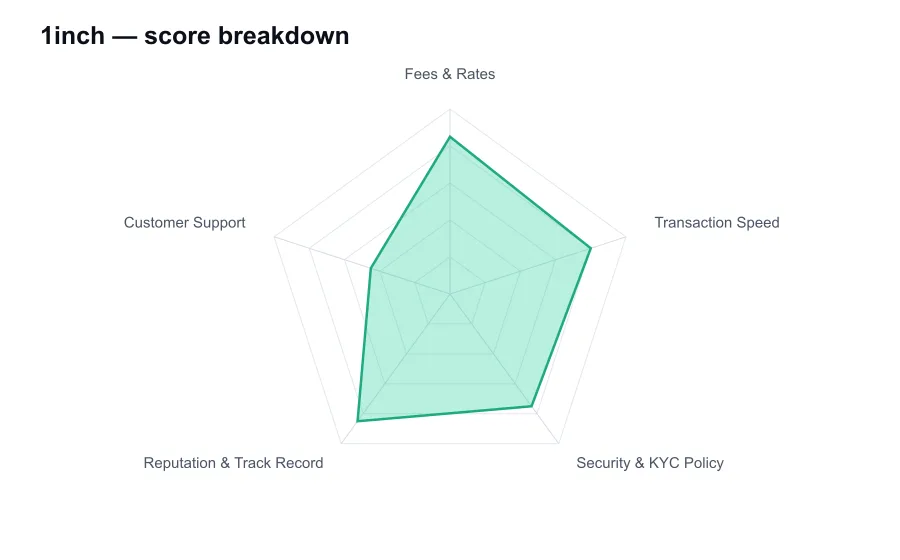
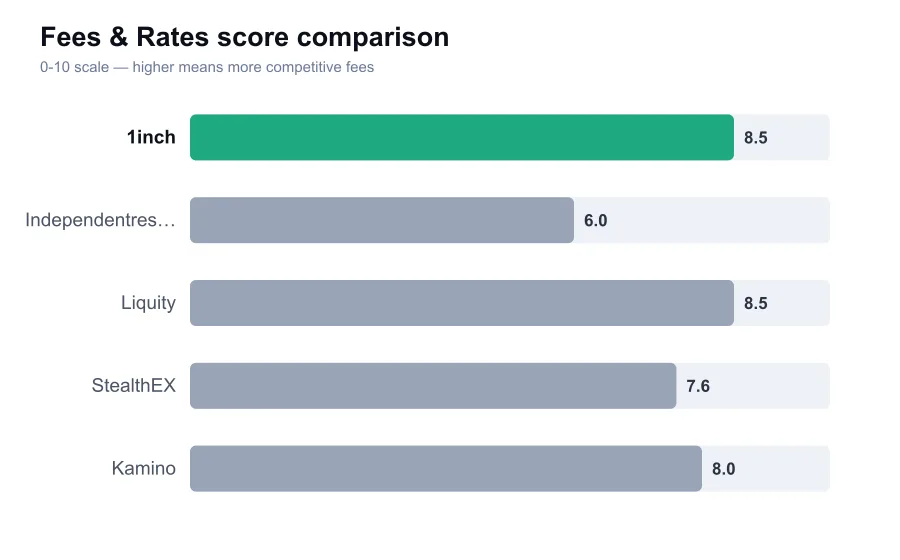
1inch scores 7.8/10 overall in our independent review, measured against every other provider we've compared, strongest on Fees & Rates (8.5/10) and weakest on Customer Support (4.5/10).
DEX aggregation · No-KYC · Limit orders · Multi-chain routing
1inch is one of the best known decentralized exchange aggregators in crypto, and it earned that position rather than buying it with loud marketing. Instead of operating a conventional exchange order book, it searches liquidity across decentralized exchanges and routes a swap through one or several venues. For Ethereum users, and increasingly for users on supported EVM chains, that can produce better execution than clicking directly through Uniswap, Sushi, Balancer, or Curve. It is a trading tool, not a custodial exchange, and that distinction shapes almost every strength and weakness here.
The central appeal is price discovery. A simple token swap may be split across multiple liquidity sources, with 1inch's Pathfinder algorithm attempting to minimize the total cost after liquidity depth, pool fees, and routing are considered. In active markets, this often works very well. A trader selling a meaningful amount of ETH, WBTC, or stablecoins can see a noticeably better quote than on a single automated market maker. The benefit is less dramatic for tiny swaps, where gas and routing complexity can outweigh a few basis points of price improvement.
1inch does not generally add a standard protocol fee to ordinary swaps through its aggregation interface. That is a real advantage. Users still pay the underlying DEX pool fees, the network gas fee, and any spread created by limited liquidity. The displayed quote is usually transparent about expected output, but it is not magic. If a route passes through several pools, each pool takes its own fee. On Ethereum mainnet, a supposedly cheap swap can become expensive fast once gas is included.
The best fee story is therefore on lower cost networks. 1inch supports networks including Ethereum, Arbitrum, Optimism, Polygon, BNB Chain, Avalanche, Gnosis Chain, Base, zkSync Era, and others as integrations evolve. On Arbitrum or Base, routing an order through multiple sources is much more practical than it was during Ethereum's expensive gas periods. A small retail swap that would be irrational on mainnet can make sense there. The platform's economics are better than a centralized exchange withdrawal fee, but only if the chain itself is affordable.
Limit orders are one of 1inch's more useful additions. They are signed off chain and executed when conditions are met, rather than sitting as an onchain order that burns gas immediately. This gives experienced users a familiar way to target a price without surrendering custody. The trade-off is execution certainty. A limit order still needs available liquidity and an executor willing to fill it. It is not the same as a deeply liquid centralized exchange book where matching is constant and immediate.
Speed depends largely on the blockchain, not on 1inch's interface. The quote itself appears quickly, often within seconds, and the transaction is submitted directly from the user's wallet. On an L2, confirmation can feel close to instant. On Ethereum, it may take a few minutes in normal conditions, and longer if a user sets an uncompetitive gas price. During volatile markets, the quoted route can become stale before confirmation, producing a failed transaction or less favorable execution within the selected slippage tolerance.
That last point matters. Aggregators can find clever routes, but complexity increases the number of moving parts. A route through three or four pools may offer the best expected price but carry more exposure to price movement and transaction failure. 1inch gives users useful controls, including slippage settings and route details, yet a newcomer can still make poor choices by setting excessive slippage. A 5 percent tolerance is not a convenience setting. It is an invitation for bad execution in a fast market.
Security is solid in the sense that 1inch is a mature, heavily scrutinized DeFi protocol with public smart contracts, a long operating history, audits, and a serious bug bounty presence. Its noncustodial structure is a major positive. 1inch does not hold a user's private keys or maintain a pooled exchange balance that can be frozen or hacked in the same way as a centralized platform. Users authorize transactions through their own wallet, then assets move according to the contract call.
That does not mean the risk disappears. Users must understand token approvals, fake token contracts, wallet-draining phishing pages, and malicious signature requests. The 1inch brand has been copied repeatedly by scammers, especially in search ads and social media replies. The protocol can be secure while an individual user's wallet is still compromised through a fake front end. Hardware wallet use, a bookmarked official URL, and periodic approval revocation are sensible precautions rather than paranoid rituals.
There is no standard KYC requirement for using the 1inch web app or its underlying aggregation contracts. That appeals to privacy-minded users and people who do not want to create another account merely to exchange tokens. It also means there is no account recovery desk. Lose the wallet seed phrase, sign a harmful approval, or send funds to the wrong address, and 1inch cannot reverse the result. Self custody is freedom with a sharp edge.
Its reputation is strong among DeFi natives. 1inch launched in 2019 and has survived several market cycles, network migrations, and the collapse of more than a few celebrated competitors. The 1INCH token and DAO governance have had their usual governance-token complications, but the swapping product remains the reason people use the brand. It is not as simple as Uniswap's core interface, and it does not have the institutional familiarity of Coinbase, but it is an established part of the decentralized trading stack.
Customer support is the weak point, though this is common in noncustodial DeFi. Documentation and community channels can answer basic questions, and the interface explains many transaction states reasonably well. What users should not expect is a responsive personal agent who can trace a missing swap and repair it. Blockchain transactions are public, but interpreting a failed route, a token approval, or a bridge issue can still be intimidating. Support exists mostly as self service guidance and community help.
1inch is particularly good for traders who already understand wallets and want to compare decentralized liquidity without manually visiting five different exchanges. It is less attractive for someone making recurring, very small Ethereum mainnet purchases, where gas eats the benefit. For stablecoin swaps, it is smart to compare its quote with Curve directly. For major blue-chip swaps, compare it with Uniswap as well. The best aggregator quote is not always the most obvious route, but it should still be checked.
My view is that 1inch remains a very capable execution layer rather than a complete trading home. It can save money and improve fills for users who know what they are signing, especially on L2 networks. Its weak support model and the ever present wallet-security burden make it a poor first stop for crypto beginners. For self-directed DeFi traders, though, it belongs in the regular toolkit. The product has earned that status through utility, not hype.
Who it suits
1inch suits self-custody traders who compare prices and regularly use Ethereum L2s, Arbitrum, Base, or Polygon. It is particularly useful for larger swaps where split routing can improve execution. Beginners who need phone support, account recovery, or simple fiat purchases should use a regulated centralized exchange instead. Tiny Ethereum mainnet swaps are often better postponed or moved to a cheaper network.
The practical view
Strengths and trade-offs
What stands out
- Finds liquidity across multiple DEXs
- Usually no added swap protocol fee
- Noncustodial, no standard KYC
- Useful limit-order functionality
- Strong coverage of EVM networks
What to weigh
- Ethereum gas can erase pricing gains
- No account recovery or hands-on support
- Complex routes can fail in volatile markets
Scorecard
How the score is built
Verdict
My take on 1inch
1inch is one of the few DeFi aggregators that feels like essential infrastructure rather than a novelty. Its routing can genuinely improve a trade, and the noncustodial model is a meaningful advantage for users prepared to manage their own wallet security. The catch is that better routing does not protect anyone from gas fees, bad slippage settings, or phishing. It is excellent at its narrow job, but it isn't a beginner-friendly replacement for a full-service exchange. Experienced onchain traders should keep it bookmarked.
Review questions
1inch FAQ
Does 1inch charge a fee for swaps?
1inch generally does not charge a standard fee for normal aggregation swaps. You still pay network gas, underlying liquidity-pool fees, and any price impact or spread from the route.
Do I need KYC to use 1inch?
No standard identity verification is required to connect a wallet and use 1inch's decentralized swapping tools. Access can still depend on local laws and third-party wallet or RPC services.
How fast is a 1inch swap?
Quotes appear quickly, but final settlement depends on the chain. L2 swaps may confirm in seconds, while Ethereum mainnet transactions commonly take minutes and can slow during congestion.
Reader experiences
What users report
Continue your comparison
Read across the full ranking before deciding which provider best fits your own needs.
Compare providers