Ranked #3 of 74 · Updated October 2026

StealthEX review
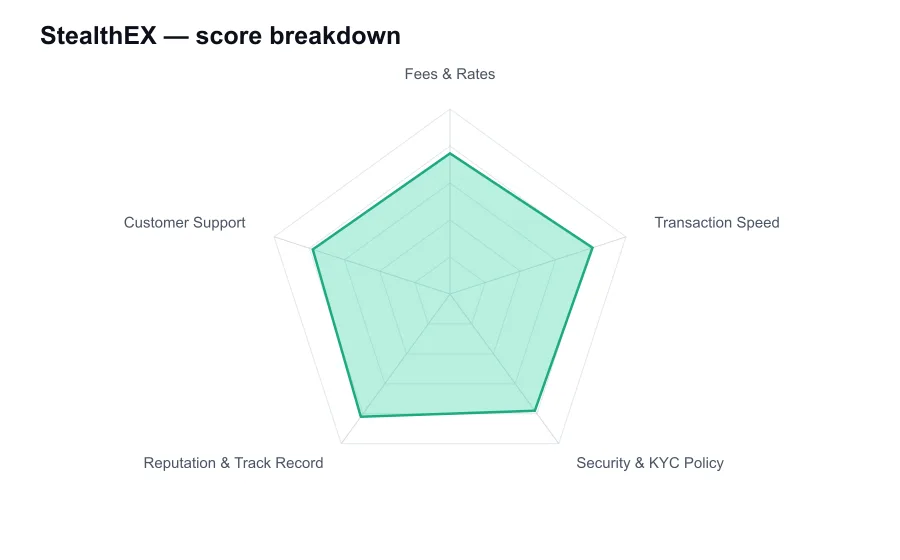
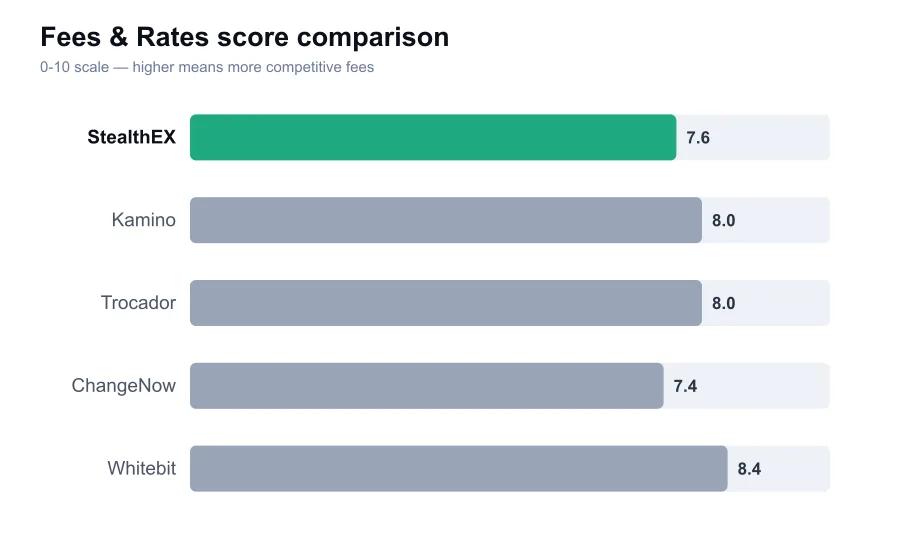
StealthEX scores 7.9/10 overall in our independent review, measured against every other provider we've compared, strongest on Reputation & Track Record (8.2/10) and weakest on Fees & Rates (7.6/10).
No-registration swaps · Fixed-rate exchanges · 1,000+ supported assets · API and exchange widget
StealthEX is a well-known noncustodial crypto exchange aggregator that has grown beyond the bare-bones swap widget model. It still does one thing first: it lets users exchange one crypto asset for another without depositing into a conventional trading account. But it also has a developed affiliate presence, API and widget options, a large supported-asset catalogue, and enough market visibility to stand apart from the many lookalike instant exchangers.
The core appeal is obvious. You can convert assets directly to a wallet address without leaving a balance on the platform, navigating a spot market, or submitting routine account information. For self-custody users, that is genuinely convenient. It is particularly useful for someone holding an asset in one wallet who needs a different coin on another chain. The experience is much less intimidating than selling into a stablecoin and manually buying again on a centralized exchange.
StealthEX supports a very large number of coins and tokens, often listing more than a thousand assets through its liquidity relationships. That breadth is impressive, but it should not be confused with deep liquidity in every market. Major pairs such as BTC, ETH, USDT, USDC, SOL, LTC, and XRP are the sensible place to use the service. A newly issued token, a marginal network, or a tiny market-cap coin can carry a much larger hidden spread and more operational risk.
Its fee model is typical of an aggregator. StealthEX states that it charges a service fee, commonly described around 0.4 percent for many exchanges, while the resulting quote can also reflect partner pricing and network costs. The exact effective cost is therefore not always reducible to a neat headline percentage. This is not a criticism unique to StealthEX, but it is why users should compare final payout figures. On common pairs, its quotes can be quite competitive. On less liquid routes, they can be noticeably weaker than a major exchange.
Fixed-rate transactions are one of StealthEX's more useful tools. A fixed quote protects the user from price movement during the defined exchange window, which matters if a payment or transfer needs a predictable amount. Floating-rate swaps can be cheaper in stable markets but expose the sender to execution movement. StealthEX makes the distinction reasonably visible. I prefer that approach to platforms that claim an attractive rate and explain the variability only after a user has deposited.
Speed is usually solid. After the inbound transaction reaches the required confirmation threshold, StealthEX routes the exchange and sends the payout. Fast-chain conversions can finish quickly, while Bitcoin, Ethereum during congestion, and certain wallet-maintenance periods can stretch the clock. The service does not control every step, but its transaction tracking and established routing operation make it more dependable than a small unknown swap page. It is fast enough for ordinary retail needs, not designed for millisecond-sensitive execution.
One area where StealthEX deserves credit is acknowledging that exchange timing is chain-dependent. Many users blame the provider when their own deposit is waiting for confirmations. A transparent service should distinguish between awaiting deposit, processing exchange, and sending payout. StealthEX's tracking flow helps with that. It does not remove anxiety when a transfer is delayed, but it gives the customer something more useful than a generic loading screen.
The platform is noncustodial in the practical sense that users do not create a persistent account balance for ongoing trading. That sharply lowers the risk of a customer account being drained through poor password security or held indefinitely in a centralized exchange account. It does not eliminate counterparty risk during a live swap. You are still sending crypto into a transaction process controlled by the provider and its partners, so accurate addresses and sensible transaction sizing remain essential.
StealthEX generally markets no-registration exchanges, and for many normal swaps that is how the product works. The critical qualifier is compliance. The company can request KYC or source-of-funds information for a transaction identified as risky. That may frustrate users who expected complete anonymity, but it is more honest to view this as conditional privacy rather than an absolute promise. Anyone who cannot tolerate a possible review should not use any centralized routing service for a sensitive transfer.
Its public reputation is stronger than average for this category. StealthEX has operated since 2018, maintains an active public brand, and is regularly compared with competitors such as ChangeNOW, SimpleSwap, and Changelly. Longevity matters because an instant exchanger needs to demonstrate that it can deal with wallet maintenance, token migrations, customer mistakes, and volatile markets over years rather than months. Still, public review sites should be read critically. Referral incentives can make ratings look cleaner than the difficult cases behind them.
The company has not reached the transparency standard of a regulated exchange such as Kraken. There is no public order book, no familiar audited financial reporting, and no reason to treat a swap service as a savings account. That is not StealthEX's business model. It is a transaction conduit. Once you accept that distinction, the relevant comparison is against other noncustodial aggregators, where StealthEX ranks toward the stronger and more established choices.
Support is available around the clock and is one of the better reasons to choose an established brand rather than a newly created exchanger. The practical support tools are transaction IDs, hashes, email communication, and status tracking. In uncomplicated cases, that is enough. In an AML review or a liquidity-provider issue, response quality becomes more important than response speed. StealthEX has a credible support reputation, though no support desk can make a compliance hold disappear on demand.
I would still be careful with token networks. USDT on Tron, Ethereum, Solana, BNB Smart Chain, and other networks are not interchangeable deposits. StealthEX may support many variants, but the sender must choose the exact route displayed in the order. Check the wallet's ability to receive the selected asset, keep enough gas for any follow-up movement, and never use a large amount as your first test of an unfamiliar chain.
StealthEX is one of the better all-purpose choices in the instant exchange market. It has meaningful scale, strong asset coverage, useful fixed-rate functionality, and a more established record than many privacy-focused competitors. The price is not always the best, and its no-KYC positioning has normal compliance limits. Those are not fatal flaws. For retail users who value convenience and self-custody, StealthEX is a service I would consider near the top of the aggregator shortlist, provided they compare quotes and respect the risks of a routed swap.
Who it suits
StealthEX is a strong fit for self-custody users who need convenient cross-chain swaps among major assets and want a choice between fixed and floating rates. It also suits wallet providers and publishers seeking an exchange widget or API integration. Professional traders needing deep visible liquidity should use a spot exchange instead. Users seeking guaranteed anonymity should not rely on any service that can pause flagged transactions for compliance review.
The practical view
Strengths and trade-offs
What stands out
- Large supported asset catalogue
- Established since 2018
- Fixed and floating exchange modes
- Noncustodial wallet-to-wallet flow
- Useful transaction tracking
What to weigh
- Effective cost can exceed the visible service fee
- KYC can be triggered by compliance checks
- Thin tokens may receive poor quotes
- No public order book or advanced trading
Scorecard
How the score is built
Verdict
My take on StealthEX
StealthEX has earned its place near the front of the instant-exchange market through longevity, asset coverage, and a product that usually behaves as advertised. It is more credible than a freshly launched no-KYC swap site, though it remains less transparent than a regulated exchange with a visible market. The service fee is reasonable, but the final quote is what should decide each transaction. For normal self-custody conversions, it is a good choice. For large or urgent trades, better execution transparency is still available elsewhere.
Review questions
StealthEX FAQ
Does StealthEX require KYC?
Most ordinary exchanges can be initiated without account registration or routine KYC. StealthEX may request documents if its compliance process or a partner flags the transaction.
What fee does StealthEX charge?
StealthEX commonly cites a service fee around 0.4 percent, but the effective rate also reflects liquidity-provider pricing and blockchain network costs. Check the final amount shown for your specific route.
Can I use a fixed rate on StealthEX?
Yes, fixed-rate exchanges are available for supported routes. They offer payout certainty for a limited quote window, usually at a less favorable price than the floating option.
How safe is StealthEX?
It is noncustodial for routine use, so you do not keep a standing account balance there. You still take counterparty risk during the live swap and should verify every network and wallet address.
Reader experiences
What users report
Continue your comparison
Read across the full ranking before deciding which provider best fits your own needs.
Compare providers