Ranked #5 of 74 · Updated October 2026
Trocador review
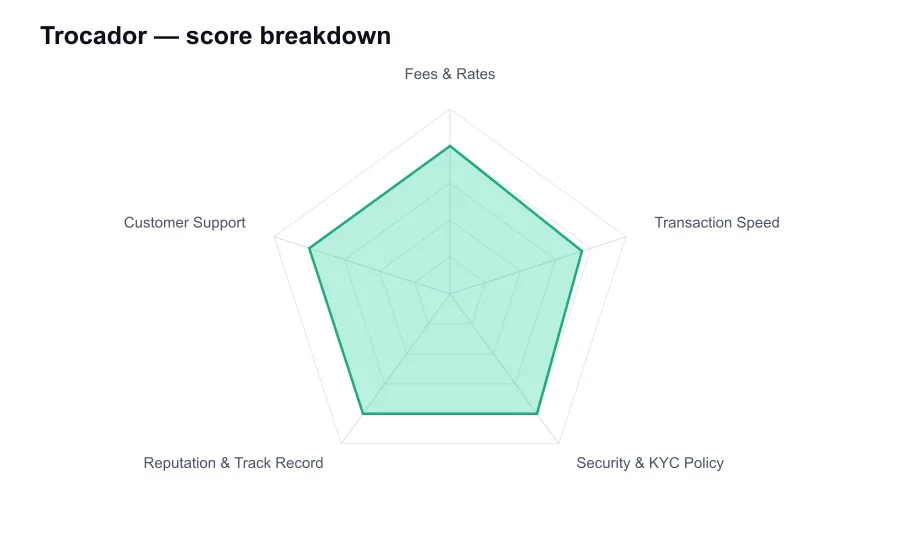
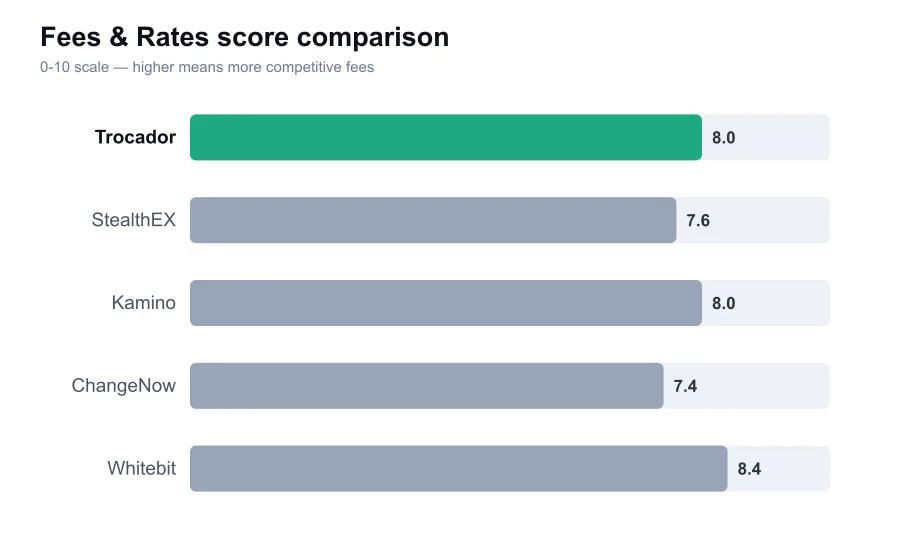
Trocador scores 7.9/10 overall in our independent review, measured against every other provider we've compared, strongest on Fees & Rates (8.0/10) and weakest on Transaction Speed (7.5/10).
Exchange Aggregator · No Routine KYC · Fixed-Rate Options · Monero-Friendly
Trocador is not simply another instant exchange. It is an exchange aggregator with a distinctly privacy-conscious identity, designed to compare offers from multiple partner services and route a swap through the one that best matches the user's choice of price, speed, and rate type. That makes it more useful than a single-provider swap form for people who already understand self-custody and want to shop the market without creating accounts everywhere.
The platform's strongest idea is simple: an instant-exchange quote is only as good as the alternatives you did not see. Trocador displays offers from participating providers, allowing users to compare expected payouts instead of taking one provider's word for it. This can expose meaningful differences on the same pair. A route that is cheap for BTC to XMR may not be the best route for ETH to USDC, and Trocador makes that difference visible.
Trocador typically adds a service fee to its routes, often around 0.5 percent, while the chosen exchange partner's pricing and network costs remain part of the final calculation. That fee means Trocador is not automatically the absolute cheapest route. Its value is the ability to see and select among providers. In many cases, the improved underlying quote offsets the aggregation fee. In others, a direct quote from the partner may be better, and experienced users should check.
The site is candid enough about this tradeoff that I do not consider the fee structure deceptive. The final payout is what matters, and Trocador gives users enough context to evaluate it. The mistake would be treating a displayed percentage as the whole cost. Network fees, liquidity spreads, fixed-rate protection, and the selected provider all matter. For larger swaps, compare the exact receive amount with direct LetsExchange, Godex, ChangeNOW, and a liquid exchange before acting.
Trocador is particularly popular among Monero users and other privacy-minded communities. Its support for privacy-oriented assets and its emphasis on minimal data collection are genuine differentiators. It does not require a conventional account for standard swaps, and users can keep the process wallet-to-wallet. That is a meaningful advantage for someone who does not want every routine conversion attached to a centralized exchange profile.
That privacy posture should be described precisely. Trocador is not a magic anonymity machine. The underlying exchange provider can have its own compliance rules, blockchain analysis tools can observe public-chain transactions, and a route can still be stopped if a partner flags it. Trocador's interface provides choices, but it cannot erase the policies of every liquidity source. Anyone needing guaranteed privacy should not rely on any custodial instant-exchange route.
One thoughtful feature is the ability to choose between fixed and floating offers where available. Fixed-rate swaps are useful when the market is moving quickly, though the protection usually comes with a less favorable quote. Floating routes may pay better in stable conditions but leave the user exposed to movement between deposit and settlement. Trocador puts that decision in front of the user rather than pretending there is a universally superior choice.
Speed varies because Trocador is a routing layer, not the entity completing every exchange. A fast provider and a quick source chain can deliver a completed swap in minutes. Bitcoin confirmation requirements, Ethereum gas congestion, bridge-style routes, and partner queues can extend that substantially. The comparison view helps users choose a route with an estimated duration, but it is still an estimate. Do not use an instant exchange for a payment that must settle by a fixed minute.
The interface is one of the better examples of useful complexity. It gives more information than a basic swap widget without becoming intimidating to a careful newcomer. You can see provider choices, rate types, expected amounts, and often limits. That said, users need to understand the network they are using. Sending USDT on the wrong chain or choosing an unsupported deposit format is a problem no aggregator can reliably rescue.
Trocador's security model benefits from avoiding persistent user balances and mandatory account creation. There is less personal data stored in a standard swap flow, and no exchange account waiting to be compromised. During execution, funds still pass through the selected partner. The practical risk is therefore distributed, not eliminated. Trocador's route selection and provider vetting matter greatly, but the customer is still trusting a chain of services.
Its reputation is strong within the privacy-focused corner of crypto. Trocador has been operating for years, is recognized by Monero users, and has developed a public identity more substantial than many anonymous aggregators. Its loyalty program and referral structure are visible, as are its efforts to build a community around the service. That does not place it beyond criticism, but it gives Trocador a much firmer track record than a newly launched swap site.
The platform has also faced the realities of operating around privacy coins and compliance-sensitive liquidity. Provider availability can change, certain routes can disappear, and a given asset may have fewer options than users expect. That is frustrating, but it is better than pretending every pair is equally liquid. A responsible user should inspect the named provider, limits, and rate conditions before pressing the exchange button, particularly on Monero-related transactions.
Support is one of Trocador's better qualities. It has a support channel, transaction tracking, and a visible community presence that makes it easier to assess whether the team is engaged. Still, it cannot always solve a partner-side hold instantly. If the selected provider controls a transaction in progress, Trocador may need to escalate rather than directly release funds. Keep the order ID and transaction hashes, and be patient without becoming passive.
I rate Trocador highly for the right user. It combines comparison shopping with a privacy-respecting workflow and does so with more transparency than most instant-swap sites. It is not a low-fee trading exchange, nor is it a fully trustless protocol. For occasional self-custody swaps, especially where provider choice and privacy matter, it is among the best tools available. Just compare the final payout, select reputable routes, and avoid treating no-KYC as a promise of zero scrutiny.
Who it suits
Trocador is an excellent fit for self-custody users who want to compare instant-exchange offers, especially people swapping privacy-oriented assets or moving between chains. It suits careful users who understand networks and will read route details. High-frequency traders and users seeking the lowest possible execution costs should use an order-book exchange. It is also not ideal for anyone who needs a guaranteed settlement time.
The practical view
Strengths and trade-offs
What stands out
- Compares quotes from multiple exchange providers
- Strong privacy-conscious and Monero-friendly positioning
- Fixed and floating route choices
- No persistent custodial account for normal swaps
What to weigh
- Trocador fee can make direct routes cheaper
- Partner availability varies by asset and region
- A partner compliance hold can still delay funds
Scorecard
How the score is built
Verdict
My take on Trocador
Trocador stands out because it gives users a choice instead of forcing them into one opaque quote. The small aggregation fee is a fair trade for that visibility, although savvy users should still check direct routes for large swaps. Its privacy-first culture and credible reputation make it one of the more trustworthy instant-exchange tools, not a substitute for trustless trading. For wallet-to-wallet conversions, it is a service I would actively consider before going directly to a single provider.
Review questions
Trocador FAQ
Does Trocador charge a fee?
Trocador commonly adds a service fee of about 0.5 percent, while the selected provider and network conditions affect the final quote. Compare the final payout, not just the stated fee.
Does Trocador require KYC?
Trocador does not generally require an account or routine KYC for standard swaps. Its exchange partners can apply their own compliance checks to transactions they flag.
Is Trocador good for Monero swaps?
It is one of the better-known aggregators among Monero users because it compares routes involving privacy-focused assets. Availability and limits can change, so inspect the live provider offers.
Who holds funds during a Trocador exchange?
Trocador routes the exchange to a selected provider. You do not keep a standing balance on Trocador, but the chosen provider temporarily processes the funds during the swap.
Reader experiences
What users report
Continue your comparison
Read across the full ranking before deciding which provider best fits your own needs.
Compare providers