Ranked #9 of 74 · Updated October 2026

Liquity review
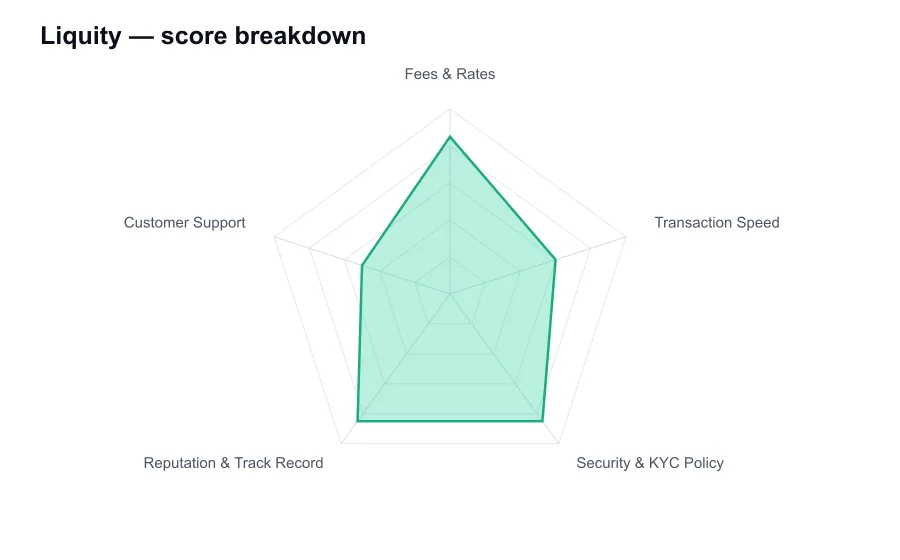
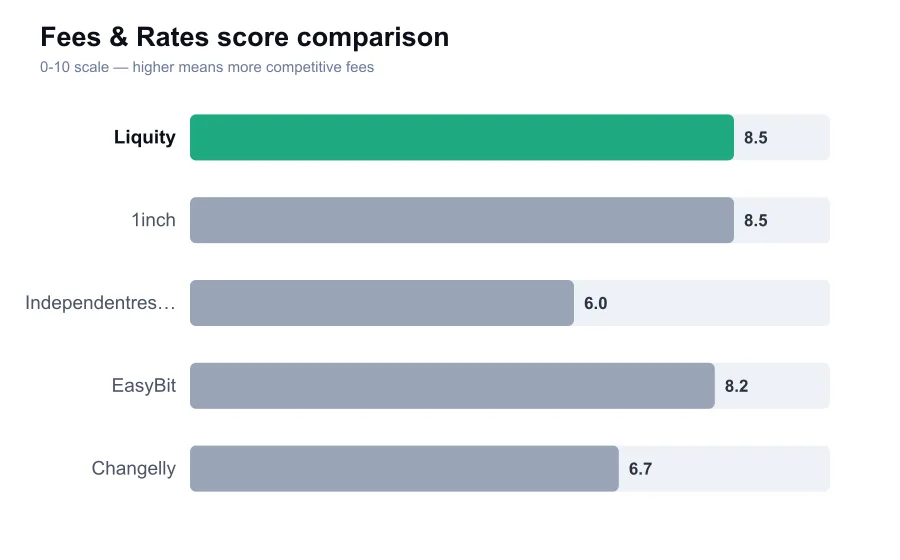
Liquity scores 7.7/10 overall in our independent review, measured against every other provider we've compared, strongest on Fees & Rates (8.5/10) and weakest on Customer Support (5.0/10).
No-KYC · ETH-Backed Borrowing · Noncustodial · Decentralized Stablecoins
Liquity occupies a distinctive corner of DeFi. Rather than trying to be a general lending market with dozens of assets, it was built around borrowing a stablecoin against ETH collateral with unusually strong decentralization goals. The original Liquity system issued LUSD, while Liquity V2 introduced BOLD and a redesigned borrowing model. Its narrow focus is a strength. Users know what they are getting, and the protocol avoids pretending that every volatile token belongs in a lending market.
The classic Liquity design made a simple promise: deposit ETH, borrow LUSD, maintain at least a 110 percent collateral ratio, and pay a one-time borrowing fee rather than an ongoing interest rate. That fee has a floor of 0.5 percent and rises with redemption activity through a base-rate mechanism. For a borrower who expects to keep a loan open for months, that structure can be exceptionally efficient compared with variable-rate money markets.
It also has an important qualification. The initial borrowing fee is not fixed in practice, because heavy redemptions can lift the base rate dramatically. Someone borrowing during calm conditions may pay close to the 0.5 percent minimum. Someone borrowing after a stressed market event can face a much higher charge. Liquity shows the fee before confirmation, but users should never assume the minimum applies just because they saw it mentioned in an explainer.
Liquity V2 changes the comparison somewhat. BOLD borrowers select an interest rate, and the protocol uses borrower-set rates to manage redemptions and borrowing conditions. This introduces more flexibility, but it removes some of the old system's elegant simplicity. Users need to understand their rate choice, the possibility of redemption pressure, and the mechanics of the relevant collateral branch. That is not a criticism of the upgrade, but it does mean V2 rewards a more attentive user.
For the right borrower, fees remain Liquity's headline advantage. Aave can be cheaper during low-utilization periods, but its variable rates can change quickly. Maker-style vaults offer wider collateral choices, yet their stability fees and governance parameters are another moving target. Liquity's ETH-first approach is refreshingly direct. If your collateral is ETH and your aim is to unlock liquidity without selling it, the economics can be excellent.
Ethereum mainnet is the price of that clarity. Opening or adjusting a Liquity position requires onchain transactions, so speed depends on Ethereum block inclusion and the gas market. Under ordinary conditions, transactions confirm in minutes rather than seconds. During a volatile selloff, gas can become expensive and confirmation anxiety is real. The protocol itself does not impose a long approval process, but the chain is not built for Solana-style immediacy.
The liquidation model deserves respect because it is both efficient and unforgiving. A trove below the minimum collateral ratio can be liquidated. The Stability Pool absorbs liquidated debt in exchange for ETH collateral, which is central to the protocol's design. Depositors can earn compensation, but they are explicitly taking liquidation exposure. A Stability Pool position is not a cash account, and its value can fluctuate as debt is offset and ETH is received.
Liquity is noncustodial and permissionless. There is no normal KYC process, no centralized operator holding customer balances and no support agent capable of restoring a lost wallet. That gives it a genuine censorship-resistance advantage over centralized lenders, especially for technically capable users. It also means a user is responsible for wallet security, transaction verification, tax records and every consequence of a signed approval.
The protocol has a serious security pedigree. Liquity's original contracts were extensively audited and designed to minimize upgrade and governance dependence. Its governance-light architecture has been one of its strongest reputational points. There is no claim here that smart contracts are risk-free, because they are not. But Liquity has earned more confidence than a typical new stablecoin project through restraint, transparent mechanics and years of public use.
Its reputation is strongest among DeFi users who value immutability and predictable rules. LUSD became a respected decentralized stablecoin, even if it never reached USDC's liquidity or USDT's commercial reach. Liquity does not have a giant marketing machine, and that has probably helped it avoid the froth that surrounds many token launches. It feels like financial infrastructure built by people who care about mechanism design.
There are drawbacks beyond gas. ETH-only collateral, or tightly scoped collateral branches in V2, can be limiting. Borrowers holding BTC, SOL or diversified token portfolios must look elsewhere or take extra conversion risk. Liquity stablecoins may also have thinner liquidity than the largest centralized alternatives in some venues. That matters if you need to move a large amount instantly or repay through a specific exchange.
Support is deliberately limited because there is no account operator behind the protocol. Documentation, community channels and educational material can answer many operational questions. They cannot reverse a liquidation or identify a wallet owner. This is one of those cases where modest support is not evidence of neglect, it is a consequence of the product's trust model. Still, users accustomed to a broker will find the lack of personal assistance uncomfortable.
Liquity is best treated as a specialized ETH liquidity tool, not a universal borrowing platform. Keep the collateral ratio comfortably above the 110 percent floor, budget for gas, and understand the stablecoin's market liquidity before borrowing. People who only want dollar exposure should not borrow it against volatile ETH merely because the fee looks attractive. Cheap debt can become expensive if it forces you to sell collateral at the bottom.
I rate Liquity highly for what it deliberately does not try to be. The original system's fee model and decentralized architecture remain unusually compelling, while V2 offers more flexibility at the cost of extra complexity. It is not fast, beginner-friendly or broad enough to replace a large exchange. For an informed ETH holder who wants noncustodial borrowing with rules that don't change on a whim, it is one of DeFi's most credible options.
Who it suits
Liquity suits experienced ETH holders who want to borrow without selling and understand collateral ratios. It also fits DeFi users who value permissionless access and minimized governance dependence. Beginners, users needing fiat withdrawals, and borrowers seeking many collateral choices should look to a regulated exchange or a broader lending protocol.
The practical view
Strengths and trade-offs
What stands out
- Competitive borrowing model for ETH holders
- Permissionless and noncustodial
- Strong protocol design reputation
- No recurring interest in the original LUSD system
What to weigh
- Ethereum gas can be costly
- Liquidation threshold is unforgiving
- Limited collateral scope
- Stablecoin liquidity is smaller than USDC or USDT
Scorecard
How the score is built
Verdict
My take on Liquity
Liquity remains one of DeFi's better-designed lending systems because it stays focused. The original LUSD product offers a genuinely attractive alternative to floating-rate borrowing, while V2 is more adaptable but less effortless to grasp. Ethereum gas and hard liquidation rules are not minor annoyances, they shape how the protocol should be used. Conservative ETH-backed borrowing is where Liquity shines.
Review questions
Liquity FAQ
Does Liquity charge interest?
The original LUSD system uses a one-time borrowing fee rather than recurring interest, with a 0.5 percent minimum and a variable base rate. Liquity V2 BOLD uses borrower-selected interest rates.
What happens if my Liquity collateral ratio falls too low?
Your position can be liquidated if it falls below the applicable minimum collateral ratio. In the original system, that threshold is 110 percent for ETH-backed troves.
Does Liquity require identity verification?
No. Liquity is a permissionless DeFi protocol and standard use does not require KYC. Wallet and transaction responsibility stays with the user.
Reader experiences
What users report
Continue your comparison
Read across the full ranking before deciding which provider best fits your own needs.
Compare providers