Ranked #66 of 74 · Updated October 2026

CoinCraddle review
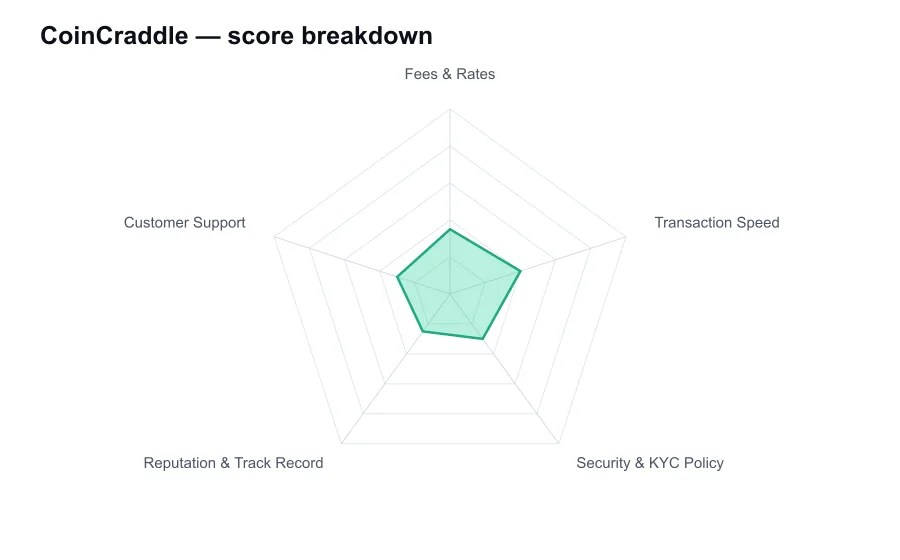
CoinCraddle scores 3.2/10 overall in our independent review, measured against every other provider we've compared, strongest on Transaction Speed (4.0/10) and weakest on Reputation & Track Record (2.5/10).
Crypto exchange flow · Wallet to wallet transfers · Small test only
CoinCraddle is the kind of crypto provider that deserves more investigation than its apparent simplicity might suggest. In a market full of exchange widgets, affiliate funnels, and lightly documented swap services, the name alone tells a prospective customer very little. I could not establish the depth of public operational information that would support treating CoinCraddle as a mature exchange. That is the central fact shaping this review, more than any marketing language about convenience or rapid conversion.
A trustworthy provider should let a user identify who operates it, where the business is registered, what services it actually provides, and which legal terms govern a transaction. Those details are especially important for a crypto exchange because a mistaken or delayed transfer cannot be reversed by a card issuer. Public information associated with CoinCraddle does not provide the kind of easy, independently verifiable corporate profile that I expect before recommending a platform for material amounts.
There is an important distinction between unknown and unsafe. A new business can be competent, and an established business can fail customers. Still, an exchange without an independently demonstrated track record starts with a credibility deficit. It has not yet shown how it handles a difficult market event, a wallet outage, a hacked account, an overloaded chain, or a dispute over a delayed payout. Crypto customers should not be asked to finance that learning curve with funds they cannot lose.
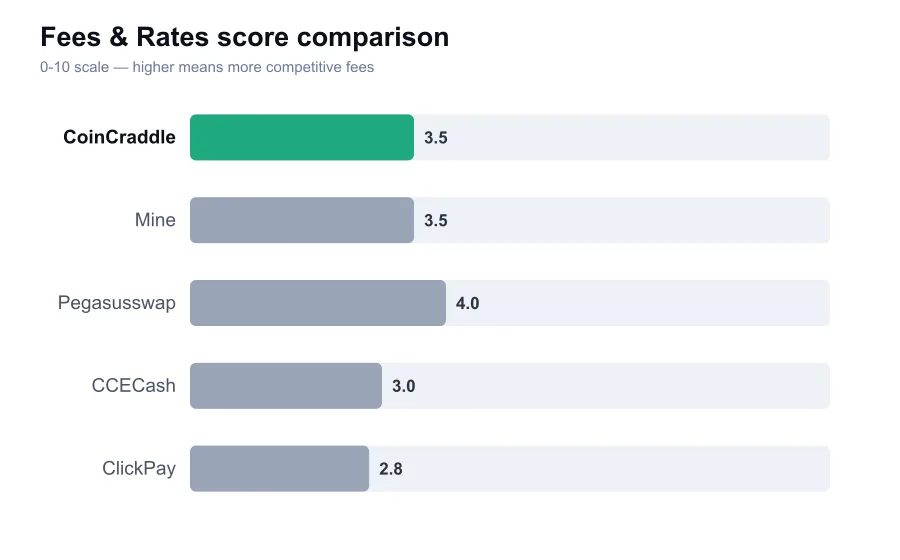
Fee analysis is constrained by the same lack of transparency. I cannot verify a stable, public CoinCraddle pricing schedule that states a service fee, a fixed versus floating rate policy, the treatment of blockchain costs, and any separate withdrawal charges. This makes it impossible to give the provider a high fee score. A service can claim favorable pricing while embedding its margin in an exchange quote. What matters is not an advertising phrase, but the number of destination coins that arrive in the wallet.
If you are considering a CoinCraddle quote, do the comparison properly. Note the exact amount sent, the network selected, the amount promised, the rate lock duration, and the final amount after all stated deductions. Compare that result with an order on Kraken, Coinbase Advanced, or Binance where available, and with an established instant service if you need a direct wallet to wallet route. For common pairs, a convenience service has to offer either a clearly better price or a materially easier experience to justify its additional counterparty risk.
Speed also needs to be separated from a website's impression of speed. A fast quote generator is not the same thing as a fast settlement system. A real crypto swap has to detect the deposit, wait for sufficient confirmations, source the outgoing asset, broadcast it with a sensible fee, and deal with any anti fraud screening. There is not enough independent performance evidence to say CoinCraddle consistently handles that sequence well. I would treat any published timing estimate as aspirational.
Network choice has a large effect. A USDT transfer on Tron can confirm differently from a USDT transfer on Ethereum, and a low fee Bitcoin deposit can sit unconfirmed far longer than a customer expects. A competent exchange explains these differences before the customer sends. It should also warn users about unsupported networks, minimum amounts, memo requirements, and token contract issues. If CoinCraddle's transaction pages do not make every one of those rules unmistakable, that is not a minor presentation flaw. It creates a direct loss risk.
The security picture is difficult to assess because verifiable security disclosures are limited. There is no broadly recognized proof of reserves, public audit history, clearly documented custody model, or widely cited independent assessment that would allow a reviewer to rate CoinCraddle with confidence. Claims such as secure, protected, or encrypted are basic expectations for any website. They do not answer the critical questions about private key management, hot wallet exposure, access controls, monitoring, and incident response.
Customers should also resist the temptation to call a swap provider noncustodial just because it has no conventional account page. If you send crypto to a deposit address controlled by the service, it has control of those funds until it sends the output. That is a custody event, even if it lasts only minutes. The operational risk may be small for a small successful swap, but it grows directly with transaction size. This is why a test transfer is prudent, not paranoid.
KYC is another potential point of friction. A provider may market a simple or privacy friendly exchange flow but retain the right to pause an order for compliance checks. That is common across the industry, and it is not automatically unreasonable. The problem is ambiguity. Customers need to know whether verification can be requested, what documents may be required, whether a transaction can be canceled during review, and how long the provider normally takes to respond. I could not find a sufficiently robust public basis to rate CoinCraddle highly for policy clarity.
Reputation requires more than a few scattered references or a handful of very short customer reviews. Strong reputation is built through years of public operational continuity, visible responses to criticism, recognized partnerships, and a pattern of users receiving support when something goes wrong. CoinCraddle does not currently show that kind of deep public footprint. That is a more serious issue than having a small social following. It means a customer has limited outside evidence to rely on when deciding whether to trust the operator.
Support becomes especially important with a lesser known provider. A useful help desk provides a real ticket trail, clear order status, responsive contact channels, and answers tied to the transaction ID. An anonymous chat response is not sufficient for an irreversible transfer. I could not verify a mature, well documented support record for CoinCraddle, so I would assume support risk exists until the provider demonstrates otherwise through transparent procedures and consistently documented user outcomes.
There is no reason to keep a standing balance with CoinCraddle, even if a transaction works. A swap service should be used transaction by transaction, with the output delivered to a wallet the customer controls. Do not send a large amount in anticipation of a better rate, do not reuse an old deposit address without explicit instruction, and do not let urgency override basic verification. Those rules apply everywhere, but they matter most when the provider's history is thin.
CoinCraddle may appeal to users who prefer a minimal interface and do not want a lengthy exchange account process. That is understandable. Yet friction is not always a flaw. Account security settings, regulated onboarding, and identifiable support teams can be valuable precisely when a transfer encounters trouble. The fastest looking route is not necessarily the route with the best practical outcome.
My assessment is that CoinCraddle remains too lightly documented to recommend beyond a controlled, low value test. It has not supplied enough public evidence to compete on trust with established exchanges or well known instant swap brands. That does not make every transaction destined to fail. It means the risk cannot be responsibly priced by an ordinary user. Until transparency improves, choosing a better documented alternative is the smarter call.
Who it suits
CoinCraddle is not a strong recommendation for ordinary buyers, active traders, or anyone exchanging a meaningful amount. At most, it may interest an experienced wallet user willing to test a very small transaction and independently verify the destination network. People who need accountability, fiat access, tax reporting, or dependable support should use a recognized exchange with clear operating disclosures.
The practical view
Strengths and trade-offs
What stands out
- Potentially simple crypto exchange flow
- May be usable for a tiny controlled test
- Avoids the complexity of a trading terminal
What to weigh
- Weak public transparency on ownership and operations
- No clearly benchmarkable fee schedule
- Unproven support and settlement record
- Not appropriate for stored balances or large transfers
Scorecard
How the score is built
Verdict
My take on CoinCraddle
CoinCraddle has not earned the trust implied by handing over irreversible crypto. Its apparent simplicity may be appealing, but simplicity without transparent fees, security information, and a durable reputation is not a customer benefit. There are too many better documented alternatives to accept that uncertainty for a routine swap. Keep away from large transfers until the service can demonstrate substantially more accountability.
Review questions
CoinCraddle FAQ
Should I use CoinCraddle for a large transfer?
No. The public information available is not strong enough to support a large transfer recommendation. If you decide to use it, limit the first transaction to an amount you can afford to lose.
Can CoinCraddle's fees be compared easily?
Not reliably from a clearly established public schedule. Compare the exact final receive amount, network, and timing rules with established exchanges before you send any funds.
Is a CoinCraddle swap noncustodial?
Not in the strict sense while processing. Any service that receives coins at its deposit address controls them until it sends the payout, even if it does not maintain a long term customer account.
Reader experiences
What users report
Continue your comparison
Read across the full ranking before deciding which provider best fits your own needs.
Compare providers