Ranked #65 of 74 · Updated October 2026
Mine review
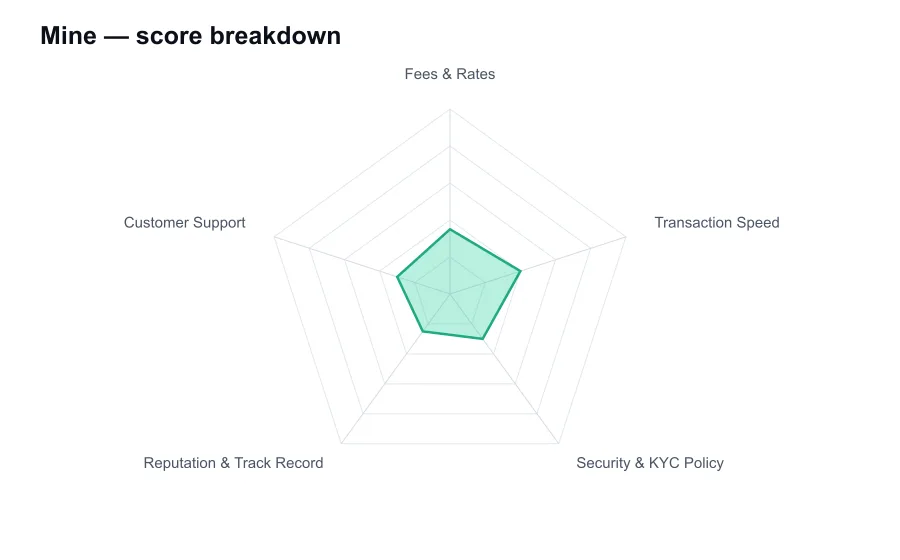
Mine scores 3.2/10 overall in our independent review, measured against every other provider we've compared, strongest on Transaction Speed (4.0/10) and weakest on Reputation & Track Record (2.5/10).
Crypto conversion service · Quote-based transactions · Small-order test use
Mine is a difficult provider to assess because the name itself is unusually generic in crypto. That may sound trivial, but it creates a real due-diligence problem. Search results can mix unrelated mining projects, applications, exchanges, and wallet services. A financial provider should be easy to identify, easy to verify, and easy to distinguish from imitators. Mine starts at a disadvantage on that basic trust test.
Before discussing rates or transaction speed, a user needs to establish the exact legal entity behind the service, its official domain, supported countries, and customer terms. If that information is not plainly available, do not send funds. Crypto fraud frequently exploits lookalike brands and vague naming. The burden should not fall on a customer to work out which version of a company is genuine after money has left their wallet.
Mine appears better viewed as a small exchange or conversion service than as a full-scale trading venue. That means it should be judged against services such as Changelly, SimpleSwap, FixedFloat, or an established local broker, not against a spot exchange with visible order books. The relevant questions are simple: what rate is locked, how long is it valid, what happens if the transfer arrives late, and who has custody while the swap is pending?
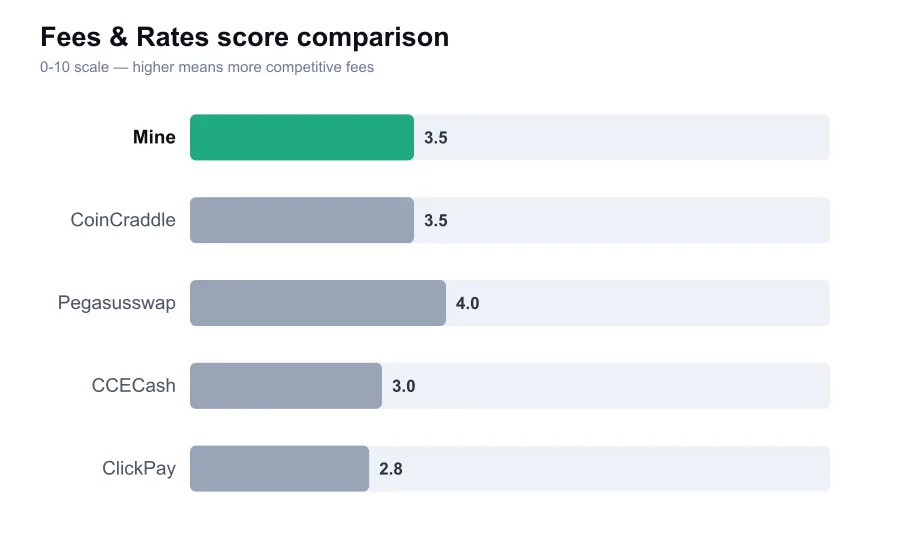
The public evidence needed to answer those questions confidently is limited. I could not establish a robust, consistently documented fee structure that breaks out service charges, spread, payment fees, and blockchain costs. A vague claim of competitive pricing isn't enough. With a small exchanger, the rate quote is the product. If Mine cannot make the customer-facing math obvious, its pricing cannot be called competitive with confidence.
This is especially important with smaller altcoins and cross-chain routes. A quote that looks fine against a broad market price may conceal an expensive route, a thin liquidity source, or an unfavorable network charge. Check the output amount against at least one reputable comparison source. If Mine offers a fixed-rate order, confirm precisely what conditions can void that rate. If it offers a floating rate, assume the final amount can move materially in a volatile market.
Speed claims should also be treated with restraint. A crypto swap can be fast only if the provider has liquidity, automated wallet handling, and no compliance intervention. Bitcoin confirmation times, Ethereum gas conditions, and destination-chain congestion all sit outside the provider's control. Mine may process a normal order promptly, but it has not built the public operational record that would make me comfortable relying on it for deadline-sensitive transactions.
The moment an order needs a manual review, a generic service becomes much less attractive. You need a transaction identifier, a named support channel, a written explanation, and a stated resolution path. Without those, the customer is left refreshing a block explorer and hoping. That is not a sensible operating model for someone converting rent money, business proceeds, or a sizeable trading position.
Mine's security profile is hard to score generously for the same reason. I found no widely recognized evidence of reserve attestations, extensive security documentation, regulated custody arrangements, or a long-standing vulnerability disclosure program. A small provider doesn't need to imitate Coinbase's corporate machinery, but it should still explain how it protects wallets, handles access controls, and responds to suspicious transfers.
KYC can be another source of friction. Users often choose smaller conversion services because they expect less paperwork, then discover that transaction monitoring still applies. That is not necessarily a criticism of compliance itself. The problem is surprise. Mine should say plainly whether identity checks are required before payment, what triggers a review, what documents can be requested, and whether a customer can obtain a refund if they decline verification.
The lack of a strong independent reputation is Mine's biggest concern. There is a major difference between a young company with identifiable operators and a service whose public identity is hard to separate from similarly named projects. Reputation is not just star ratings. It includes corporate disclosures, dispute handling, longevity, technical transparency, and a pattern of users being able to reach someone when things go wrong.
Support should be tested before any transaction. Ask a specific question about an unsupported memo, a delayed confirmation, or a wrong chain deposit. A useful answer will explain the actual procedure and its limits. A canned reply saying that funds are safe is not useful. I would also avoid conducting business solely through informal messaging channels, especially if there is no matching case number or official email trail.
Mine may still be workable for a technically literate person who has independently verified the genuine service and wants to trial a tiny exchange. That is a narrow recommendation, not an endorsement for broad use. The platform has too many unanswered public questions for novice buyers, merchants, or users who require a reliable fiat on-ramp and a predictable compliance experience.
A sensible test, if you choose to make one, is deliberately boring. Send a small amount from a wallet you control, select a common asset and network, save the quote, and do not use money needed that day. Confirm the received amount and timing before considering a second transaction. Never let a smooth first swap convince you that a provider is safe for a larger amount.
Mine's central problem is not necessarily that it is bad. It is that the available evidence does not let an independent reviewer identify enough reasons to trust it. In crypto, uncertainty is a cost. Better-known exchanges may ask for more information or charge a visible fee, but they usually offer clearer accountability if an order fails. Mine needs stronger public disclosures before it can compete beyond the small-test-transaction niche.
Who it suits
Mine is only for experienced users who can verify the exact official service independently and are prepared to use a very small test amount. It does not fit beginners, merchants, or anyone who needs clear fiat support and dependable escalation. Users moving significant value should choose a recognized exchange or a licensed broker with identifiable operations.
The practical view
Strengths and trade-offs
What stands out
- May offer a simple conversion workflow
- Suitable for a carefully controlled small test
- Potentially less complex than a trading terminal
What to weigh
- Generic name complicates provider verification
- Limited transparent fee information
- Weak public security evidence
- Not appropriate for urgent or high-value orders
Scorecard
How the score is built
Verdict
My take on Mine
Mine has a credibility problem before its transaction flow even begins, because its public identity is difficult to verify cleanly. That makes every other unknown, including fees, compliance handling, and support, more consequential. A successful small swap would not change that assessment. Until Mine offers clearer company and service documentation, it remains a speculative convenience option rather than a trusted exchange choice.
Review questions
Mine FAQ
Why is verifying Mine's official identity important?
The name is generic and can overlap with unrelated crypto projects. Confirm the legal entity, official domain, support contact, and terms before sending any funds.
Are Mine's exchange fees transparent?
A reliably documented all-in public fee schedule is not easy to establish. Compare the final amount received with a liquid exchange or reputable quote source.
Is Mine suitable for a large crypto swap?
I would not use it for a large or urgent swap without a long, independently verified record of successful service and clear support escalation.
Reader experiences
What users report
Continue your comparison
Read across the full ranking before deciding which provider best fits your own needs.
Compare providers