Ranked #63 of 74 · Updated October 2026
XGram review
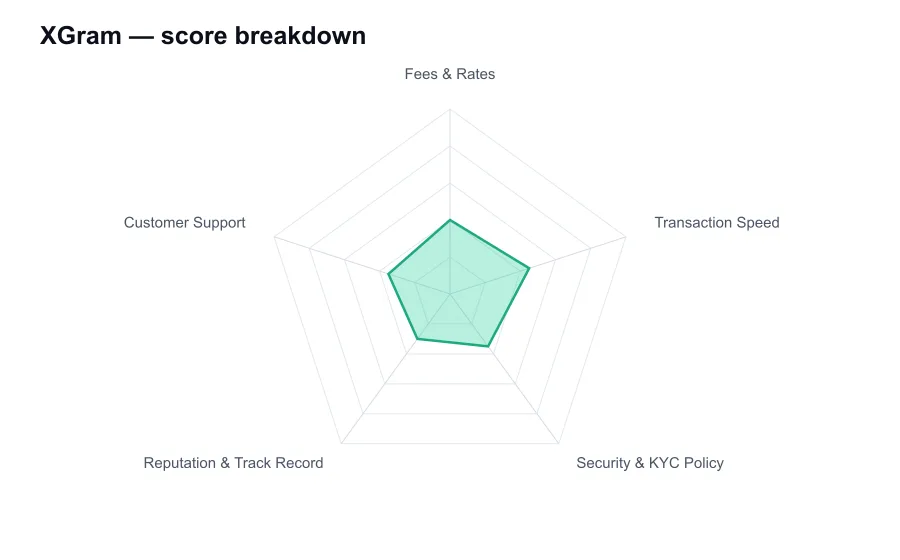
XGram scores 3.7/10 overall in our independent review, measured against every other provider we've compared, strongest on Transaction Speed (4.5/10) and weakest on Reputation & Track Record (3.0/10).
Crypto to crypto exchange · Simple swap flow · No long term custody recommended
XGram sits in the crowded market of small crypto exchange and swap brands, a part of the industry where a polished landing page can easily create more confidence than the underlying operation has earned. Unlike household names such as Kraken or Coinbase, XGram does not have a deep public record, broad regulatory footprint, or years of independently documented operational history. That does not prove it is illegitimate. It does mean a reviewer has to start from caution rather than familiarity.
The first issue is basic transparency. Publicly available information about the company behind the XGram name, its legal jurisdiction, management team, licensing position, custody arrangements, and financial backing is limited. A service asking customers to send irreversible crypto should make those facts straightforward to verify. Small providers do not need to publish the same volume of filings as a public company, but a real business identity and clear operational terms are the minimum standard.
The branding suggests a service focused on exchanging digital assets rather than a full featured spot exchange with advanced trading tools. That distinction matters. An instant exchange quotes a final conversion and processes an order, while a conventional exchange lets users place orders on a visible market. With an instant service, the customer is relying on the operator's liquidity sources, pricing logic, and payout process. There is less control, and there is usually less recourse if something goes wrong.
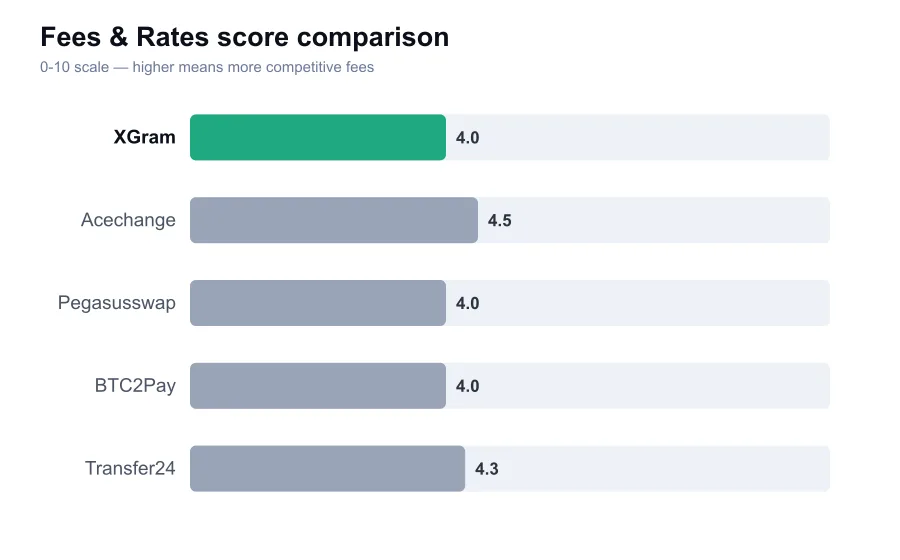
I would not make confident claims about a published flat XGram fee because the fee presentation is not sufficiently established in public materials. That is itself a drawback. A credible swap service should show whether it charges a service percentage, embeds compensation in the exchange rate, adds a network withdrawal fee, or combines all three. If the only meaningful number is the amount shown at the end of a quote, customers cannot easily compare it with alternatives.
A low quoted fee can also be misleading. The real test is the difference between the market value of the coins sent and the value of the coins received, after blockchain fees. Smaller services often advertise an attractive rate on a liquid pair, then offer a weaker rate on the pair a customer actually needs. Before sending funds, compare the final receive amount against an exchange you already trust and against at least one established swap provider. A few seconds of comparison can reveal a surprisingly large spread.
There is not enough independently verifiable evidence to give XGram a strong transaction speed rating. It may process ordinary orders quickly, but a promise of fast exchange is easy to make and hard for an outsider to audit. Actual completion time depends on deposit confirmations, available liquidity, manual risk checks, the outgoing chain fee, and whether the destination network is congested. A site timer or estimated duration should be treated as an estimate, not a service level agreement.
The sensible way to test an unproven exchange is with a small amount on a liquid pair. Watch whether the order page detects the deposit promptly, whether the received amount matches the quote rules, and whether the outgoing transaction is broadcast without an unexplained pause. Keep the transaction ID, screenshots of the quote, and the order reference. If the service cannot handle a modest test cleanly, it has no business receiving a larger transfer.
KYC policy is another area where clarity matters more than slogans. Some smaller crypto services market themselves as registration free or private, but that does not mean they will never ask for documents. Transaction screening can trigger a request for identification, source of funds evidence, or an explanation of a wallet's history. If XGram has such a policy, it should explain when it applies, how long a review takes, and what happens to funds while a review is pending. Vague compliance language is not good enough.
The absence of a compulsory account may appeal to privacy focused users, yet it also removes account protections familiar from larger platforms. There may be no strong login history, withdrawal whitelist, security key support, or structured dispute process. More importantly, a customer sending to a one time deposit address is exposed to the operator's custody controls until payout. Calling a service noncustodial because it does not hold a long term account balance is misleading. Temporary custody is still custody.
I also found no broad, independently established evidence that would justify placing XGram alongside long standing exchanges on security. Security claims on a website are not a substitute for public audits, transparent incident reporting, proof of reserves, a named security team, or a credible legal entity. Those signals are imperfect, but their absence makes risk harder to assess. With a small exchange, lack of information should reduce the amount you are willing to risk, not be waved away as a privacy feature.
Reputation is where XGram scores weakest. There is simply too little durable third party history to distinguish a dependable young service from one that has not yet faced pressure. Review sites can help, but they are easily manipulated and should be read for patterns rather than averages. Look for dated reports with transaction details, recurring complaints about delayed payouts, and clear evidence that the operator resolved specific problems. A pile of short five star comments proves almost nothing.
Support should be judged by accessibility and accountability, not by a chat bubble. A reliable provider gives customers a documented route to contact it, an order identifier, realistic response expectations, and a clear escalation path. If XGram relies only on anonymous messaging channels or fails to publish workable support terms, that is a serious concern. Crypto transfers are irreversible. Users need more than an informal promise that somebody will answer.
For a prospective user, the important question is not whether XGram might complete a small swap. Many services can do that. The question is whether it has earned enough trust for money that matters. Based on the limited public footprint available, I would not treat it as a primary exchange, a place to store funds, or a venue for a large conversion. Better established services may ask more of users, especially on identity checks, but they also provide more evidence of who is accountable.
XGram could become more credible by publishing a verifiable legal entity, detailed fee disclosure, supported asset and network rules, a plain KYC policy, security practices, and transparent incident communication. Those are not cosmetic additions. They are the information customers need before sending assets. Until then, the service remains difficult to assess fairly, and uncertainty is a legitimate reason for a low score.
My take is blunt. XGram may be usable as a carefully tested micro transaction route, but it has not demonstrated the transparency required for a meaningful recommendation. The absence of a strong public record is not an accusation of fraud. It is a reason not to confuse possibility with trust. Users who value privacy should still demand clarity, and users who value safety should choose a better documented provider.
Who it suits
XGram is only a possible fit for experienced users testing a very small crypto to crypto transaction after independently checking every detail. It does not suit first time buyers, businesses, traders needing dependable execution, or anyone moving significant value. Users who need clear fee schedules, strong support, and a documented operator should choose a larger established exchange instead.
The practical view
Strengths and trade-offs
What stands out
- Simple exchange focused proposition
- May suit a small test transaction
- Potentially lighter onboarding than major exchanges
What to weigh
- Limited public company and security transparency
- Fee disclosure is hard to independently verify
- No substantial established reputation
- Not suitable for custody or large transfers
Scorecard
How the score is built
Verdict
My take on XGram
XGram's core problem is not that it is small. It is that the public evidence needed to judge a small exchange remains thin. Without strong disclosures on ownership, fees, security, and support, a good looking exchange flow is not enough. Treat it as unproven and keep any exposure trivial. A provider should earn trust with verifiable information, not ask users to supply it through blind deposits.
Review questions
XGram FAQ
Is XGram safe for a large crypto exchange?
I would not use XGram for a large transfer based on its limited publicly verifiable operating and security record. If you use it at all, start with a small test and keep independent records of the quote and transaction.
Are XGram's fees clearly published?
A clearly established public flat fee schedule is not available to confidently benchmark. Check the final receive amount, network costs, and terms before sending, then compare that quote with established alternatives.
Does XGram require identity verification?
Do not assume that a light onboarding flow guarantees no KYC. Crypto services can apply transaction monitoring and request documents for a flagged order. Read the current policy before depositing.
Reader experiences
What users report
Continue your comparison
Read across the full ranking before deciding which provider best fits your own needs.
Compare providers