Ranked #29 of 74 · Updated October 2026
Curve review
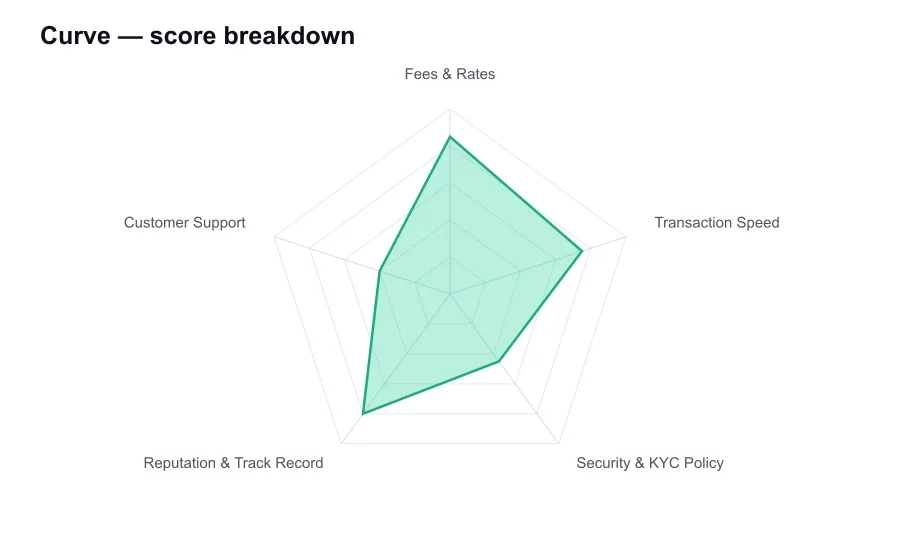
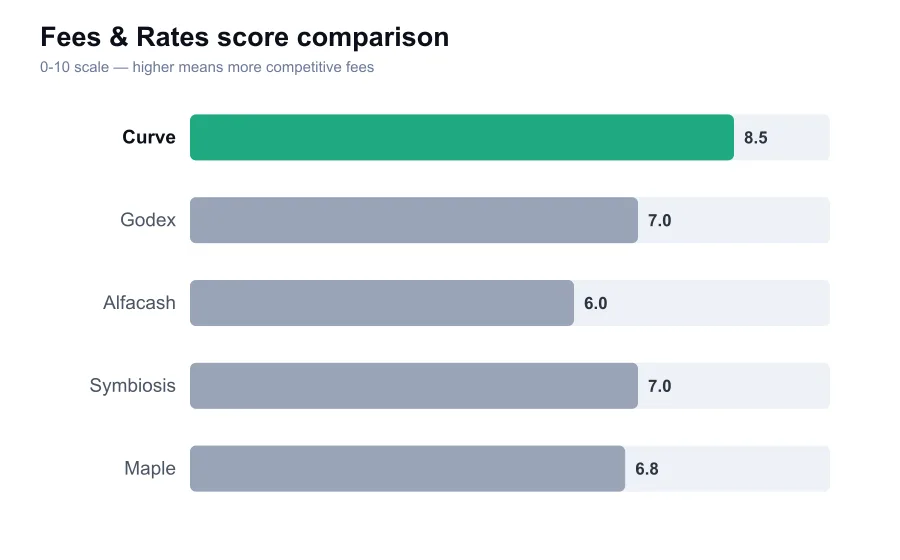
Curve scores 6.8/10 overall in our independent review, measured against every other provider we've compared, strongest on Fees & Rates (8.5/10) and weakest on Customer Support (4.0/10).
StableSwap liquidity · No-KYC · Multi-chain pools · Liquidity provider rewards
Curve is one of DeFi's foundational automated market makers, built specifically around assets that should trade near the same value. Stablecoins, wrapped versions of major coins, and liquid staking derivatives are its natural territory. It does not try to beat Uniswap at every kind of token trading. Instead, Curve's StableSwap design aims to offer deep liquidity and low slippage for correlated assets, which is exactly why it became central to stablecoin trading and onchain yield strategies.
The basic experience is simple enough. Connect a wallet, select a pool or swap route, approve the token, and confirm the transaction. Under the surface, though, Curve is a large collection of pools with different assets, risk profiles, fee settings, and incentives. A USDC to USDT swap in a heavily used pool is very different from entering a niche pool containing a volatile derivative token. The Curve name alone tells users almost nothing about the specific risk they are taking.
Fees are usually one of Curve's strongest selling points. Many traditional stablecoin pools use a base trading fee around 0.04 percent, though pool parameters vary and newer pool types can use dynamic fees. For a sizeable stablecoin exchange, that can be materially cheaper than trading through a standard 0.30 percent AMM pool, especially when Curve's bonding curve keeps slippage low. Liquidity providers earn a share of trading fees, sometimes supplemented by CRV incentives or external rewards.
Low visible fees do not always mean low total cost. A pool that has become imbalanced can produce worse execution, and a stablecoin that has lost market confidence can trade at a meaningful discount. Curve's pricing mechanics reflect supply and demand rather than promising a one dollar redemption. Users swapping into a discounted stablecoin are taking a view on that asset, whether they admit it or not. The cheap swap fee is no compensation for holding something that may depeg.
Gas is the other major cost. Curve began on Ethereum, where even an inexpensive pool fee can be overshadowed by network fees during congestion. Its presence across multiple networks, including Arbitrum, Optimism, Polygon, Base, and others, makes the experience much more affordable for ordinary users. On an L2, Curve is often excellent for stablecoin rebalancing. On Ethereum mainnet, it makes most sense for larger trades, LP management, or transactions where the price improvement is worth the gas.
Transaction speed follows the chain. A swap on Ethereum can take minutes and may fail if the market shifts beyond the user's slippage tolerance before inclusion. On L2s it is often much faster, usually seconds. Curve's contracts themselves are not trying to create an exchange-like instant fill. They settle onchain, with all the advantages and constraints that implies. A centralized venue such as Kraken can feel faster, but that speed comes with custody, account controls, and a different type of counterparty risk.
For stablecoin specialists, Curve can be exceptionally efficient. Its pools have historically handled large volume in assets such as USDC, USDT, DAI, FRAX, crvUSD, and various wrapped or yield-bearing equivalents. The protocol's crvUSD stablecoin also introduced LLAMMA, a liquidation mechanism designed to gradually rebalance collateral as prices move rather than relying only on a sudden hard liquidation event. It is an innovative idea, but it is not simple and should not be treated as a low-risk borrowing tool.
Providing liquidity is where inexperienced users most often misunderstand Curve. A stable pool can seem safer than a volatile token pair because it reduces conventional impermanent loss between assets expected to stay close in price. But it replaces that with concentration risk. If one stablecoin depegs, liquidity providers can end up holding more of the asset that everyone else is selling. That happened in dramatic form across DeFi during past stablecoin crises. A high annual percentage yield does not erase that risk.
Security is Curve's biggest concern today, not because the protocol is amateurish, but because it has an extensive and complicated history. Curve has been battle-tested over years and has undergone audits, yet it has also suffered serious incidents. In 2023, a Vyper compiler vulnerability affected several Curve pools and led to major losses. Curve has also faced attacks and economic stress involving pools, tokens, and integrations. Long operating history can be evidence of resilience, but it is also evidence that mature code can still fail.
The protocol's complexity has grown over time. Multiple pool types, gauges, voting escrow CRV, factory deployments, lending features, cross-chain deployments, and external integrations create a broad attack and operational surface. Governance is influential because veCRV holders direct CRV emissions, while Convex has historically become a powerful force in that ecosystem. This is fascinating for sophisticated users, but it is not the cleanest environment for someone who simply wants to exchange two stablecoins once a month.
Curve is noncustodial and does not require standard KYC for wallet-based swapping or liquidity provision. That is a clear positive for users who want to retain control of assets. It also means that mistakes are final. There is no refund desk for sending funds to the wrong network, approving a fake contract, or entering an unsuitable pool. Phishing remains a persistent threat, especially because Curve users often interact with third-party dashboards, gauges, and incentive tools.
Reputation is complicated but substantial. Curve is not a newcomer that can disappear after one market cycle. It has been a critical piece of Ethereum DeFi infrastructure since 2020 and has influenced how stablecoin liquidity is organized across the industry. At the same time, its incidents, governance politics, and dependence on token incentives have damaged the perception of effortless safety. Calling Curve trusted is fair. Calling it simple or risk-free is not.
Support is mostly documentation, community discussion, and public issue resolution. That is adequate for technically capable users, but not comforting for someone facing a large loss or a confusing contract interaction. Curve's interface and ecosystem can also feel dated or fragmented compared with modern consumer exchange apps. A user may need to consult analytics sites, block explorers, and community explanations to understand a pool's true condition. That is too much work for casual traders.
Curve remains extremely useful for what it does best: moving between correlated assets with competitive slippage and fees. A stablecoin trader, a DAO treasury manager, or an experienced LP can find real value here, particularly on low-fee chains. It is a poor place to blindly pursue eye-catching liquidity incentives or to borrow against volatile collateral without understanding crvUSD mechanics. The protocol rewards users who can distinguish a healthy pool from a yield trap.
My final view is that Curve is indispensable infrastructure with a safety record that demands respect rather than blind confidence. Its fee efficiency and specialized pricing are still first class, and few competitors match its relevance in stablecoin liquidity. But the security history, complex ecosystem, and LP tail risks prevent an unqualified recommendation. Use Curve for deliberate, informed stable-asset trades. Do not use it as a substitute for risk analysis.
Who it suits
Curve suits experienced stablecoin traders, treasury managers, and liquidity providers who can evaluate pool composition and depeg risk. It is especially useful for large correlated-asset swaps on low-cost networks. Casual users who want a simple exchange or guaranteed stablecoin safety should look elsewhere. New liquidity providers should avoid chasing CRV incentives until they understand how pool imbalances can change what they hold.
The practical view
Strengths and trade-offs
What stands out
- Excellent pricing for correlated assets
- Low fees in many stablecoin pools
- Deep historic stablecoin liquidity
- Noncustodial and no routine KYC
- Available across several networks
What to weigh
- Serious historical security incidents
- Liquidity providers face depeg exposure
- Complex pools, incentives, and governance
- Limited direct customer support
Scorecard
How the score is built
Verdict
My take on Curve
Curve is still one of the most important protocols in DeFi, and its specialized stable-asset execution remains genuinely hard to beat. That status should not obscure the cost of complexity and its meaningful exploit history. For a careful stablecoin swap, it can be an excellent choice. For passive yield seekers, it can be a far riskier proposition than the interface suggests. Curve deserves use, scrutiny, and respect in equal measure.
Review questions
Curve FAQ
What fees does Curve charge?
Many classic Curve pools have used a 0.04 percent trading fee, but exact fees vary by pool and newer designs may use dynamic pricing. Network gas is charged separately.
Is Curve safe for liquidity providers?
No liquidity pool is risk-free. Curve LPs can face smart contract risk, pool imbalance, and major losses if a stablecoin or derivative asset depegs.
Does Curve require KYC?
Curve's decentralized wallet-based functions generally do not require standard KYC. Users retain custody and are responsible for their wallet, approvals, and transaction choices.
Why is Curve good for stablecoin swaps?
Its StableSwap pricing curve is designed for assets expected to trade near the same value, which can reduce slippage compared with a standard constant-product pool.
Reader experiences
What users report
Continue your comparison
Read across the full ranking before deciding which provider best fits your own needs.
Compare providers