Ranked #30 of 74 · Updated October 2026
Godex review
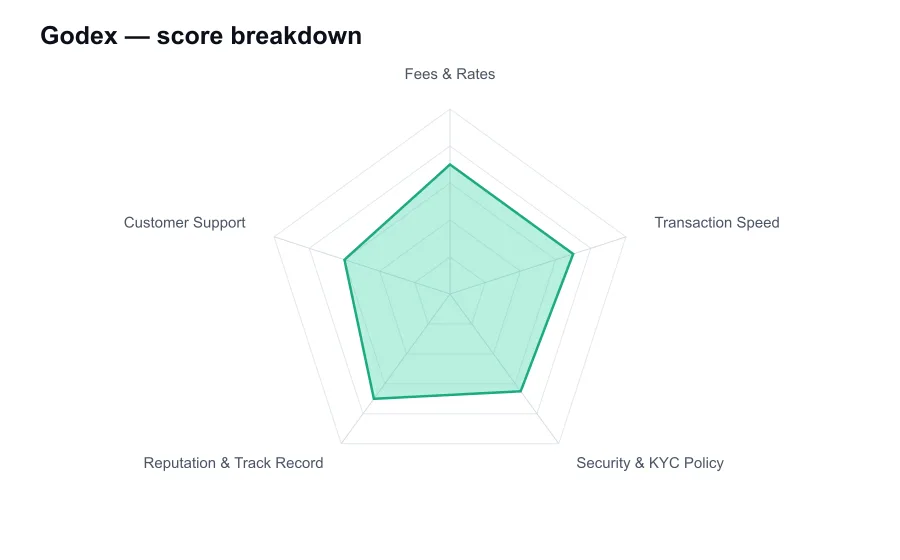
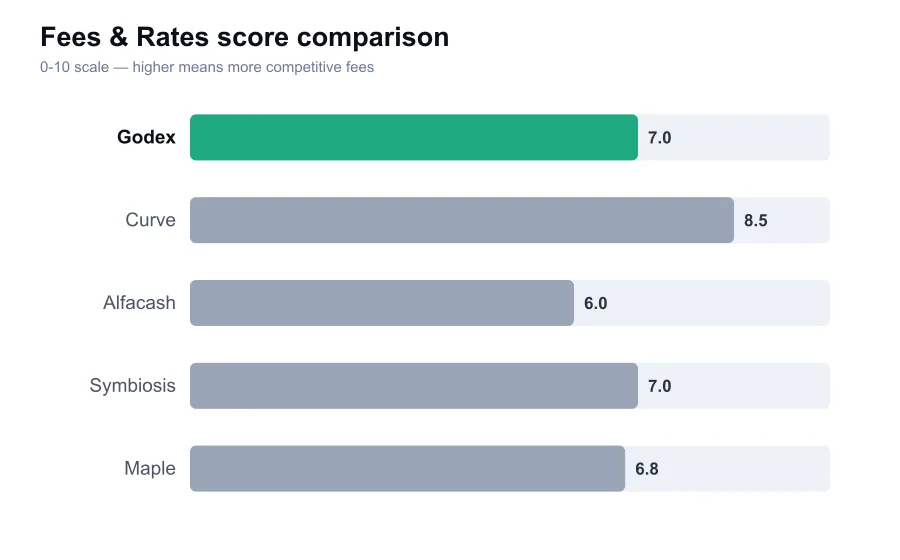
Godex scores 6.8/10 overall in our independent review, measured against every other provider we've compared, strongest on Fees & Rates (7.0/10) and weakest on Customer Support (6.0/10).
Fixed-Rate Swaps · No Routine KYC · Wallet-to-Wallet · Multi-Asset Support
Godex is one of the older names in the no-account instant-exchange segment. It is built for a specific kind of user, someone who already holds crypto in a personal wallet and wants to swap without opening a trading account, placing limit orders, or going through routine identity verification. It is not a replacement for Coinbase, Kraken, or Binance. It is a simpler conversion layer, and that distinction explains both its appeal and its limitations.
The service has traditionally emphasized anonymous exchange and a fixed-rate model. That proposition remains attractive to users who want to know the expected payout before they send funds. Fixed pricing reduces the unpleasant surprise of a market move during confirmation time, particularly on volatile pairs. Godex is not unique in offering it, but it has made rate certainty a central part of its identity rather than an optional afterthought.
The fee story is clearer than at many quote-based rivals, though users should still read the actual offer. Godex has promoted a flat exchange fee in the 0.5 percent range, with network costs and market pricing reflected in the final quote. A flat figure is easy to understand, but it does not automatically make every swap cheap. On liquid pairs, a centralized exchange can cost far less. On odd altcoin pairs, Godex's all-in quote can be reasonable because it removes several manual steps.
What matters is the receiving amount. Godex may advertise a fixed fee, yet liquidity and network conditions can make a quote less attractive than one from LetsExchange, ChangeNOW, or Trocador. I would not assume it wins every comparison. For a normal-sized conversion, opening two or three browser tabs takes less than a minute and can save a meaningful amount. That is especially true during high Ethereum gas periods.
Godex's fixed-rate mechanism is useful for users who value predictability, but it has practical conditions. The user must send the correct asset, on the correct network, and within the allotted time. A late or underfunded deposit can create a manual support case. Fixed rate protects against normal market movement, not against user mistakes, blockchain congestion beyond the allowed window, or an unsupported token sent to the deposit address.
Transaction speed is respectable for an instant-exchange service, not extraordinary. The swap cannot begin in earnest until the deposit reaches the confirmation threshold. Litecoin or a quick EVM transfer can be processed relatively fast. Bitcoin and busy Ethereum transfers naturally take longer. In ordinary conditions, many transactions settle within several minutes to half an hour. A longer wait does not necessarily mean something is wrong, but Godex should not be chosen for a hard deadline.
The interface is uncomplicated and that works in its favor. There is little account clutter, and the transaction page provides a way to follow the swap. New users should still slow down at the address and network stage. Godex supports numerous assets, and multi-network tokens create room for costly mistakes. USDT on Ethereum, Tron, BNB Chain, Polygon, and other networks are not interchangeable just because the ticker looks the same.
Godex does not generally demand KYC for standard swaps, which is a defining attraction. Yet no exchange service operating in the real world can honestly promise that every transfer will bypass scrutiny forever. Suspicious activity, sanctions exposure, stolen-fund alerts, or partner requirements can lead to a hold and a request for information. Users who think no-KYC means no compliance should reset their expectations before they send anything.
From a custody perspective, Godex reduces some risks because it does not ask customers to keep a long-term exchange balance. You connect no wallet and retain no account there. Funds are nevertheless transferred into the swap process, so there is an unavoidable period of counterparty exposure. This is safer than leaving a large balance on a poorly secured exchange, but it is less trust-minimized than a decentralized swap executed directly from a wallet.
The company has a longer public footprint than many similar services, and that counts. Godex has been known in crypto swap comparisons for years and has a material collection of user reports across review platforms and forums. The record is not spotless. Complaints about delayed transactions, quote disputes, and support friction appear, as they do for nearly every instant exchanger. The relevant question is whether the service is recognizable and testable, and on that point it clears the bar.
I would still be careful with large sums. Godex has not built the kind of institutional transparency associated with a heavily regulated exchange, and it is not designed as a venue for six-figure execution. For a modest wallet-to-wallet conversion, the risk profile is understandable. For a major portfolio rebalance, professional trading venue fees, liquidity, and accountability are usually more attractive than the convenience of a single swap form.
Support is available through the website and email, with the transaction ID being the key piece of information for any issue. Routine questions are normally manageable. Complicated cases can be slower because the support team may need to coordinate with a liquidity source or investigate a deposit. That is frustrating, but it is more honest to see it as a structural limitation of instant exchanges than to expect the response speed of a bank transfer desk.
Godex is particularly good for someone who values a fixed expected result more than squeezing every basis point from a trade. It is also convenient for converting an asset that their primary exchange does not list. It is less compelling for day traders, users seeking fiat ramps, or anyone wanting advanced order types. Its product is deliberately narrow, and it works best when used for that narrow job.
My take is that Godex remains a credible mid-tier instant exchanger. It has real longevity, straightforward mechanics, and a useful fixed-rate proposition. Its shortcomings are the usual ones for this category, higher all-in costs than an exchange, temporary counterparty risk, and occasional support dependency. Use it for a measured wallet swap, compare its quote first, and do not confuse its privacy-friendly onboarding with an absence of compliance risk.
Who it suits
Godex suits self-custody users making occasional, moderate-sized swaps who prefer a fixed expected payout. It is particularly useful for coins not conveniently available on a user's main exchange. Day traders, high-volume users, and people who need fiat services should look to conventional exchanges. Anyone sending a large amount should compare quotes and consider splitting the transaction.
The practical view
Strengths and trade-offs
What stands out
- Fixed-rate swaps reduce price uncertainty
- No routine account registration
- Longer operating history than many instant exchangers
- Broad selection of supported crypto assets
What to weigh
- All-in pricing can trail exchange order books
- No guarantee against compliance-related holds
- Not ideal for very large or urgent transfers
Scorecard
How the score is built
Verdict
My take on Godex
Godex has survived because it does a simple job reasonably well. Its fixed-rate focus is more valuable than flashy marketing, especially in a volatile market. The service is not cheap enough to replace an exchange for regular trading, and its privacy positioning does not eliminate compliance risk. Still, for a straightforward wallet swap with a checked quote, Godex is a credible and practical choice.
Review questions
Godex FAQ
Does Godex charge a 0.5 percent fee?
Godex has historically promoted a flat fee around 0.5 percent. Network costs and liquidity pricing also affect the final payout, so check the quoted receive amount before confirming.
Does Godex require KYC?
Routine swaps generally do not require KYC or an account. Transactions flagged by compliance systems can still be reviewed, and additional information may be requested.
Are Godex rates really fixed?
Godex offers fixed-rate swaps, subject to its stated deposit window and conditions. Send the exact asset and amount promptly, because a late or incorrect deposit can affect processing.
Reader experiences
What users report
Continue your comparison
Read across the full ranking before deciding which provider best fits your own needs.
Compare providers