Ranked #33 of 74 · Updated October 2026
Maple review
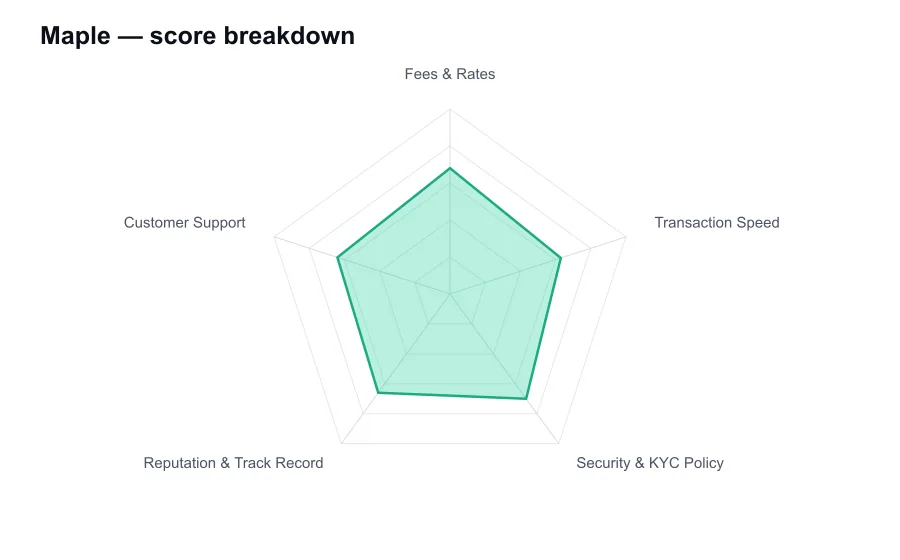
Maple scores 6.7/10 overall in our independent review, measured against every other provider we've compared, strongest on Security & KYC Policy (7.0/10) and weakest on Transaction Speed (6.3/10).
Institutional credit · Onchain lending · Stablecoin yield products · Permissioned pool options
Maple is one of the more unusual names in DeFi because it was built around institutional credit rather than anonymous retail lending pools. Its original proposition was to bring capital markets logic onchain: lenders could supply digital assets into pools, while professional borrowers received undercollateralized or unsecured credit after assessment by designated pool delegates. That made Maple more ambitious than a standard overcollateralized protocol, and it also made the risks much more concrete.
The platform has evolved substantially since its early pool model. Today its public offering includes institutional lending infrastructure and products associated with syrupUSDC, designed to provide onchain yield sourced from Maple's lending activity. The details of eligibility, liquidity, geography, and available products can vary, so a user should read the live terms rather than relying on old descriptions of Maple as a single simple lending pool. This is a credit platform, not a universal retail exchange.
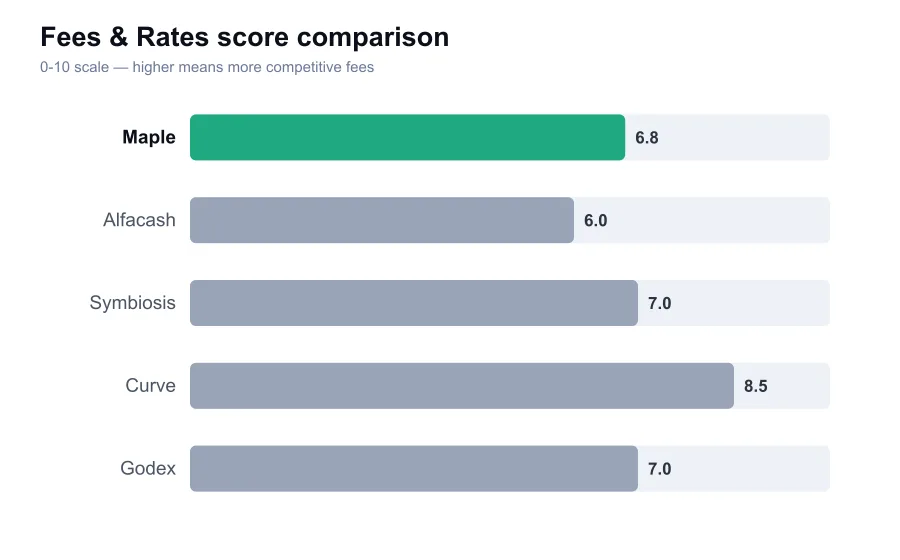
Maple's fees are not comparable with a flat spot trading fee. A lender's return is shown as a yield after, or alongside, the economics of loan origination, servicing, and pool management, depending on the specific product. Borrowers negotiate or receive terms reflecting their credit profile, collateral structure, duration, and liquidity needs. That can be efficient for large professional borrowers. It is not a transparent one line price menu for someone swapping a few hundred dollars of tokens.
Retail users considering syrupUSDC should look beyond the advertised annual percentage yield. The first question is where the yield comes from. In Maple's case, it is tied to institutional lending and the associated credit risk, not magic. The second question is how redemptions work during stress. Yield products can have redemption windows, liquidity conditions, or operational constraints that look unimportant until many users want out at once. Read the current product documents before treating a tokenized yield balance as cash.
Transaction costs depend heavily on the chain and access route. Onchain deposits, redemptions, transfers, and approvals require network fees, while cross chain movement can add bridging costs and risk. The protocol may be cheaper to interact with than executing repeated Ethereum mainnet trades, but that does not mean it is ideal for tiny balances. A user chasing a few points of yield with a small deposit should calculate the full cost of entering, exiting, and potentially moving stablecoins across networks.
Speed is also more nuanced than a swap confirmation. Token transactions can settle quickly on the relevant chain, but institutional credit does not move at the speed of a meme coin trade. Borrower onboarding, loan structuring, credit decisions, and collateral processes are deliberately slower because they involve real underwriting. That is a feature, not a flaw. Anyone expecting instant access to every product should use a conventional exchange or a simple overcollateralized lending market instead.
Maple's reputation deserves both credit and scrutiny. It established itself as a serious attempt to connect professional credit with DeFi, which is harder to build than another automated market maker. It also faced a severe public test in the 2022 credit crisis, when borrower defaults including the highly visible Orthogonal situation damaged lenders and exposed the fragility of undercollateralized crypto credit. A credible review cannot mention Maple's institutional vision without mentioning that episode.
The response since then matters. Maple has changed products, emphasized stronger risk frameworks, and continued to operate in a far more cautious market. But recovery and adaptation do not erase history. The platform's central risk remains credit judgment. If a borrower fails, the lender does not care that the smart contract settled perfectly. Smart contract security is necessary, while underwriting quality and legal enforceability are equally important.
This is the key difference between Maple and Aave or Spark. In an overcollateralized market, a user can often inspect collateral rules and liquidation thresholds mechanically. Maple's credit approach involves assessing counterparties, structures, and delegated decision making. That may generate returns unavailable in purely collateralized lending, but it also introduces risks that cannot be reduced to a health factor on a dashboard. The potential reward is payment for taking more complicated risk.
Security on the technical side benefits from Maple's long operating history, public profile, and institutional orientation. Its products have had greater scrutiny than a newly launched anonymous protocol. Still, there is no sensible way to award a credit protocol a perfect security score. Smart contract bugs, oracle and integration failures, custody arrangements, governance actions, counterparty defaults, and stablecoin risk all remain relevant. Diversification is not optional for a Maple lender.
KYC is product dependent. Direct interaction with certain onchain products may be wallet based, while institutional borrowing, permissioned pools, and regulated access routes can require substantial verification. That is appropriate for a protocol courting professional capital, but it means Maple does not offer the uniform open access experience some DeFi users expect. Prospective users should not assume that a public token interface grants access to every lending opportunity.
Support is more serious than the Telegram only model common in DeFi, particularly for professional participants, but retail users should still set expectations correctly. Documentation and official channels can explain an integration or product rule. They cannot guarantee immediate redemption, reverse a mistaken wallet transaction, or compensate a loss due to a borrower default. A platform dealing with institutional credit can be responsive and still not provide consumer banking protections.
The best use case is narrow but legitimate. A sophisticated stablecoin user who understands the credit source of yield may find Maple's products more intellectually honest than a high yield platform that refuses to explain its business model. An institution needing blockchain based credit rails has even more reason to examine it. Someone looking for quick token swaps, an insured savings account, or guaranteed liquidity does not.
My judgment is that Maple is a serious platform with serious risks, which is a better description than calling it simply safe or unsafe. Its reputation has been earned through innovation and scarred by real credit losses. That history should make users more careful, not automatically dismissive. Maple can belong in a diversified, research driven DeFi allocation. It should never be mistaken for a risk free stablecoin yield account or a replacement for a liquid exchange balance.
Who it suits
Maple suits sophisticated stablecoin holders who can evaluate credit risk and institutions seeking onchain lending infrastructure. It can also suit DeFi users willing to research syrupUSDC terms, redemption mechanics, and concentration risk. Beginners looking for token trading, instant cash access, or guaranteed yield should avoid it. Investors who cannot tolerate delayed liquidity or credit losses should choose a simpler product.
The practical view
Strengths and trade-offs
What stands out
- Distinct institutional credit focus
- Yield source is tied to lending activity
- More established than most credit protocols
- Useful infrastructure for professional borrowers
What to weigh
- History includes significant borrower defaults
- Not a simple exchange or cash equivalent
- Credit risk is harder to assess than liquidation risk
- Access and KYC vary by product
Scorecard
How the score is built
Verdict
My take on Maple
Maple deserves respect for attempting a difficult thing, bringing real credit assessment into public blockchain markets. It also deserves skepticism because its history proves that credit losses are not theoretical. The platform is more credible than a mystery yield farm, but its products demand more analysis than an overcollateralized lending market. Use Maple only if you understand that the yield is compensation for risk, not a promotional gift.
Review questions
Maple FAQ
Is Maple a crypto exchange?
No. Maple is primarily an onchain credit and lending platform. Some products offer tokenized yield exposure, but it is not a broad retail exchange for buying and selling many cryptocurrencies.
What is the main risk of lending through Maple?
Credit risk is central. Borrowers can default, and that risk exists alongside smart contract, stablecoin, liquidity, and operational risks. Past defaults show why lenders must diversify.
Does Maple require KYC?
Requirements vary. Institutional borrowing and permissioned products can require verification, while some onchain products may be wallet based. Check the current terms for the product and jurisdiction.
Reader experiences
What users report
Continue your comparison
Read across the full ranking before deciding which provider best fits your own needs.
Compare providers