Ranked #32 of 74 · Updated October 2026

Symbiosis review
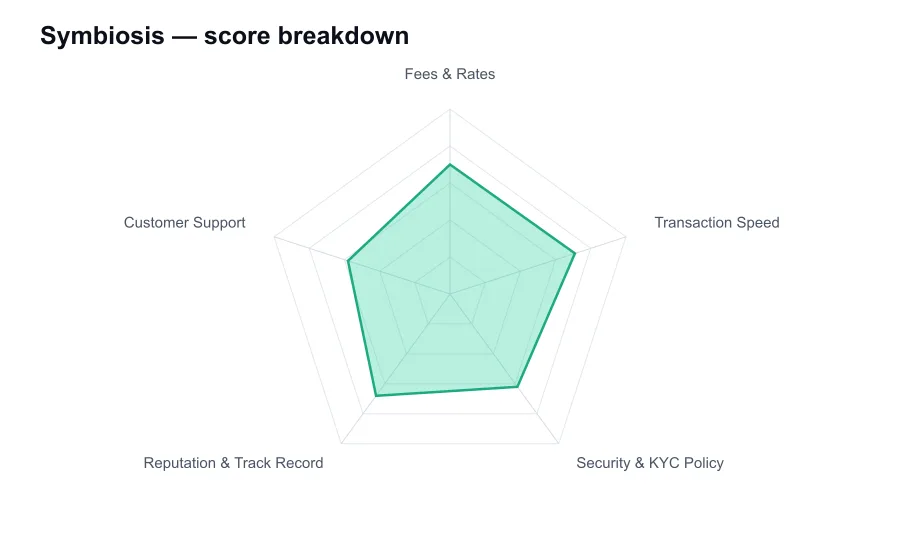
Symbiosis scores 6.7/10 overall in our independent review, measured against every other provider we've compared, strongest on Transaction Speed (7.1/10) and weakest on Customer Support (5.8/10).
Cross-chain swaps · Self-custody · No routine KYC · Multi-network routing
Symbiosis is not an exchange in the traditional custodial sense. It is a cross-chain liquidity protocol designed to let users swap assets between blockchain ecosystems from a single interface. A person can begin with an asset on one supported network and end with another asset on a different network without manually using a bridge, finding a destination decentralized exchange, and managing wrapped versions of tokens at every step. That is the practical problem Symbiosis is trying to solve.
The product belongs in the same broad conversation as LI.FI-powered aggregators, Rango, Squid, Stargate-based routes, and other cross-chain swap tools. Its pitch is especially attractive to DeFi users who are tired of building their own route across chains. Instead of bridging USDC, switching networks, approving another contract, and swapping again, Symbiosis can package the route into one intent. The result is cleaner, but it is not magic. There are still several protocols, pools, relayers, and blockchains behind that clean screen.
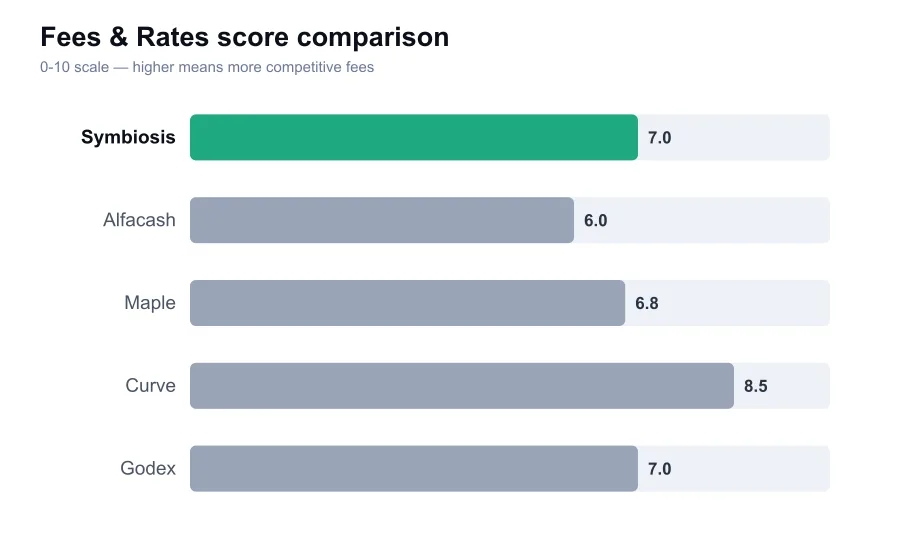
That complexity makes fee analysis more important than it is on a single-chain decentralized exchange. A Symbiosis transaction can include a swap fee from an automated market maker, bridge or cross-chain execution costs, protocol charges, gas on the source chain, and sometimes destination-chain gas handling. There is no honest universal number that applies to every route. A low-fee transfer between inexpensive networks can be cheap, while an Ethereum-originated route can become expensive before the swap itself has even begun.
The protocol has historically used pool-based swap fees around the familiar decentralized-finance range, often near 0.3 percent for liquidity pools, but users should not treat that as the all-in cost. The quote displayed before confirmation is the figure that matters. It should show the estimated output, minimum received amount, price impact, and network costs. If those details are unclear, do not proceed simply because the interface says the route is optimized. A route can be technically efficient and still be uneconomic for a small transaction.
For medium-sized transfers between supported lower-cost chains, Symbiosis can be very competitive against doing every step manually. The savings are often in avoided mistakes and time rather than in a tiny protocol fee. Anyone who has paid Ethereum gas twice because a bridge deposited the wrong wrapped asset understands that point. For large orders, though, compare several aggregators and inspect slippage. Cross-chain liquidity is fragmented, and a route that looks good for a $500 trade can be poor for a $25,000 trade.
Speed is similarly route dependent. A swap between fast networks can complete in a few minutes, sometimes less if confirmations and relayer activity are favorable. A transaction involving Ethereum, a congested source chain, or a destination with delayed finality can take considerably longer. Unlike a centralized exchange, Symbiosis cannot simply update an internal ledger and declare the trade done. The underlying chains have to confirm events, and the cross-chain execution machinery has to complete its work.
That means a pending transaction is not automatically a failure. Users should check the transaction hash on the source chain, the protocol's transaction tracker where available, and the destination wallet before panicking. Still, cross-chain waiting is one of the least pleasant experiences in crypto. Funds can be in transit, the destination token may not appear in a wallet interface immediately, and a failed downstream swap can require a refund or claim path. Symbiosis makes this easier than manual bridging, but it cannot erase the underlying operational complexity.
The security model is fundamentally different from a centralized exchange. Symbiosis does not require users to deposit funds into an account controlled by a company, and it does not impose ordinary customer KYC. You connect a self-custody wallet, approve a contract, and sign transactions. That is a major advantage for users who value control and composability. It also means there is no support agent who can reverse a mistaken approval, recover a seed phrase, or cancel a transfer after it has been confirmed.
Smart-contract risk is the central concern. Cross-chain protocols are among the most attractive targets in DeFi because they touch multiple networks and can control deep pools of liquidity. Symbiosis has undergone security reviews and publishes technical and audit-related material, but an audit is not an insurance policy. The wider history of crypto bridges is full of sophisticated failures. A user should treat every cross-chain protocol as a calculated exposure, keep approvals narrow where possible, and avoid using unfamiliar token contracts merely because they appear in a route.
No routine KYC is a genuine feature, not a loophole to exploit. Wallet-based access makes Symbiosis useful for users in places where centralized onboarding is awkward or for those who simply do not want another financial account. Yet users remain responsible for legal compliance, sanctions restrictions, tax reporting, and the source of funds they move. The lack of an account also means the protocol has far less ability to intervene if a regulator, wallet provider, or token issuer blocks part of a transaction path.
Symbiosis has been active through several market cycles since its 2021-era launch and has earned recognition among cross-chain DeFi users. It has a more substantial identity than a fly-by-night bridge clone, with documented integrations and a visible community. Its reputation is still narrower than that of an exchange like Kraken or a base-layer protocol such as Uniswap. That is not a criticism of its product, it is a realistic measure of maturity. Cross-chain infrastructure remains a fast-moving, high-risk sector.
The protocol's own SIS token and governance ambitions add another layer that ordinary swap users do not need to care much about. Governance can help align liquidity incentives and development, but token ownership does not make a route safer or cheaper by itself. I would judge Symbiosis by execution quality, transparent quoting, contract security, and support for the networks I need. DeFi users sometimes spend too much time evaluating a governance token and too little time checking whether the route has enough real liquidity.
Support is better thought of as a combination of documentation, community channels, transaction explorers, and team assistance rather than a conventional customer-service desk. Telegram and Discord-style community support can be helpful, and a public protocol has the benefit that other experienced users may recognize a common routing issue. It can also be uneven. If you need a guaranteed response at a particular hour, a decentralized protocol is not the right expectation. Public channels are useful, but never share your seed phrase or private key with anyone claiming to be support.
The interface has improved the complicated task it represents. Network selection, token choice, allowance approval, route quote, and status tracking are presented in a sequence that a DeFi regular will understand quickly. New users need to slow down. Confirm the network at both ends, verify the destination asset, read the minimum received amount, and leave enough native gas token in each wallet. A successful USDC route is not much help if you arrive on a chain with no gas to make the next transaction.
Symbiosis is best for users who already understand self-custody and want fewer steps in a cross-chain move. It is not the place for a first crypto purchase, an emergency transfer, or money that cannot tolerate smart-contract and bridge risk. Start with a small test transaction, especially on a new route. That may feel cautious, but a test is cheaper than discovering that a wallet has selected the wrong network after you have sent a large amount.
My take is that Symbiosis is useful infrastructure, not a substitute for judgment. It can reduce the friction of moving value across chains and often does so with a more coherent experience than manual bridge hopping. The price of that convenience is exposure to smart contracts, liquidity fragmentation, and cross-chain execution risk. For informed DeFi users, that trade can make sense. For anyone who wants the certainty of a bank-like transfer, it absolutely does not.
Who it suits
Symbiosis is for experienced DeFi users moving assets between supported chains who understand wallet approvals, gas, and bridge risk. It is particularly useful for reducing the number of manual steps in a multi-chain swap. Beginners buying their first crypto, users needing guaranteed settlement, and people uncomfortable with irreversible transactions should use a regulated centralized exchange instead. Test a new route with a small amount first.
The practical view
Strengths and trade-offs
What stands out
- Cross-chain swaps from one interface
- No routine KYC or custodial account
- Useful route abstraction for DeFi users
- Supports self-custody wallet workflows
What to weigh
- Smart-contract and bridge risk
- Total fees vary by chain and route
- Support is less predictable than a centralized exchange
Scorecard
How the score is built
Verdict
My take on Symbiosis
Symbiosis solves a real usability problem in cross-chain DeFi and does so with a cleaner experience than assembling a bridge-and-swap route by hand. Its best attribute is not that it is risk-free, because it is not, but that it makes a complicated process more manageable for users who know what they are signing. Costs can be competitive, yet every route needs individual scrutiny. I would use it selectively for supported, liquid routes and never treat a cross-chain swap as routine enough to skip a final check.
Review questions
Symbiosis FAQ
Does Symbiosis require KYC?
Symbiosis is wallet-based and does not normally require centralized account KYC. Users remain responsible for complying with laws, sanctions rules, and tax obligations.
How long do Symbiosis cross-chain swaps take?
Many routes finish within minutes, but timing depends on source and destination confirmations, congestion, relayer activity, and the selected networks.
What fees does Symbiosis charge?
The final cost can include liquidity-pool fees, cross-chain execution costs, source-chain gas, and price impact. Review the displayed quote and minimum received amount before signing.
Reader experiences
What users report
Continue your comparison
Read across the full ranking before deciding which provider best fits your own needs.
Compare providers