Ranked #34 of 74 · Updated October 2026

FixedFloat review
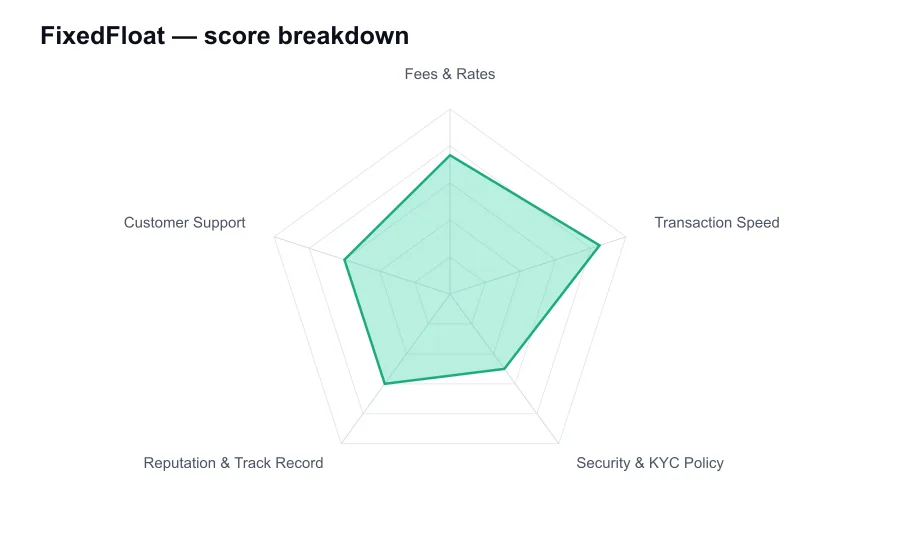
FixedFloat scores 6.6/10 overall in our independent review, measured against every other provider we've compared, strongest on Transaction Speed (8.5/10) and weakest on Security & KYC Policy (5.0/10).
No routine KYC · Fixed rate swaps · Floating rate swaps · Lightning Network support
FixedFloat is one of the better known instant crypto swap services aimed at people who want to exchange coins without opening a conventional trading account. It has never tried to be Coinbase, Kraken, or Binance. There is no order book, no fiat balance, and no elaborate dashboard. You choose the assets, send funds to a generated address, and receive the converted asset at another address. That simplicity is the point, and it has made FixedFloat popular with technically confident users who value speed and privacy.
The service is especially associated with Bitcoin, Lightning Network, Ethereum, stablecoins, and a broad list of major altcoins. Its interface is unusually clean for this corner of the market. A newcomer can understand the basic flow quickly, while an experienced user can get through a repeat transaction in minutes. FixedFloat also exposes enough technical detail, including expected amounts, rate mode, network requirements, and transaction status, to make it more useful than many anonymous swap sites that reveal almost nothing until after a deposit is sent.
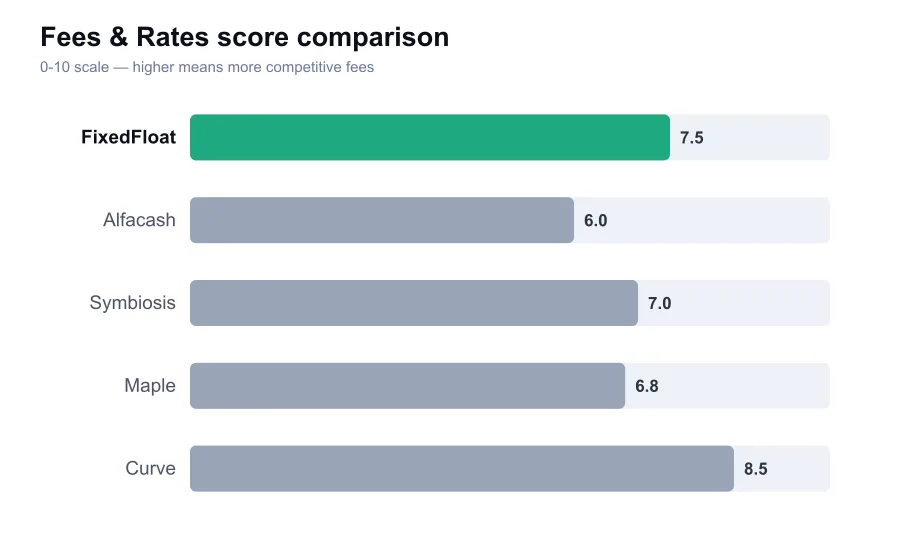
There are two pricing modes. The floating rate option has historically charged a 0.5 percent service fee, while the fixed rate option has charged 1 percent. The floating quote moves with the market between quote creation and execution. The fixed quote locks the displayed exchange rate for a limited period, subject to the service receiving the required deposit in time. That structure is sensible. A 1 percent premium for certainty is not cheap, but it is plainly stated and can be worthwhile during a fast market.
The headline fee is only part of the cost. Network fees, liquidity spreads, and the difference between a visible reference price and the provider's executable rate still matter. FixedFloat is often competitively priced for straightforward Bitcoin, Litecoin, Ethereum, and stablecoin swaps, but it should not be treated as automatically cheapest. Compare the received amount with ChangeNOW, SimpleSwap, StealthEX, and a liquid centralized exchange if you already have an account. On thin assets or during severe network congestion, the effective cost can become noticeably less attractive.
I like that FixedFloat gives users a real choice rather than marketing every quote as free. Too many instant exchange services bury their spread inside a vague best rate promise. FixedFloat's floating quote is clearer about accepting market movement, and the fixed quote makes the extra charge visible. The catch is that users need to read the quote before sending. Sending too little, too much, or after the rate window expires can turn an easy swap into a support ticket.
Speed is one of the reasons FixedFloat developed a following. For assets with healthy liquidity and normal chain conditions, an exchange can complete after the required network confirmations and a short processing window. Lightning swaps can be particularly quick, often far quicker than an onchain Bitcoin transfer. Swaps involving Ethereum and tokens depend heavily on gas conditions, while Bitcoin transactions depend on the fee attached to the incoming transaction. No instant exchange can outrun the blockchains it uses.
The practical experience is better than services that force a manual review on routine transactions. FixedFloat's automated pipeline generally means that a normal deposit goes from detected, to confirmed, to exchanged, to sent without human intervention. That is exactly what privacy minded users expect. Still, advertised estimates are not a guarantee. A low fee Bitcoin deposit, an overloaded Ethereum network, or a liquidity issue in a less common asset can add hours. Anyone on a deadline should avoid exotic pairs and use an adequately funded network fee.
The no account design is a real privacy advantage, but users should be precise about what it means. FixedFloat has commonly operated without routine identity verification for standard swaps. It does not mean every transaction is beyond compliance review. Like other noncustodial style exchange services, it can flag activity through risk controls and may request information in exceptional cases. If a transaction triggers a review, the privacy and speed benefits can evaporate quickly. That possibility is not unique to FixedFloat, but it matters.
Security is also more complicated than the word noncustodial suggests. During an exchange, FixedFloat does take possession of the assets sent to its deposit address before paying out the destination asset. Users are therefore trusting its hot wallet practices, liquidity operations, and compliance process for that period. This is not self custody in the strict sense. The safe approach is to make a small test transaction for an unfamiliar route, save the exchange ID, verify the destination address carefully, and never leave more value in the process than necessary.
Its track record has serious blemishes. FixedFloat publicly attributed large thefts in February 2024 to external attacks, with blockchain investigators reporting losses in the tens of millions of dollars across incidents. The company said affected systems were isolated and services resumed, but the events changed the risk calculation. A swap service can have a fast interface and still be exposed through wallet infrastructure. Users should not dismiss those incidents simply because their own transaction may be small.
That history does not automatically mean FixedFloat is unusable. It does mean the service deserves a lower security score than its polished operational flow might suggest. Major centralized exchanges have also suffered breaches, but they generally have more public corporate information, regulated entities, and established recovery procedures. FixedFloat offers less visibility into ownership, reserves, insurance, and internal controls. For a quick personal swap that may be acceptable. For a large transfer, it is a material weakness.
Reputation is mixed in a way that experienced crypto users will recognize. FixedFloat has been around long enough to have a real user base, a documented product identity, integrations around Lightning, and many reports of successful routine swaps. It is not a brand that appeared yesterday with a generic template. Yet its reputation is not comparable to a heavily regulated exchange with years of audited disclosures. Public review platforms also need careful reading, because instant exchange complaints are often tied to delays, address errors, rate movement, or compliance holds.
Support is available through the site's contact channels and is generally geared toward resolving a specific exchange ID rather than offering a full account management experience. That can work well for a simple missing payout problem. It is less reassuring if a large transaction is delayed or a compliance review begins. The service does provide status tracking, which removes some need to ask basic questions, but its support reputation is not strong enough to make me comfortable treating it as a high touch provider.
FixedFloat is at its best as a tool, not a financial home. It suits someone who already controls their own wallet, understands confirmation times, and wants a quick conversion between established assets without registration. It is a poor fit for first time buyers, users needing bank transfers, people who need detailed tax statements, or anyone moving money they cannot afford to have delayed. The product is efficient, but it expects the customer to know what they are doing.
My view is that FixedFloat remains useful but no longer deserves blind trust based on convenience alone. The transparent fee choices, clean flow, and Lightning support are genuine strengths. The security incidents and limited institutional transparency are equally real weaknesses. Use it for modest, time sensitive swaps after checking the quote against alternatives, and keep large holdings in a wallet under your own control. That is a more disciplined use of FixedFloat than treating it as a substitute for a regulated exchange.
Who it suits
FixedFloat fits self custody users who need a quick crypto to crypto swap, especially Bitcoin and Lightning users. It is best for modest transfers where convenience matters more than formal protections. Beginners buying their first crypto, users needing fiat rails, and anyone transferring a large amount should look to a regulated exchange or split the transaction across safer routes.
The practical view
Strengths and trade-offs
What stands out
- Clear fixed and floating rate options
- Fast Lightning Network swaps
- No routine account registration
- Clean interface with detailed exchange status
What to weigh
- Major 2024 security incidents remain concerning
- Not truly noncustodial during processing
- Limited corporate and reserve transparency
- Large or flagged transfers can face review
Scorecard
How the score is built
Verdict
My take on FixedFloat
FixedFloat has a genuinely strong product experience, and its fee model is more candid than much of the instant exchange market. The problem is not the interface. It is the gap between easy swapping and the level of trust required to hand assets to an opaque service, particularly after the 2024 incidents. For small, deliberate swaps it can be a useful option. For substantial balances, convenience is not enough compensation for the security and transparency risk.
Review questions
FixedFloat FAQ
Does FixedFloat require KYC?
Routine swaps have generally not required account registration or standard KYC. Transactions can still be screened, and the service may request information in exceptional compliance or security cases.
What does FixedFloat charge?
FixedFloat has advertised a 0.5 percent fee for floating rate exchanges and a 1 percent fee for fixed rate exchanges. Network fees and the quoted execution rate also affect what you receive.
How fast are FixedFloat swaps?
Normal swaps are often completed after required blockchain confirmations and automated processing. Lightning can be very fast, while Bitcoin, Ethereum, and token swaps depend on network conditions and deposit fees.
Reader experiences
What users report
Continue your comparison
Read across the full ranking before deciding which provider best fits your own needs.
Compare providers