Ranked #2 of 74 · Updated October 2026
Whitebit review
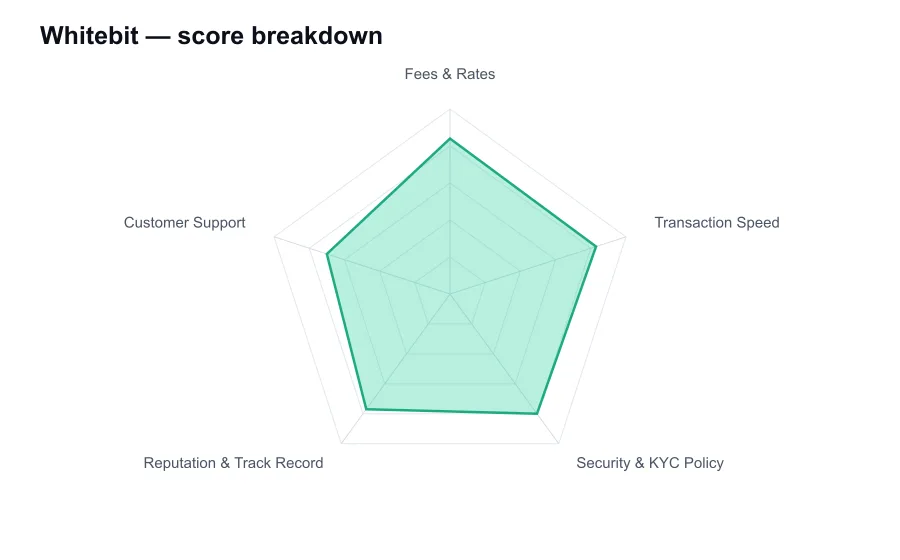
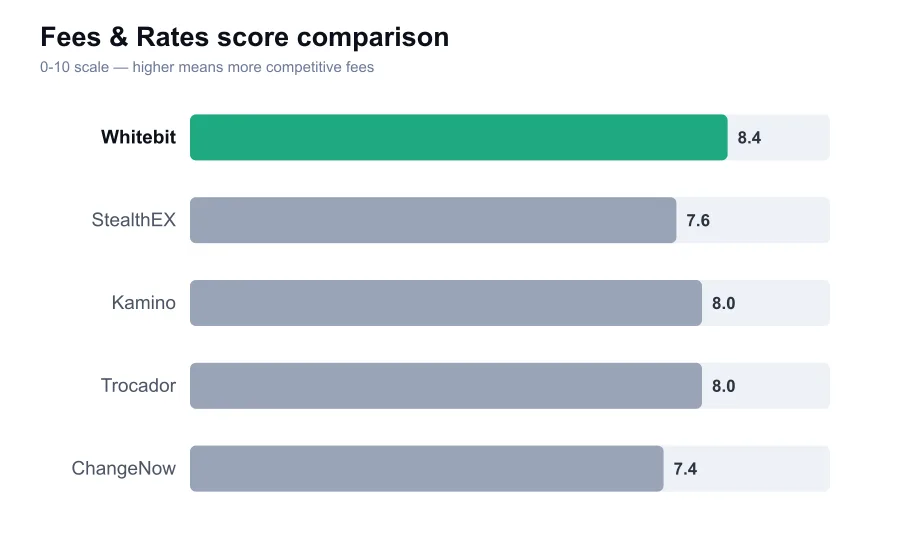
Whitebit scores 8.0/10 overall in our independent review, measured against every other provider we've compared, strongest on Fees & Rates (8.4/10) and weakest on Customer Support (7.0/10).
Spot trading · Futures markets · Fiat access · 24/7 support
WhiteBIT is a centralized crypto exchange built for people who actually trade, rather than a simple swap widget for occasional conversions. It offers spot markets, futures, margin-related products in eligible regions, earn products, card-linked services in some markets, and a large collection of trading pairs. The exchange has grown quickly from its Ukrainian roots into a Europe-focused platform with a substantial retail presence. It sits somewhere between a mass-market exchange and a more serious active-trading venue.
The first thing WhiteBIT gets right is its trading interface. A beginner can buy a major asset through a straightforward conversion screen, while a regular trader can use a proper order book, charting tools, market and limit orders, stop functions, and API access. That breadth makes it more useful than an instant exchange for anyone who wants price control. It also makes the platform more complex, especially for a first-time buyer who only wants to acquire a little BTC or USDC.
WhiteBIT's standard spot fee is commonly quoted at up to 0.1 percent, which is competitive with the large centralized exchange market. Some pairs and products have their own fee treatment, and high-volume or market-making customers can qualify for lower rates. This is the kind of pricing structure I prefer because the charge is visible before execution rather than buried inside a conversion quote. Users should still inspect the specific market fee and the spread on the quick-buy screen, because convenience conversions are not the same as a limit order on a liquid book.
Futures pricing is also competitive by retail exchange standards, with maker fees around 0.01 percent and taker fees around 0.035 percent on many contracts, subject to the current schedule. Those numbers are attractive, but they should not be confused with a reason to use leverage casually. Funding, liquidation risk, slippage, and volatile collateral can dwarf the posted commission. WhiteBIT gives traders the tools, but the exchange cannot protect someone who opens an oversized perpetual position during a violent market move.
Deposit and withdrawal costs require more scrutiny. Crypto deposits are generally free apart from the network transaction used to send them. Withdrawals carry asset-specific fees and minimums, which can change with blockchain conditions. Fiat payment methods can also involve card processor, bank, or regional charges. This is normal, but it means a trader should not rate the platform solely by the 0.1 percent spot headline. For frequent small withdrawals, network fees matter more than the trade fee.
Execution speed is one of WhiteBIT's stronger points. On active pairs, the matching engine is responsive and market orders are generally filled immediately at available liquidity. Limit orders behave as they should, either filling against the book or resting until price reaches them. A centralized exchange has a major practical advantage here over a multi-hop on-chain swap: the trade itself does not wait for block confirmations. The blockchain delay begins only when you withdraw.
That distinction matters in a fast market. You can sell an asset on WhiteBIT quickly, but you may still wait for risk checks, batching, and chain confirmations before receiving it in a private wallet. Most normal withdrawals are processed without drama, yet no centralized exchange should be treated as an instant cash machine during market stress. Deposits can also be delayed by confirmation requirements or temporary wallet maintenance. The status page and wallet notices are useful, but they do not eliminate operational pauses.
Security is a serious part of WhiteBIT's public pitch. The exchange states that it keeps the large majority of client assets in cold storage and publicizes security certifications and security partnerships. It has also promoted its compliance with CryptoCurrency Security Standard requirements. Those measures are meaningful, and WhiteBIT's security posture appears more developed than that of a small offshore exchange with anonymous operators. Two-factor authentication, anti-phishing controls, withdrawal address protection, and careful account hygiene are still essential on the user side.
The uncomfortable truth is that centralized custody always creates a single point of exposure. A cold-storage claim is reassuring, not a personal guarantee. Users must consider operational security, legal jurisdiction, banking relationships, asset segregation, and the exchange's ability to handle a crisis. WhiteBIT has published proof-of-reserves material for supported assets, which is better than silence, but proof of reserves is not a complete audit of liabilities, governance, or liquidity. It should be treated as one transparency signal among several.
KYC is mandatory for ordinary use of WhiteBIT. That makes the platform a poor match for anyone specifically seeking anonymous trading, but it is unsurprising for an exchange serving regulated markets and fiat channels. Expect identity verification and potentially more information for higher limits or compliance review. The verification process can feel intrusive, particularly to users accustomed to wallet-based protocols. In return, WhiteBIT offers access to fiat rails and a more conventional regulated-exchange framework than no-KYC alternatives.
WhiteBIT has built a visible track record since its 2018 launch and has invested heavily in sports sponsorships, charitable campaigns, and brand partnerships. That visibility does not prove that every customer experience will be perfect, but it does make the business easier to identify and assess than an obscure exchange with no public footprint. Its ties to Ukraine and its response to the country's crisis have also shaped its reputation. The platform has a real operating history, not merely an attractive landing page.
Public feedback is mixed in the way exchange feedback usually is. Many traders praise the interface, range of markets, and low spot fees. Critics often focus on verification delays, account restrictions, withdrawal reviews, or dissatisfaction with support during a compliance problem. Those are not trivial complaints. A platform's real quality appears when a user cannot access funds immediately, and centralized exchanges are rarely loved in that moment. WhiteBIT's reputation is solid, but it has not achieved the near-universal institutional trust of Kraken.
Support is available around the clock through chat and ticket channels, with a help center covering the usual account, deposit, and trading questions. For routine issues, the documentation is competent and the multilingual approach is useful. I found the support model stronger than many small exchanges, though it can still become slow when a case crosses into fraud prevention or compliance. That is partly unavoidable, but users deserve specific updates rather than generic assurances while funds or documents are under review.
For active spot traders, WhiteBIT has a stronger proposition than many regional rivals. The fee schedule is low, the order-book environment is familiar, and the platform has enough features to avoid feeling like a stripped-down broker. Liquidity is deepest in the major assets, naturally. Before trading smaller altcoins, inspect the order book and recent volume. A long token list can create an illusion of liquidity, while a large market order on a thin pair can still move the price sharply.
For a long-term holder, I would separate the trading decision from the custody decision. WhiteBIT is a reasonable place to buy, sell, and rebalance, especially if its local fiat routes work for you. It is not where I would keep a life-changing balance indefinitely. Withdraw long-term holdings to a wallet you control, use a unique password and hardware-backed two-factor authentication, and whitelist withdrawal addresses. That advice applies to every centralized exchange, including the better ones.
My assessment is that WhiteBIT is a capable, competitively priced exchange that deserves consideration from European retail traders and intermediate users. Its security and compliance posture are more mature than those of a typical lightly regulated platform, but mandatory KYC and centralized custody will rule it out for some people. The real strength is everyday trading utility, not revolutionary technology. Choose it for transparent fees and a full exchange experience, then manage your own custody risk sensibly.
Who it suits
WhiteBIT fits European retail traders, active spot users, and people who want a conventional exchange with competitive posted fees. It is also a sensible choice for traders who need fiat access and order-book controls. Privacy-first users should look elsewhere because verification is central to the product. Long-term holders should use it to trade, then withdraw significant balances to self-custody.
The practical view
Strengths and trade-offs
What stands out
- Low visible spot trading fees
- Proper order books and advanced trading tools
- Strong security and compliance posture
- Large choice of assets and markets
What to weigh
- KYC is required for normal use
- Withdrawal and compliance reviews can frustrate users
- Smaller altcoin books can be thin
Scorecard
How the score is built
Verdict
My take on Whitebit
WhiteBIT is much more compelling as a trading venue than as a place to leave assets indefinitely. Its low spot fees, fast matching, and polished platform make it a credible alternative to bigger exchanges for many users. The mandatory KYC and occasional friction around compliance are the cost of its regulated, centralized model. I would happily consider it for liquid-market trading, while keeping personal wallet control as the final step.
Review questions
Whitebit FAQ
What are WhiteBIT spot trading fees?
WhiteBIT commonly lists standard spot fees of up to 0.1 percent. Check the live fee schedule for the pair, account tier, and product you intend to use.
Does WhiteBIT require identity verification?
Yes. WhiteBIT uses KYC verification for normal account use and may request further documents for higher limits or compliance checks.
Is WhiteBIT suitable for long-term storage?
It has substantial security controls, but it remains a centralized custodian. Long-term holders should usually withdraw meaningful balances to a wallet they control.
Reader experiences
What users report
Continue your comparison
Read across the full ranking before deciding which provider best fits your own needs.
Compare providers