Ranked #1 of 74 · Updated October 2026
Defillama review
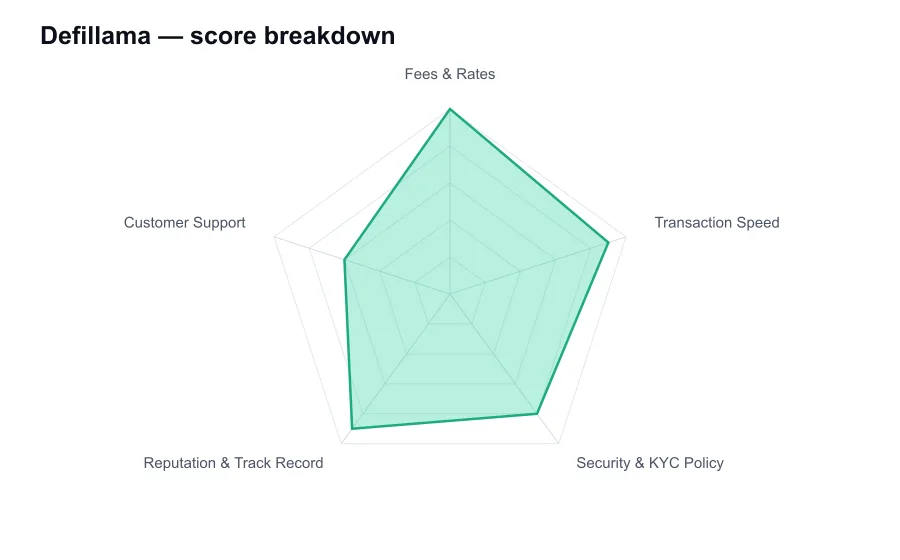
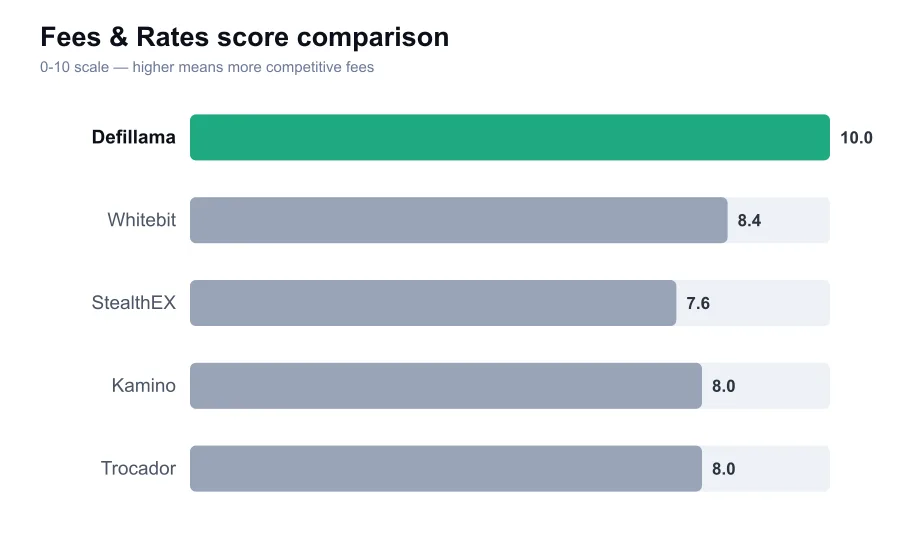
Defillama scores 8.7/10 overall in our independent review, measured against every other provider we've compared, strongest on Fees & Rates (10.0/10) and weakest on Customer Support (6.0/10).
DeFi TVL tracking · Yield aggregation · Stablecoin analytics · Public data API
DefiLlama is one of the most useful public research tools in decentralized finance, and it has become far more than a total value locked leaderboard. The site tracks protocols, chains, bridges, stablecoins, yields, fees, revenue, token unlocks, governance treasuries, and decentralized exchange activity. It does not take deposits or execute trades in the way a centralized exchange does. Think of it as a public data layer for DeFi, built for people who want to see what is actually happening on-chain.
That independence is central to its reputation. DefiLlama has deliberately positioned itself as a data provider rather than a project trying to issue a token, push trading referrals, or steer users toward a preferred protocol. In a sector full of dashboards with undisclosed commercial incentives, that stance matters. The site is not perfect, but its general culture is refreshingly skeptical of hype and much closer to open-source research than to crypto marketing.
For ordinary users, the price is hard to beat. The website's core functionality is free. You can compare chains, inspect protocol TVL, look at fee and revenue history, explore stablecoin supply, and review yield opportunities without opening an account. There are no trading commissions because DefiLlama does not execute your trades, and no subscription wall blocking basic public research. That makes its value proposition unusually strong.
The free model does not mean every number should be accepted uncritically. TVL is useful, but it can be inflated by looping, collateral reuse, temporary incentives, bridged assets, and capital that leaves as soon as emissions decline. DefiLlama usually provides better context than a raw headline figure, especially through categories and historical charts, but users must still understand what they are measuring. A protocol with rising TVL is not automatically safe, profitable, or sustainable.
The Yield page is especially popular because it aggregates opportunities that would otherwise be scattered across hundreds of protocols. It can save a lot of time. It can also tempt users into chasing the highest displayed APY without understanding token emissions, smart contract risk, depegs, lockups, or withdrawal liquidity. A four-digit yield is usually a warning light, not an invitation. DefiLlama shows the opportunity, it does not underwrite it.
Speed is excellent for a public analytics service. Pages are generally quick, dashboards are responsive, and data updates often arrive fast enough for research and monitoring. It is not a trade execution terminal, so comparing it with a low-latency exchange feed misses the point. For tracking daily flows, protocol changes, stablecoin movements, or the state of a chain ecosystem, its refresh pace is more than sufficient.
The platform's API is another major strength. Developers, researchers, journalists, and analysts can use its data endpoints to build dashboards or test ideas without negotiating enterprise contracts. That has helped DefiLlama become part of the basic infrastructure of DeFi research. Public APIs can have rate limits, endpoint changes, and occasional inconsistencies, so production users should build sensible fallbacks. But the openness is far better than the opaque data practices common elsewhere.
Security looks different here because DefiLlama is not a custodian. It does not ask users to deposit funds, and most of the site can be used without an account or KYC. That eliminates a huge class of risks. There is no exchange balance to freeze and no identity database required just to read a chart. The danger is indirect, through phishing, fake clones, malicious links, or users connecting wallets to third-party protocols they discovered through a dashboard.
DefiLlama itself has been associated with a strong security-conscious culture, including a public stance against unnecessary token launches and questionable monetization. Still, users need to verify URLs carefully and treat external protocol links as research starting points, not endorsements. A listing on DefiLlama does not mean a protocol has been audited, insured, or approved. In DeFi, even reputable dashboards cannot remove smart contract and governance risk.
Its track record is impressive for a product that grew inside a fast-moving sector. DefiLlama became a widely cited reference during the DeFi boom and retained relevance after the market cooled. It is used by analysts, crypto publications, protocol teams, and serious retail participants. The service has also handled public internal tension in the past, which was not ideal, but the episode reinforced that users should care about governance and continuity even in data projects they trust.
The breadth of coverage is a serious advantage over narrower tools. Messari offers deeper paid research and formal reports. Token Terminal provides excellent financial metrics but has a more professional and subscription-oriented feel. Dune enables flexible custom queries but requires more technical work. DefiLlama sits in the middle, broad enough for discovery, simple enough for quick checks, and detailed enough to support real research when combined with primary sources.
Customer support is not really its selling point. The project communicates through public channels, documentation, social media, GitHub, and community spaces rather than a polished enterprise help desk. That is fine for a free public utility, but it can be frustrating if a user needs a data correction, has an API problem, or wants an explanation for a methodology decision. Responses can be good, but they are not guaranteed to feel like traditional customer service.
Another weakness is information overload. The site has grown substantially, and new tabs, datasets, and metrics can make the first visit feel like entering a control room. Beginners may not know whether to focus on TVL, volume, fees, revenue, stablecoin market cap, or yields. The answer depends on the question being asked. DefiLlama is powerful because it offers many lenses, but that power comes with a responsibility to learn basic DeFi accounting.
DefiLlama is indispensable for anyone researching decentralized finance, but it is not a shortcut around due diligence. Its free access, broad coverage, and non-custodial design make it one of the highest-value tools in crypto. The support experience is informal and some figures require interpretation, yet those are manageable flaws. Use it to narrow a research list, then read protocol documentation, audit reports, governance proposals, and on-chain data before putting money at risk.
Who it suits
DefiLlama is ideal for DeFi researchers, on-chain analysts, journalists, developers, and investors comparing protocols before making decisions. It is useful for beginners too, provided they learn what TVL, emissions, and protocol revenue actually mean. It does not suit anyone seeking fiat purchases, wallet custody, or direct trade execution. Users who want detailed bespoke research may still need Dune, Messari, Token Terminal, or primary on-chain sources.
The practical view
Strengths and trade-offs
What stands out
- Extensive DeFi data available free
- No wallet custody or KYC for browsing
- Strong coverage of chains and protocols
- Useful public API for developers
What to weigh
- Not a trading or custody platform
- Metrics can be misinterpreted
- Support is community-oriented
- Listings are not safety endorsements
Scorecard
How the score is built
Verdict
My take on Defillama
DefiLlama has earned its place as essential DeFi infrastructure because it makes a vast amount of useful data public and accessible. The site is fast, broad, and unusually independent in spirit, with no need to hand over identity documents or assets just to investigate a protocol. Its weakness is the same as its strength: it gives users a great deal of information without making every judgment for them. Used with skepticism and proper research habits, it is among the best free resources in crypto.
Review questions
Defillama FAQ
Is DefiLlama an exchange?
No. DefiLlama is a DeFi analytics platform. It provides data about protocols, chains, yields, fees, and other metrics, but it does not custody assets or normally execute trades.
Does DefiLlama require KYC?
No KYC is generally required to browse DefiLlama's public dashboards and use its public data tools.
Is a protocol on DefiLlama safe to use?
No. A listing means DefiLlama tracks the protocol's data. It does not mean the protocol is audited, risk-free, endorsed, or suitable for your funds.
Reader experiences
What users report
Continue your comparison
Read across the full ranking before deciding which provider best fits your own needs.
Compare providers